
Is Your Richmond HVAC System Overdue for a Tune-Up?
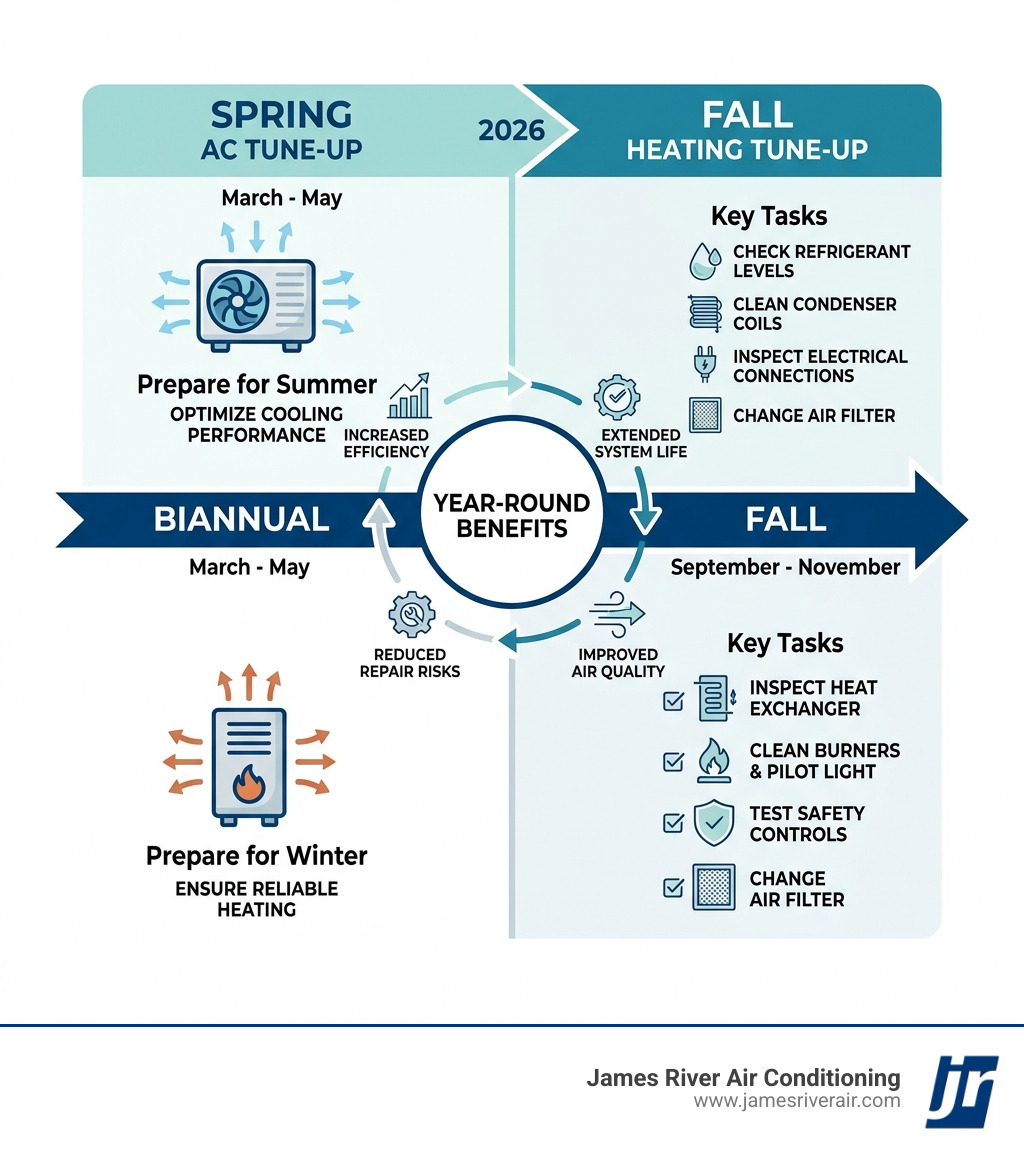
How often should you service your HVAC is one of the most important questions a Richmond homeowner can ask — and the short answer is: twice a year.
Quick Answer: HVAC Service Frequency
| System Type | Recommended Frequency | Best Timing |
|---|---|---|
| Central AC | Once a year (minimum) | Spring (March-May) |
| Gas Furnace | Once a year (minimum) | Fall (September-November) |
| Heat Pump | Twice a year | Spring and Fall |
| Any system 10+ years old | Twice a year (no exceptions) | Spring and Fall |
Most HVAC professionals — and the U.S. Department of Energy — agree that a biannual schedule is the gold standard for residential systems. That means one visit in the spring before cooling season, and one in the fall before heating season kicks in.
Why does it matter so much? A neglected system can use up to 25% more energy than one that gets regular care. And research shows that 85% of HVAC repairs trace back to a lack of routine maintenance. A small tune-up now prevents a much bigger problem — and a much bigger bill — later.
Whether your system is brand new or pushing 15 years, staying on a consistent service schedule is one of the smartest things you can do for your home’s comfort and your wallet.
How Often Should You Service Your HVAC for Peak Performance?

When we talk about “peak performance,” we aren’t just talking about your house feeling cool on a 95-degree July afternoon. We’re talking about efficiency, air quality, and safety. To keep your system humming along at its best, a biannual schedule is non-negotiable for most Richmond homes.
Think of it like a car. You wouldn’t dream of driving 50,000 miles without an oil change, right? Your HVAC system runs for thousands of hours every year. In fact, a central air conditioner in a climate like ours might work for 7 to 9 months out of the year. If you skip maintenance, that system is essentially “driving” cross-country without ever checking the fluids or the tires.
For those with specialized needs, we offer both JRAC Residential Preventive Maintenance and JRAC Commercial Preventive Maintenance to ensure every type of property stays comfortable. Staying informed is half the battle, which is why we regularly share JRAC Tips to help you stay ahead of the curve.
How Often Should You Service Your HVAC in Richmond’s Variable Climate?
Richmond isn’t exactly known for “mild” weather. We get the full experience: bone-chilling winters, pollen-heavy springs, and humid summers that feel like walking through a warm soup. This variable climate puts immense strain on your equipment.
The high humidity in Virginia doesn’t just make you uncomfortable; it forces your AC to work double-time to dehumidify the air. This leads to faster wear on the evaporator coils and the condensate drain system. Furthermore, our intense pollen seasons can quickly clog outdoor condenser fins and indoor filters. If you only service your system once a year, you might be entering the peak of summer with a unit already suffocating under a layer of spring yellow dust. This is why we emphasize that how often should you service your hvac is heavily dependent on the local environment.
Determining How Often Should You Service Your HVAC Based on System Age
Age changes everything. Here is how we break down the schedule based on how long your unit has been sitting in your yard or attic:
- New Installations (0-5 Years): You might think a new system is “set it and forget it,” but annual service is actually required by most manufacturers to keep your warranty valid. One visit per season is still best to ensure the initial installation remains calibrated.
- Mid-Life Units (6-10 Years): This is when components like capacitors, contactors, and fan motors start to show their age. Biannual visits catch these small parts before they fail and take out the expensive compressor with them.
- Systems Over 10 Years: At this stage, you are in “damage control” mode. Older units are less efficient by nature, and missing even one service can lead to a 20-30% spike in energy usage. For systems over 15 years, some homeowners even opt for tri-annual checks to ensure safety, especially regarding heat exchangers in gas furnaces.
The Professional Maintenance Checklist and Benefits
When a professional technician arrives at your home, they aren’t just looking at the unit; they are performing a deep-dive diagnostic. A professional visit typically takes 60 to 90 minutes and covers things you simply cannot do yourself.
The Professional Checklist Includes:
- Coil Cleaning: Cleaning your coils can improve cooling efficiency by up to 40%. Dirty coils force the system to consume 20-30% more energy.
- Refrigerant Levels: Low refrigerant reduces efficiency by 10-20% and puts the compressor at risk of overheating.
- Electrical Connections: Technicians tighten terminals and measure “amps” on motors to ensure nothing is about to short-circuit.
- Safety Controls: This is critical for gas furnaces, where we check for cracks in the heat exchanger to prevent carbon monoxide leaks.
- Thermostat Calibration: We ensure your “brain” is talking to the “muscles” correctly so you aren’t paying for cooling you aren’t getting.
There are many Benefits of Regular HVAC Maintenance, but the primary one is peace of mind. To help you understand the difference, here is a breakdown of roles:
| Task | Homeowner (DIY) | Professional (Technician) |
|---|---|---|
| Change Air Filter | Yes (Monthly) | Yes (During Visit) |
| Clear Debris from Outdoor Unit | Yes | Yes |
| Inspect Electrical Wiring | No (Safety Risk) | Yes |
| Check Refrigerant Pressures | No (Requires License) | Yes |
| Clean Evaporator Coils | No | Yes |
| Calibrate Thermostat | Basic Settings | Deep Calibration |
| Flush Condensate Drain | Yes (Vinegar) | Yes (Deep Clean/Vacuum) |
Why Regular Service Extends Equipment Lifespan
The math is simple: a well-maintained system lasts longer. While a neglected unit might need a total replacement in as little as 10 years, a system that receives regular care can easily last 15 to 20 years. That is an extra decade of service from a single investment!
By fixing duct leaks, you can improve efficiency by about 20%. By keeping the system clean, you reduce the friction and heat that kills mechanical parts. Regular maintenance prevents 70-80% of all HVAC breakdowns. When you consider that emergency repairs can cost 3 to 5 times more than a scheduled tune-up, the return on investment is usually between 3:1 and 6:1. Every dollar you spend on maintenance saves you roughly $3 to $6 in future repairs and energy costs.
Warranty Requirements and Documentation
This is the “fine print” that catches many Richmond homeowners off guard. Most major HVAC manufacturers (like Carrier, Trane, or Lennox) explicitly state in their warranty terms that the unit must be professionally serviced at least once a year.
If your compressor fails in year seven, the manufacturer may ask for “proof of maintenance.” If you can’t provide service records from a licensed company, they can legally deny your claim, leaving you with a multi-thousand-dollar repair bill. We provide detailed documentation for every visit to ensure your parts protection remains ironclad.
Signs Your System Needs Attention and DIY Maintenance Tips
Even if you follow the “twice a year” rule, your system might occasionally cry out for help between visits. You should never ignore the “warning whispers” of your HVAC. If you notice a sudden spike in your power bill, check out our High Energy Bill Tips for a checklist of potential culprits.
Essential DIY Tasks Between Professional Visits
You are the first line of defense for your home comfort. Here are 5 Tips to Show Your HVAC System Love that you can do yourself:
- Filter Replacement: This is the single most important DIY task. Change your filters every 1 to 3 months. A dirty filter can block airflow and lower efficiency, raising your bills by 5-15%.
- Clear the Perimeter: Ensure there is at least a 2-foot clearance around your outdoor condenser unit. Remove leaves, tall grass, and “Richmond weeds” that can choke the airflow.
- Vent Check: Make sure your indoor registers aren’t blocked by furniture or curtains. Contrary to popular belief, closing vents in unused rooms can actually increase pressure in your ducts and cause leaks.
- Drain Line Maintenance: Pouring a cup of vinegar down your condensate drain line once a month during the summer can prevent algae clogs and water damage.
- Listen and Smell: Get to know the “normal” sounds of your system. If you hear banging, whistling, or smell a persistent “burning” odor, something is wrong.
Red Flags Requiring Immediate Professional Service
Sometimes, “waiting for the scheduled visit” isn’t an option. If you see any of the following, call us immediately:
- Ice on the Lines: If you see ice on the copper refrigerant lines or the outdoor unit (during summer), you likely have a leak or a major airflow restriction.
- Water Pooling: Water around your indoor furnace or air handler usually means a clogged drain or a cracked pan, which can lead to mold and floor damage.
- Rapid Energy Spikes: If your bill jumps 30% in one month without a major weather change, your system is likely struggling with a failing component.
- Inconsistent Temperatures: If the master bedroom is 80 degrees while the kitchen is 68, your ductwork or blower motor is failing to distribute air properly.
- Frequent Cycling: If the unit turns on and off every few minutes, it is “short-cycling,” which is incredibly hard on the compressor.
Frequently Asked Questions about HVAC Maintenance
How often should I change my air filters and clean my ducts?
You should check your air filters monthly. If you have pets, allergies, or live near a dusty area in Richmond, you’ll likely need to replace them every 30 to 60 days. For high-quality pleated filters in a pet-free home, every 90 days is usually sufficient. As for ducts, the National Air Duct Cleaners Association suggests a professional cleaning every 3 to 5 years, or sooner if you’ve recently completed a home renovation.
Do heat pumps require more frequent service than furnaces?
Yes. Because a heat pump provides both heating and cooling, it works year-round without a break. While a furnace sits idle in the summer and an AC sits idle in the winter, the heat pump is always on duty. For this reason, heat pumps absolutely require biannual service (Spring and Fall) to ensure the reversing valve and refrigerant cycles are working correctly for the upcoming season.
What happens if I skip my annual HVAC maintenance?
Skipping maintenance is a gamble where the house usually wins. In the first year, you’ll likely see a 5-15% increase in energy bills. By the second or third year, that increase can hit 30%. Beyond the cost, you risk safety hazards like carbon monoxide leaks, poor indoor air quality from moldy coils, and the high probability of a “peak-season breakdown”—which always seems to happen on the hottest or coldest day of the year when technicians are busiest.
Conclusion
At James River Air Conditioning, we’ve spent over 57 years serving the Richmond, Virginia community. From the historic streets of the Fan to the growing neighborhoods in Midlothian and Short Pump, we understand the unique demands Virginia weather puts on your home.
We take pride in our entrepreneurial spirit and our commitment to world-class service. Whether you are in Henrico, Chesterfield, Mechanicsville, or Glen Allen, our team is ready to ensure your system is safe, efficient, and ready for whatever the weather throws our way. Don’t wait for a breakdown to realize your system needs help.
Schedule your Richmond HVAC service today and let us help you keep your home comfortable all year long.
