

How to Improve Indoor Air Quality at Home Without Turning Your House Into a Bubble
Why the Air Inside Your Richmond Home May Be More Polluted Than You Think
How to improve indoor air quality at home is one of the most practical things you can do for your family’s health — and it’s simpler than most people expect.
Here’s a quick answer to get you started:
- Control pollution sources — eliminate or reduce radon, smoke, VOCs, and chemical irritants
- Improve ventilation — open windows when outdoor air is clean, use exhaust fans, and consider mechanical ventilation systems
- Use air filtration — HEPA air purifiers and MERV-13 HVAC filters trap harmful particles
- Manage humidity — keep indoor humidity between 30–50% to prevent mold and dust mites
- Clean regularly — vacuum, dust with microfiber, and wash bedding weekly
Most of these steps cost little to nothing.
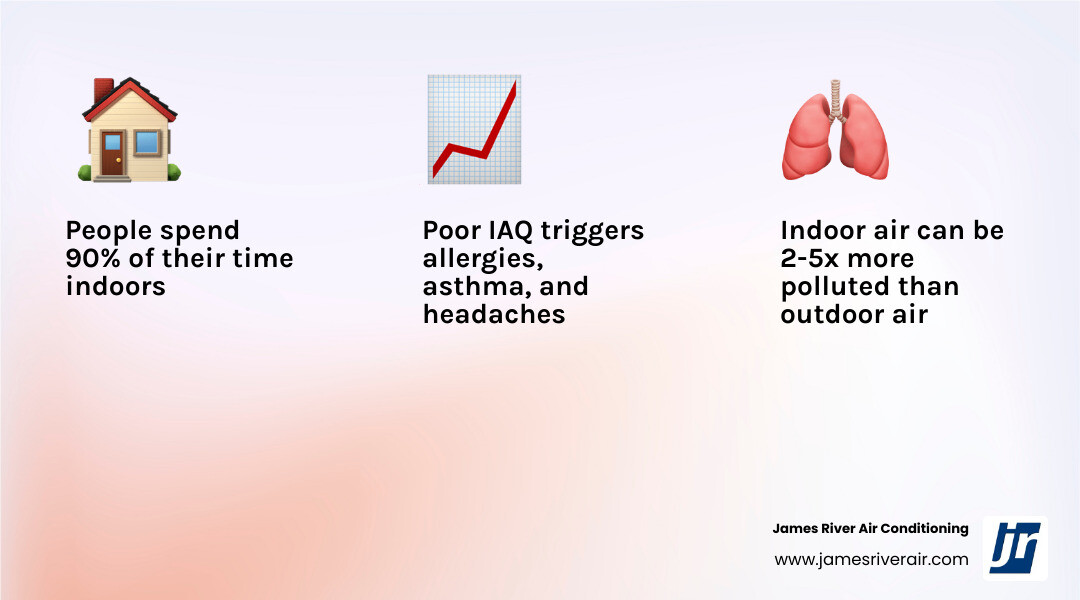
Here’s something that surprises most homeowners: the air inside your home can be two to five times more polluted than the air outside. And since most of us spend around 90% of our time indoors, that’s not a small problem.
Poor indoor air quality can trigger headaches, worsen allergies, aggravate asthma, and — in the case of pollutants like radon — contribute to serious long-term health risks. Yet it often goes completely unnoticed, because you can’t see most of what you’re breathing.
The good news? You don’t need to seal yourself inside a bubble to breathe cleaner air at home. A handful of targeted, practical steps can make a meaningful difference — and most of them are surprisingly low-cost.
Control the Source: The Most Effective Way to Improve Indoor Air Quality at Home
When we talk about how to improve indoor air quality at home, we usually start with the “Three Pillars”: source control, ventilation, and filtration. Of these, source control is the heavyweight champion. It is almost always more effective and cost-efficient to stop a pollutant from entering your air in the first place than it is to try to filter it out later.
Think of it like a leaky boat. You can spend all day bailing out water (filtration), but it’s much easier to just plug the hole (source control).
Common indoor pollutants include:
- Radon: A naturally occurring radioactive gas that is the second leading cause of lung cancer in the United States.
- Volatile Organic Compounds (VOCs): Gases emitted from paints, cleaning supplies, and even new carpets.
- Tobacco and Secondhand Smoke: These contain thousands of chemicals, many of which are carcinogenic.
- Biological Contaminants: This includes pet dander, mold, and dust mites.
By addressing Indoor Air Quality at the source, you create a baseline of health that your HVAC system doesn’t have to work overtime to maintain. Interestingly, even your water can impact air quality; certain contaminants in water can become airborne during a hot shower, which is why Water Filtration Purification is a hidden ally in the fight for cleaner air.
Eliminating Allergens and Chemical Irritants
For many of our neighbors in Richmond and Midlothian, seasonal allergies are a way of life. But when those allergens follow you inside, your home stops being a sanctuary.
To keep pet dander and dust mites at bay, we recommend a “clean from the floor up” approach. This includes:
- Microfiber Magic: Use microfiber or damp cloths for dusting. Traditional feather dusters just kick the dust back into the air. Microfiber actually traps the particles.
- Hot Water Wash: Wash your bedding and throw rugs at least once a week in hot water (at least 130°F) to kill dust mites.
- Hypoallergenic Bedding: Consider using impermeable covers for mattresses and pillows to prevent dust mites from settling in where you sleep.
- Fragrance-Free Living: Many “fresh” scents in cleaning products are actually cocktails of chemicals. Switch to unscented or low-VOC cleaners to reduce the chemical load in your air.
Managing Combustion and Off-Gassing
Combustion is a major source of indoor pollution. If you’re using a gas stove, you could be releasing carbon monoxide and nitrogen dioxide into your kitchen. We always suggest ensuring your gas stove is properly adjusted and that you always use the exhaust fan while cooking.
Then there’s the “new car smell”—which, in a home, is often the smell of formaldehyde off-gassing from new furniture or cabinetry. Formaldehyde levels are highest in new products and decrease over time. If you’re sensitive to chemicals, buying used furniture or looking for products labeled “No Added Formaldehyde” can be a smart move.
And while a wood-burning fireplace is cozy during a cold Hanover winter, it’s essentially an open flame releasing fine particulate matter into your living room. If you do use one, ensure it is well-maintained and properly vented.
Master Your Home’s Ventilation and Airflow

If source control is about stopping the “bad stuff” from getting in, ventilation is about getting the “stale stuff” out. Most older homes in Central Virginia rely on “infiltration”—basically, air leaking through cracks in windows and doors. While this provides some fresh air, it’s not exactly efficient.
Modern Residential Indoor Air Quality strategies focus on controlled ventilation. This means you decide when and how much fresh air enters your home, rather than leaving it up to a drafty door frame.
How to improve indoor air quality at home through natural ventilation
The simplest way to improve your air is to open a window. In April 2026, we’ve seen a trend of homeowners becoming more “outdoor air aware.” Before you crack the windows, check the local air quality index (AQI). If the pollen count is through the roof or there’s a nearby brush fire, keep things sealed.
When the air is clean, use “cross-ventilation.” Open windows on opposite sides of the house to create a natural breeze that flushes out indoor pollutants. Window fans can help pull fresh air in or push stale air out, especially after activities like painting or deep cleaning.
Utilizing mechanical systems for better circulation
Sometimes, natural ventilation isn’t enough—especially during the humid Richmond summers when opening a window just invites a wall of moisture inside. This is where mechanical ventilation comes in.
- Energy Recovery Ventilators (ERVs): These systems are the gold standard. They bring in fresh outdoor air while “recovering” the temperature and humidity of the air being exhausted. This means you get fresh air without your AC unit having to work twice as hard.
- Local Exhaust Fans: Your bathroom and kitchen fans are there for a reason. Use them! They remove moisture and cooking pollutants before they can spread through the rest of the house. Make sure they actually exhaust to the outside, not just into your attic.
- Air Duct Integrity: If your ducts have leaks, they might be pulling in dusty air from your attic or crawl space and blowing it into your bedrooms. Keeping your ductwork sealed is vital for both air quality and energy efficiency.
Advanced Filtration and Air Cleaning Strategies
When source control and ventilation aren’t enough, we turn to filtration. Filtration is the process of physically trapping particles so you don’t breathe them in.
| Feature | Portable Air Purifiers | Whole-Home Filtration |
|---|---|---|
| Coverage | Single room | Entire house |
| Filter Type | Often HEPA | MERV-13 to HEPA |
| Noise Level | Can be audible | Silent (integrated into HVAC) |
| Maintenance | Change individual filters | Change HVAC filter |
| Best For | Bedrooms, offices, or renters | Homeowners wanting a total solution |
How to improve indoor air quality at home with HEPA filtration
You’ve likely heard the term “HEPA” (High-Efficiency Particulate Air). To be labeled as true HEPA, a filter must trap 99.97% of particles that are 0.3 microns in size. This includes everything from dust and pollen to mold spores and some bacteria.
If you’re looking at portable units, check the CADR (Clean Air Delivery Rate). This tells you how quickly the unit can clean the air in a room of a specific size. For whole-home systems, we often recommend upgrading to a MERV-13 filter. While not quite HEPA, MERV-13 filters are incredibly effective at capturing fine particles without putting too much strain on your HVAC blower motor.
The role of air purifiers in modern homes
As we move through April 2026, air purifiers have become “smart.” Many now include built-in sensors that monitor your air in real-time and ramp up the fan speed when they detect a spike in pollutants (like when you burn the toast).
When choosing a purifier, look for:
- Activated Carbon: This is essential for removing gaseous pollutants, odors, and VOCs. A standard HEPA filter won’t stop smells, but carbon will.
- Ozone-Free Certification: Avoid “ionizers” or “ozone generators” that claim to clean the air by charging particles. Ozone is a known lung irritant and can actually make asthma worse.
- Smart Monitoring: Systems that link to your phone can help you track your air quality trends over time, letting you know if that new rug is still off-gassing.
Managing Humidity and the “Hidden” Air in Your Crawl Space
In Virginia, humidity is our constant companion. But when indoor humidity climbs above 50%, your home becomes a breeding ground for mold and dust mites. Conversely, if the air is too dry (below 30%), it can irritate your respiratory tract and make you more susceptible to viruses.
The “sweet spot” for Residential Indoor Air Quality is between 30% and 50% humidity.
Preventing mold and dust mite growth
Mold doesn’t need much to grow—just a little organic material (like drywall or dust) and some moisture. To prevent it:
- Fix Leaks Fast: A small drip under the sink can lead to a big mold problem in the walls.
- Use Dehumidifiers: In damp basements or during the peak of summer, a whole-home dehumidifier can take the load off your air conditioner and keep the air crisp and healthy.
- Check for Condensation: If you see water beads on your windows, your humidity is too high.
Why crawl space health impacts your living area
This is the “hidden” part of the air quality equation. Did you know that up to 40-60% of the air you breathe on the first floor of your home actually originates in your crawl space?
Because of something called the “stack effect,” warm air rises and escapes through the top of your house, pulling cool air up from the bottom—the crawl space. If that crawl space is damp, moldy, or filled with pest droppings, that’s exactly what you’re breathing.
We specialize in Residential Crawl Spaces and often recommend encapsulation. By sealing the crawl space with a heavy-duty vapor barrier and installing a dedicated dehumidifier, you stop the moisture at the source. If you notice musty odors or “sticky” doors, those are Warning Signs Your Crawl Space is Impaired and could be ruining your indoor air.
Frequently Asked Questions about Indoor Air Quality
Do indoor plants actually clean the air?
This is a common myth. While it’s true that plants can absorb some VOCs in a laboratory setting, you would need a literal jungle—hundreds of plants—to make a measurable difference in a typical living room.
In fact, if you over-water your plants, the damp soil can encourage the growth of mold and microorganisms, which might actually decrease your air quality. We love plants for their aesthetic and mental health benefits, but don’t rely on them to be your primary air cleaners.
When should I test my home’s air quality?
We recommend testing in several scenarios:
- Radon Testing: Every home should be tested for radon, regardless of age or location. DIY kits are available, but professional testing provides more peace of mind.
- Before and After Remodeling: Sanding old paint or installing new flooring can release a surge of pollutants.
- Persistent Symptoms: If you find that your “allergies” disappear whenever you leave the house, it’s time for a professional IAQ assessment.
- Buying a New Home: Ensure the home you’re moving into doesn’t have hidden mold or moisture issues.
How often should I change my HVAC filters?
The old “change it every month” rule is a bit simplistic for 2026.
- Pleated Filters: These high-quality filters usually last about 90 days.
- Fiberglass Filters: These are the cheap, see-through ones. They should be changed every 30 days because they clog quickly and don’t catch much anyway.
- Pet Owners: If you have a Golden Retriever or a couple of cats, check your filter every 30 days regardless of the type. Fur and dander can clog a filter much faster than dust alone.
Conclusion
Improving the air in your home doesn’t require a laboratory-grade clean room. By focusing on source control, ensuring proper ventilation, and maintaining your filtration systems, you can create a healthy environment for your family.
At James River Air Conditioning, we’ve been helping our neighbors in Richmond, Chesterfield, Henrico, and beyond breathe easier for over 57 years. Whether you’re interested in a whole-home air purifier, a crawl space inspection, or just want to ensure your HVAC system is equipped with the right filters, we’re here to help with world-class service and local expertise.
Don’t let the air in your home be a mystery. Take these steps today to protect your long-term respiratory health and enjoy a more comfortable, cleaner living space. For more personalized advice, explore our Residential Indoor Air Quality services and let’s get your home’s air back to its best.
