

Is a Mini Split Better Than Central Air? A Quick Answer First
The central ac vs ductless mini split comparison comes down to a few key factors: whether your home already has ductwork, how many rooms you need to cool, and how much energy efficiency matters to you.
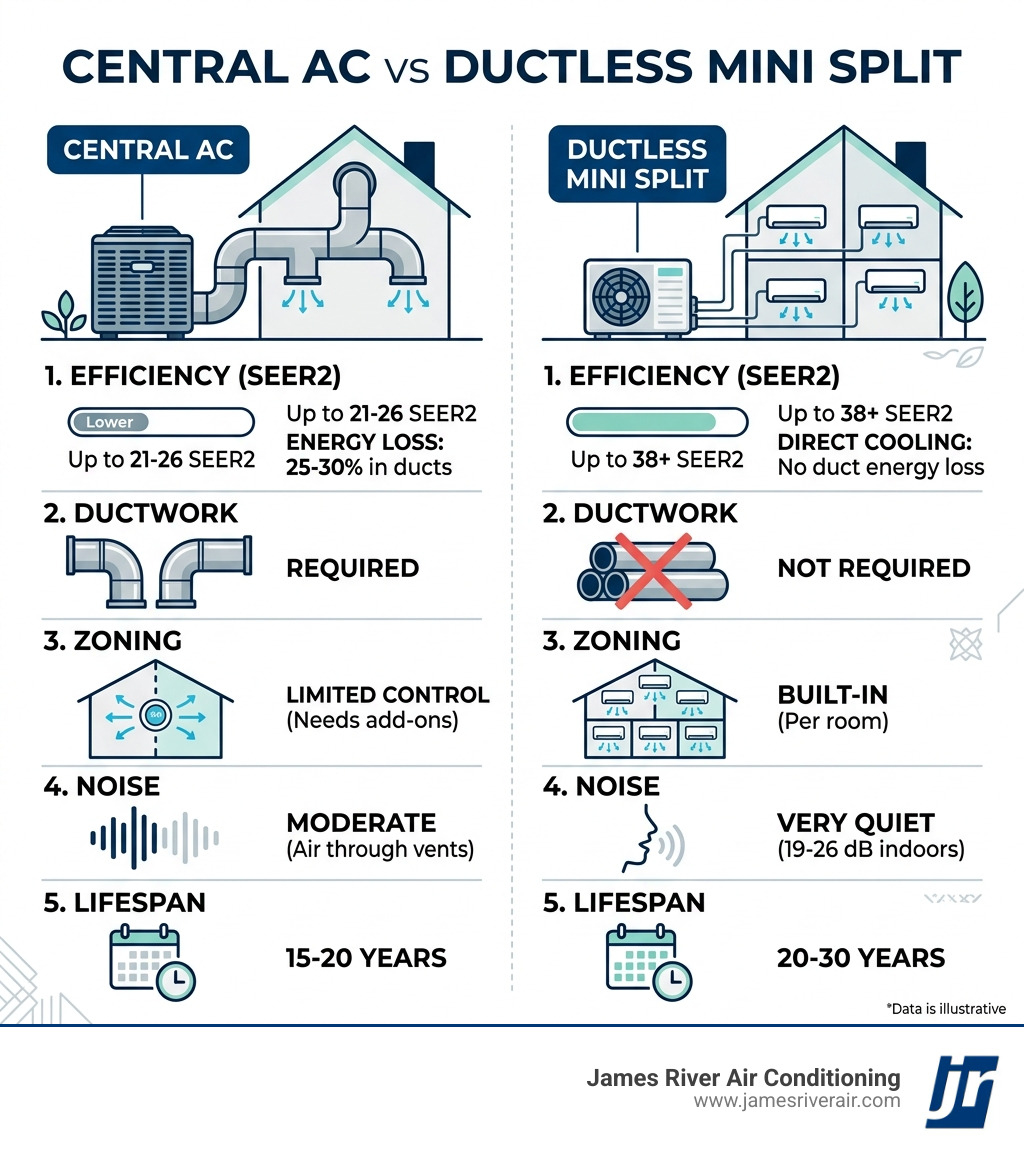
Quick Comparison:
| Factor | Central AC | Ductless Mini Split |
|---|---|---|
| Requires ductwork | Yes | No |
| Best for | Larger homes with existing ducts | Homes without ducts, additions, zoned rooms |
| Energy efficiency (SEER2) | Up to 21-26 SEER2 | Up to 38+ SEER2 |
| Duct energy loss | 25-30% | None |
| Zoning control | Limited (needs add-ons) | Built-in, per room |
| Heating capability | Paired with furnace | Many units include heat pump |
| Lifespan | 15-20 years | 20-30 years |
| Noise level | Moderate (air through vents) | Very quiet (19-26 dB indoors) |
Neither system is universally better. But knowing which one fits your home can make a big difference in comfort, energy bills, and long-term value.
If you live in the Richmond area and aren’t sure which direction to go, you’re not alone. Homeowners here deal with hot, humid summers and variable winters — conditions that can push both systems to their limits. Choosing the wrong one means paying too much to stay comfortable, or not staying comfortable at all.
The good news is that the decision usually isn’t as complicated as it seems once you know what to look for.
Understanding the Central AC vs Ductless Mini Split Comparison

When we look at the mechanics, both systems share a common goal: moving heat from inside your home to the outside. They both use refrigerant, an outdoor condenser unit, and an indoor evaporator coil to get the job done. However, the way they distribute that cool air throughout your living space is where the paths diverge.
Central air conditioning is the “traditional” choice for many homes in areas like Henrico and Midlothian. It relies on a single, large indoor unit (often tucked away in a basement or attic) that pushes air through a network of ducts and out through vents in every room. It’s a whole-home solution designed to keep every corner of the house at a uniform temperature.
Ductless mini-splits, on the other hand, skip the ductwork entirely. Instead of one giant air handler, you have smaller indoor “heads” mounted directly on the walls or ceilings of specific rooms. These heads are connected to the outdoor unit by a slim conduit housing the refrigerant lines and power cables. This allows for much more targeted cooling.
If you are starting from scratch or looking to upgrade an aging unit, our team at James River Air Conditioning can walk you through the Air Conditioning Installation process to ensure you get the right size for your specific square footage.
Key Differences in a Central AC vs Ductless Mini Split Comparison
The most obvious difference is the “duct” part of the name. Central AC requires a complex highway of metal or flexible tubing hidden behind your walls and ceilings. If your home was built without these ducts—common in many historic Richmond properties—installing them can be a massive undertaking that involves cutting into plaster and losing closet space.
Ductless systems only require a small, three-inch hole in the exterior wall to connect the indoor and outdoor components. This makes them significantly less invasive to install. Furthermore, while a central system is controlled by one or two thermostats for the entire house, a ductless system gives you a remote for every single room.
Whether you choose the “hidden” look of central air or the “zoned” flexibility of a mini-split, keeping the system running smoothly requires professional Residential HVAC Service to check refrigerant levels and electrical connections annually.
Energy Efficiency and Performance Standards in 2026
As of April 2026, energy efficiency isn’t just a buzzword; it’s a standard that impacts your monthly utility bills. The industry uses SEER2 (Seasonal Energy Efficiency Ratio 2) to measure how much cooling you get for every watt of electricity used.
In a central ac vs ductless mini split comparison, the mini-split almost always takes the trophy for efficiency. While high-end central systems in 2026 hit impressive marks between 21 and 26 SEER2, some ultra-efficient ductless models are now soaring into the 30s, with elite models reaching as high as 38 or even 42 SEER2.
The secret to this efficiency lies in two areas: the lack of ducts and inverter technology.
- Duct Energy Loss: Traditional duct systems are notorious for waste. The U.S. Department of Energy notes that typical duct systems lose about 25% to 30% of their cooling energy through leaks, poor insulation, or “thermal bypass” (where cool air escapes into the attic before it ever reaches your bedroom). Since ductless systems deliver air directly into the room, that 30% waste is instantly eliminated.
- Inverter Technology: Most modern mini-splits use variable-speed “inverter” compressors. Think of it like a dimmer switch for a light. Instead of turning full-blast “on” and then “off,” the system slows down or speeds up to maintain a perfectly steady temperature. Traditional central units often operate more like a standard light switch—all on or all off—which consumes more energy during the frequent start-up cycles.
To keep either system running at peak efficiency, we always recommend following these 5 Tips to Show Your HVAC System Love, which include keeping your outdoor unit clear of debris and checking your filters.
2026 Efficiency Comparison Table
| System Type | Typical SEER2 Range | Energy Waste (Duct Loss) | Technology Type |
|---|---|---|---|
| Standard Central AC | 14 – 18 SEER2 | 25-30% | Single or Two-Stage |
| High-Efficiency Central AC | 19 – 26 SEER2 | 20-25% (if sealed) | Variable Speed |
| Ductless Mini Split | 20 – 38+ SEER2 | 0% | Inverter / Variable Speed |
Installation and Home Suitability: Which System Fits Your Layout?
Choosing between these two often comes down to the “bones” of your home.
When Central AC is the Winner: If you live in a newer home in Glen Allen or Short Pump that already has a well-maintained duct system, upgrading to a new central AC is usually the most straightforward path. It preserves the aesthetics of your home by keeping the equipment hidden, and it provides a uniform temperature throughout the house. For those looking for a seamless transition, we offer The Ultimate Glen Allen Residential AC Installation Guide to help you plan the project.
When Ductless Mini-Splits are the Winner: Ductless systems are the heroes of “problem” spaces. We frequently recommend them for:
- Historic Homes: Many older homes in the Richmond area have beautiful plaster walls and original woodwork that you wouldn’t want to disturb by cutting in ductwork.
- Room Additions: If you’ve added a sunroom, a finished basement, or a “frog” (finished room over garage), extending your existing central ductwork can be expensive and may overtax your current system. A single-zone mini-split is the perfect solution here.
- Attic Conversions: Attics are notoriously hard to cool. A mini-split handles the high heat load of an upper floor without needing to run bulky ducts through the lower levels.
For our neighbors in Chesterfield, we provide Affordable Air Conditioning Installation in Chesterfield VA Stay Cool for Less specifically tailored to the diverse home styles found in that area.
Comfort Control: Zoning, Noise, and Air Quality
Comfort is about more than just the number on the thermostat; it’s about how the air feels and sounds.
Zoning and Customization Ductless mini-splits offer independent zone control that central AC simply can’t match without expensive motorized dampers and complex wiring. If you like your bedroom at 68 degrees but want the guest room at 74, a mini-split makes that easy. This “occupancy-based cooling” is one reason why ductless systems can save up to 30% more energy—you aren’t wasting money cooling empty rooms.
Noise Levels If you are sensitive to noise, the mini-split is the clear victor. The indoor units are “whisper quiet,” typically operating between 19 and 26 decibels. To put that in perspective, a quiet library is about 40 decibels. Central AC units are quiet, too, but you will always hear the “whoosh” of air moving through the vents and the occasional metallic “clunk” of ducts expanding or contracting.
Indoor Air Quality Central AC has a slight edge when it comes to whole-home air quality. Because all the air in the house passes through one central filter, it is easier to integrate high-end HEPA filtration systems, UV lights, or whole-home dehumidifiers. Ductless units have smaller, washable filters in each head. While they do a great job of catching dust and allergens in that specific room, they don’t offer the same “scrubbing” power for the entire house at once.
Our Residential Installation Services include an assessment of your home’s air quality needs to help you decide which filtration path is best for your family.
Maintenance and Long-Term Reliability
Both systems are built to last, but their maintenance needs are slightly different.
Lifespan Expectations With proper care, a central AC system typically lasts between 15 and 20 years. Interestingly, ductless mini-split systems often boast a longer lifespan, with many units reliably serving homeowners for 20 to 30 years. This longevity is partly due to the inverter technology, which reduces the “wear and tear” caused by the constant on-and-off cycling seen in traditional units.
Maintenance Tasks
- Ductless Systems: These require a bit more “hands-on” work from the homeowner. Because the filters are smaller, they need to be rinsed and dried every 2 to 4 weeks during heavy use. If you neglect this, the coil can ice up or the unit can lose efficiency quickly.
- Central Systems: Maintenance is more “set it and forget it.” You generally replace the pleated filter every 1 to 3 months. However, you also have the added responsibility of ensuring your ductwork is clean and sealed.
Regardless of which system you choose, professional intervention is vital. We specialize in Residential Preventive Maintenance to ensure your refrigerant levels are correct and your condensate drains are clear. There are numerous Benefits of Regular HVAC Maintenance, including lower repair costs and a much lower chance of a mid-July breakdown.
Frequently Asked Questions
Can mini splits provide heating during Virginia winters?
Absolutely! In fact, most modern mini-splits are actually “heat pumps.” In the summer, they pull heat out of your house. In the winter, they reverse the process and pull heat from the outdoor air to bring it inside.
Thanks to advancements in 2026 technology, “cold-climate” heat pumps can now maintain high efficiency even when temperatures drop well below freezing. This makes them a viable year-round comfort solution for our region. However, you should still take steps to protect your outdoor equipment, such as following these 6 Tips Protecting HVAC from Snow.
Making Your Choice: Central AC vs Ductless Mini Split Comparison
So, which is right for you? It often comes down to your long-term goals.
- Choose Central AC if: You have existing ductwork in good condition, you want the equipment to be invisible, and you want a lower upfront installation cost for a whole-home solution.
- Choose Ductless Mini-Split if: You have no ducts, you want the absolute highest energy efficiency possible, you want room-by-room temperature control, or you are cooling a specific addition.
The Hybrid Approach In many cases, the best answer is “both.” We often see Richmond homeowners keep their central AC for the main floor but install a single-zone mini-split in a finished attic or a master bedroom that always stays too warm. This hybrid approach gives you the best of both worlds: whole-home consistency with targeted power where you need it most.
For those in the southern part of our service area, we offer Affordable AC Installation in Hopewell for a Stress-Free Summer to help you explore these hybrid options.
Conclusion
At James River Air Conditioning, we’ve spent over 57 years helping our neighbors in Richmond, Chesterfield, and Henrico stay comfortable. We know that every home has a unique personality and a unique set of challenges. Whether you’re leaning toward the whole-home power of central air or the precision efficiency of a ductless mini-split, our goal is to provide a solution that fits your lifestyle and your budget.
Don’t leave your comfort to chance. A professional comfort assessment can reveal hidden duct leaks or identify the perfect spot for a mini-split head to maximize airflow. When you’re ready to take the next step, our experts are here to provide world-class Air Conditioning Installation and support.
Give us a call today, and let’s make sure your home is ready for whatever the Virginia weather throws your way!
