
Should I Repair or Replace My Furnace or AC Right Now
Should You Repair or Replace Your HVAC System Right Now?
When to repair vs replace your HVAC system is one of the most stressful decisions a homeowner can face — especially when your heat goes out in January or your AC dies in the middle of a Richmond summer. Here’s a quick answer to help you decide:
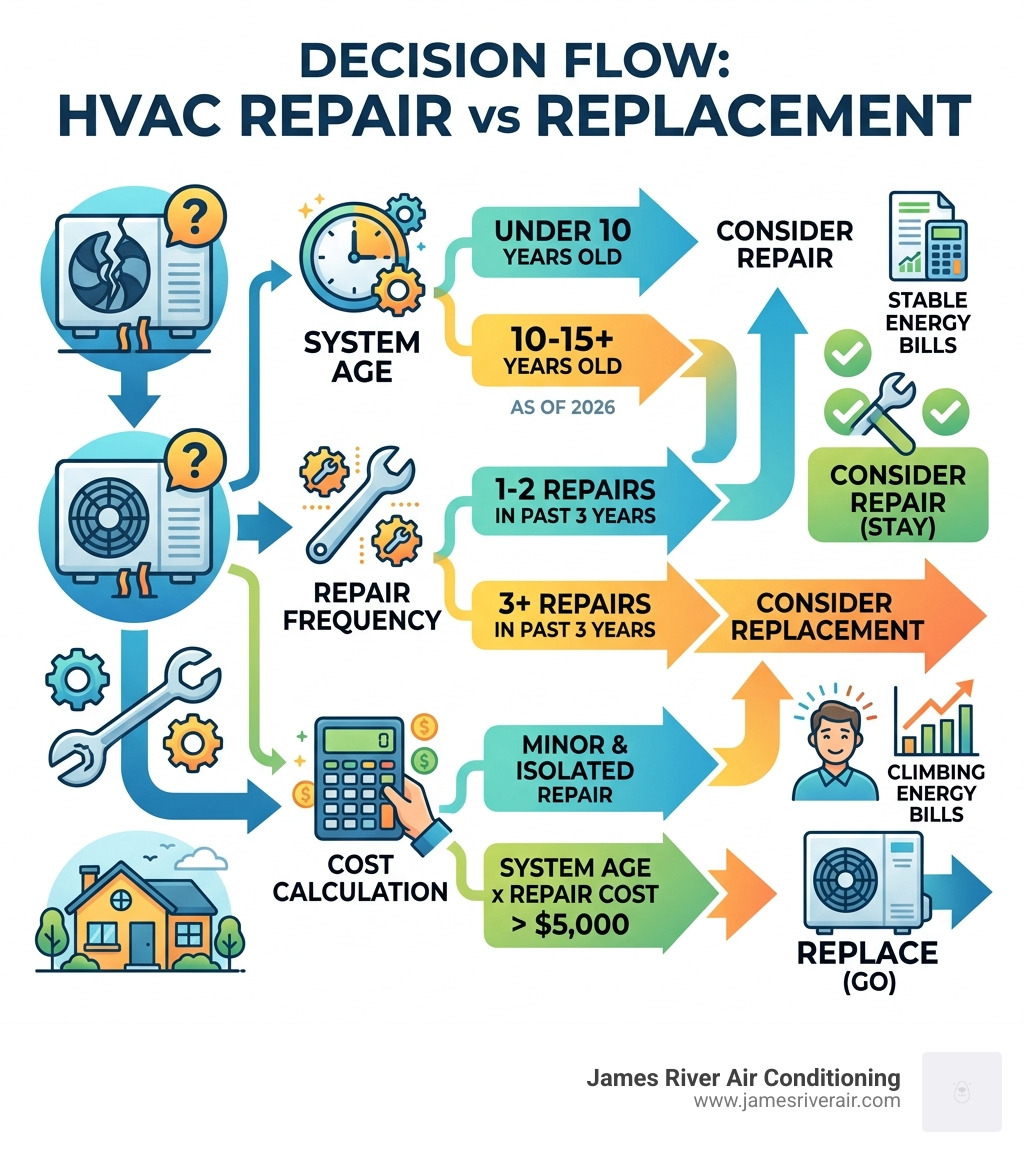
Lean toward repair if:
- Your system is under 10 years old
- The repair is minor and isolated
- You’ve had 1-2 repairs in the past 3 years
- Your energy bills have stayed stable
Lean toward replacement if:
- Your system is 10-15+ years old
- You multiply the system’s age by the repair cost and get a number over $5,000
- You’ve had 3 or more repairs in the past 3 years
- Your energy bills keep climbing despite maintenance
Most homeowners don’t think about their HVAC system until something goes wrong. Then suddenly you’re on the phone with a technician, getting a repair quote, and wondering whether you’re about to throw good money after bad. It’s a genuinely hard call — one repair might buy you years of comfort, while another might just delay an inevitable breakdown by a few months.
The good news is there are clear, proven guidelines to help you make the right call — and you don’t need to be an HVAC expert to use them.
Evaluating the Lifespan of Your Richmond Home Comfort System

As we navigate through April 2026, it is important to remember that every mechanical system has a finite lifespan. In our experience serving the Richmond area, we see that the local climate—with its humid summers and chilly winters—puts a unique strain on home comfort equipment. Understanding the average lifespan of your equipment is the first step in determining when to repair vs replace your HVAC system.
While some units seem to run forever, most reach a “retirement age” where the risk of failure outweighs the cost of maintenance. To keep your system running as long as possible, it is vital to understand the benefits of regular HVAC maintenance.
Typical Lifespan by Equipment Type
Different types of HVAC equipment age at different rates. Here is what we typically see in Virginia homes:
- Heat Pumps: These systems work hard year-round to both heat and cool your home. Because they are always in use, they typically have a lifespan of about 15 years.
- Furnaces: Since they only run during the colder months, a well-maintained gas furnace can often last 20 years or more.
- Air Conditioners: A standard central AC unit usually lasts between 15 and 20 years, depending on how hard it has to work during our peak summer heatwaves.
When Age Becomes a Factor
In the HVAC world, age isn’t just a number; it’s a reliability metric. We generally suggest that once an air conditioner or heat pump crosses the 10-year threshold, you should start keeping a closer eye on its performance. By the time a system hits the 15-year threshold, it is often significantly less efficient than modern models.
If your system is getting older, you might want to look at these 5 tips to show your HVAC system love to help squeeze a few more years out of it. However, if the breakdowns are becoming a seasonal tradition, age is likely telling you it’s time for an upgrade.
When to Repair vs Replace Your HVAC System: The $5,000 Rule
Deciding whether to sign off on a repair or invest in a new system can feel like a high-stakes guessing game. To take the emotion out of the decision, we often use a mathematical framework known as the “$5,000 Rule.” This helps homeowners in places like Glen Allen and Midlothian see the long-term financial logic of their choice. Before making a final call, it’s always wise to consult our Jrac/Residential services Jrac/Residential HVAC service team for a professional diagnosis.
Applying the $5,000 Rule: When to Repair vs Replace Your HVAC System
The formula is simple: Multiply the age of your system by the cost of the repair.
- If the result is under $5,000, repairing the unit is usually the more cost-effective choice.
- If the result is over $5,000, you should seriously consider replacement.
For example, if you have a 12-year-old AC unit that needs a repair costing $500, your total is $6,000. In this scenario, the rule suggests that your money is better spent on a new, more reliable system. This rule works because it weighs the immediate repair cost against the statistical likelihood of future failures based on the system’s age.
The Frequency of Breakdowns
Another critical factor is the repair history. We suggest looking at a three-year span. If you have had one or two minor repairs in the last three years, your system is likely still healthy. However, if you are on your third or fourth repair call in that same window, you are seeing a pattern of systemic failure.
When you find yourself on a first-name basis with your repair technician because they are at your house every other month, you are likely spending more on “band-aid” fixes than you would on a monthly payment for a new, warrantied system. For more context on what a full upgrade entails, you can explore our guide on HVAC replacement cost 2.
Critical Warning Signs and Safety Concerns
While money is a major factor, safety and comfort are paramount. There are certain “red flags” that move the needle toward replacement regardless of what the $5,000 rule says. Understanding these your guide to HVAC home comfort terms can help you communicate more effectively with your technician when these issues arise.
Immediate Safety Red Flags
Some HVAC issues are not just inconvenient—they are dangerous.
- Carbon Monoxide (CO) Leaks: If a technician discovers a cracked heat exchanger in your furnace, this is a life-safety issue. Because a cracked heat exchanger can leak deadly carbon monoxide into your home, we almost always recommend an immediate replacement.
- Gas Leaks: Persistent smells of natural gas around your unit indicate a severe fire hazard.
- Fire Hazards: Frayed internal wiring or scorched components inside the cabinet are signs that the system is no longer safe to operate.
In these cases, our Jrac/James River Air Conditioning services overview emphasizes that your family’s safety comes first.
Comfort and Performance Indicators
Sometimes the signs are more subtle but still indicate a system in decline. If you notice uneven temperatures—where the upstairs is a sauna but the downstairs is an icebox—your system may be struggling to keep up.
Excessive dust or humidity problems often mean the system is no longer effectively conditioning the air. This is particularly noticeable during an AC performance extreme heatwave in Richmond, where an aging system simply cannot remove enough moisture to keep you comfortable.
Efficiency Standards and Financial Incentives in 2026
| System Type | Older Efficiency (Approx.) | Modern Standard (SEER2/AFUE) | Potential Savings |
|---|---|---|---|
| Central AC | 10 – 12 SEER | 14.3+ SEER2 | 20% – 40% |
| Gas Furnace | 60% – 70% AFUE | 80% – 98% AFUE | 15% – 33% |
| Heat Pump | 8.0 HSPF | 8.8+ HSPF2 | 20%+ |
In 2026, the technology available for home comfort is lightyears ahead of what was standard just a decade ago. If you are looking for the ultimate Glen Allen residential AC installation guide, you’ll find that efficiency is the primary driver for most new installations.
How Efficiency Ratings Influence When to Repair vs Replace Your HVAC System
Modern systems are rated using SEER2 (for cooling) and AFUE (for heating). As of 2023, new air conditioners in the Southeast are required to have a SEER of at least 15. If your current unit is rated at SEER 10 or lower, you are likely paying 35% more on your energy bills than you need to.
Persistent energy bill spikes are often a sign that your system is “short-cycling” or running constantly to reach the set temperature. Upgrading to a high-efficiency unit not only lowers these costs but also reduces your home’s overall carbon footprint.
Refrigerant Phase-outs and Tax Credits
The type of refrigerant your system uses is a major decision factor. If your system was built before 2010, it likely uses R-22 (Freon). The production and import of R-22 were banned in 2020, making it extremely expensive and difficult to find. If an R-22 system develops a leak, the cost to recharge it often justifies a full replacement.
Furthermore, the Inflation Reduction Act has made replacement more appealing than ever. In 2026, homeowners can still take advantage of a 30% tax credit (up to $2,000) for high-efficiency heat pumps. There are also significant rebates available for moderate-to-low-income households that can cover a large portion of the installation.
Frequently Asked Questions about HVAC Decisions
How do I know if my system is too old to fix?
While age isn’t the only factor, most systems over 15 years old are nearing the end of their useful life. If a system of this age requires a major repair—like a new compressor or evaporator coil—the investment rarely pays off, as other old components are likely to fail soon after.
Is it worth repairing a system that uses R-22 refrigerant?
Generally, no. Because R-22 is no longer produced, a simple refrigerant recharge can be incredibly expensive. If your older unit has a leak, it is usually much wiser to invest that money into a new system that uses modern, environmentally friendly refrigerants like R-410A or R-454B.
Should I replace my furnace and AC at the same time?
In most cases, yes. Your furnace and AC often share the same blower motor and ductwork. Replacing them as a “matched set” ensures that both components are designed to work together at peak efficiency. It also saves you money on labor costs compared to doing two separate installations a few years apart.
Conclusion
At James River Air Conditioning, we have spent over 57 years helping our neighbors in Richmond, Henrico, and Chesterfield stay comfortable. We pride ourselves on our entrepreneurial spirit and our commitment to delivering world-class service. Whether you need a quick fix to get through the week or a complete system overhaul, we are here to provide honest, expert advice tailored to your specific home.
Don’t wait for a total system failure to start thinking about your options. Schedule your professional evaluation today and let us help you find the most cost-effective and comfortable solution for your home.
