

The Real Answer to How Often Should You Change Your HVAC Air Filter
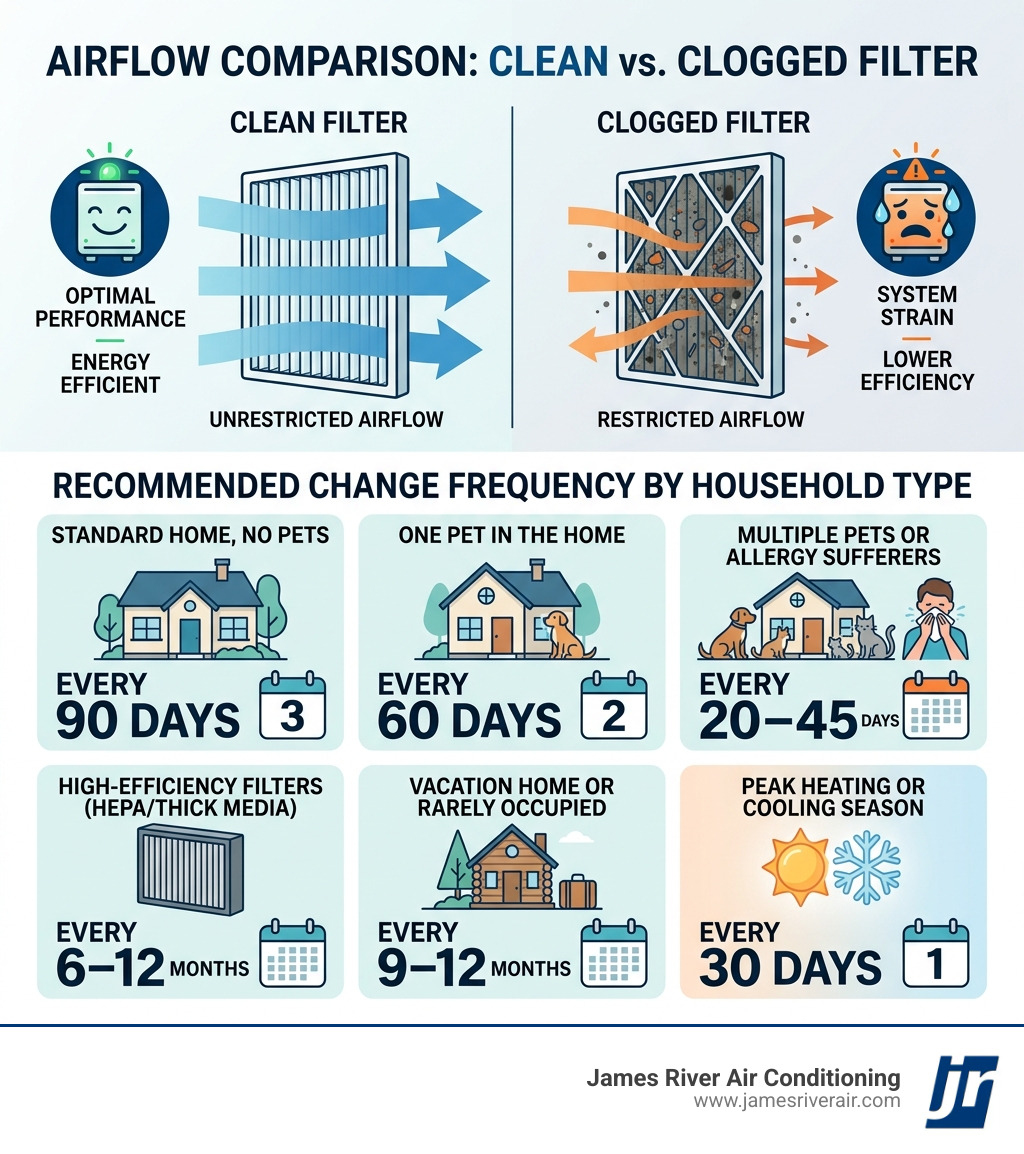
How often should you change your HVAC air filter depends on your filter type, home conditions, and how hard your system works — but here’s a quick reference to get you started:
| Household Situation | Recommended Change Frequency |
|---|---|
| Standard home, no pets | Every 90 days |
| One pet in the home | Every 60 days |
| Multiple pets or allergy sufferers | Every 20–45 days |
| High-efficiency (HEPA/thick media) filters | Every 6–12 months |
| Vacation home or rarely occupied | Every 9–12 months |
| Peak heating or cooling season | Every 30 days |
Most homeowners don’t think about their HVAC filter until something goes wrong. Maybe the air feels stuffy, the system runs longer than it should, or the energy bill creeps up without a clear reason. In many cases, a clogged filter is the culprit — and it’s one of the easiest problems to prevent.
A dirty filter doesn’t just hurt your air quality. It forces your system to work harder, which can shorten its lifespan and drive up your utility costs. According to the U.S. Department of Energy, replacing a clogged filter can improve system efficiency by 5 to 15%. That’s a meaningful difference for something that takes less than five minutes to fix.
The challenge is that there’s no single answer that works for every home. Filter type, thickness, pets, allergies, and how often your system runs all play a role. This guide breaks it all down so you can stop guessing and build a schedule that actually fits your home.
The Definitive Guide: How Often Should You Change Your HVAC Air Filter?
As we move through April 2026, many of our neighbors in Richmond and Chesterfield are firing up their air conditioning for the first time this year. This transition period is the perfect time to address the most common question we hear: “Do I really need to change this every month?”
The short answer is: probably not every month, but definitely more often than “once a year when I remember.” The general consensus among HVAC professionals is that you should replace a standard one-inch pleated filter every 90 days, or three months. This 90-day window is considered the “sweet spot” for maintaining a balance between air filtration and system airflow.
However, this is just a baseline. During seasonal peaks—like the humid Virginia summers in Henrico or the freezing winter nights in Powhatan—your system runs almost constantly. When the HVAC unit is moving air 18 to 20 hours a day, it is also pulling dust and debris through that filter 18 to 20 hours a day. In these peak seasons, we often recommend checking the filter every 30 days.
Staying on top of this simple task is a core part of Residential Preventive Maintenance. Think of it like changing the oil in your car; you wouldn’t wait for the engine to seize before visiting the mechanic. Similarly, your HVAC system needs a clean “breath” of air to function. If you are new to homeownership or just want to brush up on the lingo, our guide to HVAC Home Comfort Terms can help you understand exactly what’s happening inside your vents.
Key Factors Influencing Your Replacement Schedule
Why does your neighbor in Midlothian change their filter every month while your cousin in Rockville only does it twice a year? It isn’t just about being “neat.” Several household variables dictate how quickly a filter becomes a wall of dust.
- Number of Occupants: More people means more skin cells, hair, and movement that kicks up settled dust. A bustling household of six will clog a filter much faster than a single person living alone.
- Home Size: Interestingly, smaller homes in places like Tuckahoe or Sandston might actually need more frequent filter changes. Why? Because the same amount of activity happens in a smaller volume of air, and smaller homes often have smaller HVAC units with smaller filters that reach capacity quickly.
- Indoor Activities: Do you love burning scented candles? Do you have a wood-burning fireplace in your Mechanicsville home? Do you cook a lot of fried foods? All of these activities release particulates into the air that your filter eventually catches.
- Health Requirements: For those with respiratory issues, the filter is a medical necessity, not just a system protector. This ties directly into your Residential Indoor Air Quality, where the goal is to remove as many irritants as possible.
How often should you change your HVAC air filter in a pet-friendly home?
We love our furry friends, but from an HVAC perspective, they are “pollution factories.” If you have a Golden Retriever or a long-haired cat, your filter isn’t just catching dust—it’s catching a thick mat of fur and dander.
In a home with one pet, we recommend moving your replacement schedule up to every 60 days. If you have multiple pets, or a “zoo” of three or more animals, you should be checking that filter every 30 days. Pet dander is microscopic and sticky; it can bypass cheap filters and coat your internal components, leading to the need for Expert Heat Pump Maintenance in Hanover, VA to clean the coils.
A simple trick for pet owners: if you see “dust bunnies” forming in the corners of your hardwood floors, your HVAC filter is likely already full. The system can no longer pull those particles out of the air, so they are settling on your furniture and floors instead.
Environmental impacts on filter lifespan
Your home doesn’t exist in a vacuum. The air outside in Central Virginia significantly impacts what happens inside.
- Local Air Quality: If you live near a high-traffic area in Richmond or near new construction in Short Pump, your filter will deal with more soot and construction dust.
- Pollen Seasons: Richmond is famous for its “pollen coating” every spring. During high-pollen months, your HVAC system pulls those outdoor allergens inside every time a door or window opens.
- Wildfire Smoke: Even if the fires are hundreds of miles away, smoke particulates can drift into our region, as we’ve seen in recent years. These fine particles clog filters extremely fast.
- Usage Cycles: In the “shoulder seasons” (spring and fall) when you might have the windows open and the HVAC off, your filter will last much longer. But the moment that summer heat hits, the clock starts ticking faster.
If you suspect your environment is taking a toll on your system, it might be time for a professional Residential HVAC Service visit to ensure your ductwork hasn’t become a reservoir for outdoor pollutants.
Comparing Filter Types, Thickness, and MERV Ratings
Not all filters are created equal. The “blue” fiberglass filters you see at the grocery store are vastly different from the thick media cabinets we install in modern homes.
| Filter Type | Typical Thickness | MERV Rating | Average Lifespan |
|---|---|---|---|
| Fiberglass (Disposable) | 1 inch | 1–4 | 30 days |
| Pleated (Standard) | 1–2 inches | 5–8 | 90 days |
| High-Efficiency Pleated | 1–2 inches | 9–12 | 60–90 days |
| Media Filter (Cabinet) | 4–5 inches | 11–16 | 6–12 months |
| HEPA Filter | Variable | 17–20 | 6–12 months |
MERV stands for Minimum Efficiency Reporting Value. It’s a scale from 1 to 20 that measures how effectively a filter traps particles. While a higher MERV rating means cleaner air, it also means the filter is “tighter.” If you put a MERV 16 filter into a system designed for a MERV 4, you could actually suffocate your air conditioner and cause the motor to burn out.

How often should you change your HVAC air filter when using high-efficiency media?
If your home is equipped with a 5-inch thick media filter—like the Lennox Healthy Climate CarbonClean 16—you are in the “set it and forget it” category. These filters have a massive surface area. Because the material is folded (pleated) so many times, there is much more room for dust to land without blocking the airflow.
These high-capacity filters are designed to last a full year in many cases. However, if you have heavy pet usage or allergies, we suggest checking them at the six-month mark. Using high-efficiency media is one of the top 5 Tips to Show Your HVAC System Love because it provides superior protection for the system’s internal components while requiring less frequent maintenance from the homeowner.
Signs and Consequences of a Clogged Air Filter
Waiting for your system to stop working is not a maintenance strategy. Fortunately, your home will give you several “early warning” signs that the filter is struggling.
The Light Test: This is the most reliable DIY method. Take your filter out and hold it up to a bright light or the sun. If you can’t see the light shining through the material, it is too clogged for air to pass through efficiently. It’s time for a change.
Visible Dust Buildup: Have you noticed a “gray” film on your supply vents? Or perhaps your return vent cover is starting to look fuzzy? When a filter is full, dust begins to settle in the ductwork and blow back into your rooms.
Strange Odors: A “musty” or “dusty” smell when the heat or AC kicks on is a sign that the filter is saturated. In some cases, a very dirty filter can cause a burning smell because the restricted airflow causes the furnace components to overheat. If you notice your utility costs spiking alongside these symptoms, check out our Tips for High Energy Bills.
Potential negative consequences of neglect
What happens if you just… don’t change it? It’s just a bit of dust, right? Unfortunately, the consequences are more than just a sneezing fit.
- Frozen Evaporator Coils: Your air conditioner works by blowing warm air over cold coils. If the filter is clogged, there isn’t enough warm air to keep the coils from getting too cold. They will eventually turn into a block of ice, shutting down your cooling entirely.
- Short Cycling: The system will turn on and off rapidly because it is overheating or sensing a lack of airflow. This puts immense strain on the compressor.
- Blower Motor Failure: The motor has to work twice as hard to “pull” air through a dirty filter. This leads to premature mechanical failure.
- Poor Air Quality: Eventually, the filter can “blow out” or bypass, sending all that trapped dirt directly into your lungs and onto your expensive HVAC components.
Understanding the Benefits of Regular HVAC Maintenance can save you from a multi-thousand-dollar repair bill caused by a ten-dollar filter.
Frequently Asked Questions about HVAC Air Filters
Do you really need to change air filters every 3 months?
Yes, for most standard homes in the Richmond area, the 90-day rule is the absolute minimum. While some filters can last longer, the accumulation of microscopic skin cells and dust mites happens regardless of whether you “see” the dirt. If you’ve lost track of your last change, it is always safer to Book a Service Call and have a professional look at your system’s overall health.
How do I know if my air filter needs changing?
Beyond the light test, look for a “gray” or “ashen” color on the material. A new filter is usually crisp white or yellow. If it looks like the lint trap in your dryer, it’s long overdue. Also, listen to your system. If the air coming out of the vents sounds “whistly” or strained, the filter is likely the bottleneck.
What happens if you never change your air filter?
If you never change it, the system will eventually fail. In the short term, you’ll see a 5–15% drop in efficiency, which shows up directly on your electric bill. In the long term, the lack of airflow will cause the heat exchanger to crack or the compressor to seize. It is the leading cause of preventable HVAC breakdowns in Virginia.
Conclusion
At James River Air Conditioning, we’ve spent over 57 years helping our neighbors in Ashland, Midlothian, and throughout the Richmond area stay comfortable. We know that life gets busy, and a furnace filter is often the last thing on your mind. But taking those few minutes every three months to swap in a fresh filter is the single best thing you can do for your home’s comfort and your wallet.
Whether you need help selecting the right MERV rating for your system or you want to upgrade your home with a high-efficiency media cabinet, our team is here to provide world-class service with an entrepreneurial spirit. Don’t wait for your system to struggle—take control of your Residential Indoor Air Quality today.
Stop guessing, start changing, and if you ever find yourself in a “dusty” situation, give us a call. We’re ready to help you breathe easier.
