

Why Crawl Space Moisture Barriers and Ventilation Explained Correctly Can Save Your Richmond Home
Crawl space moisture barriers and ventilation explained together form the foundation of protecting your home from one of the most overlooked — and damaging — sources of moisture in the Mid-Atlantic region. If you live in Richmond, VA, the warm, humid summers mean your crawl space is constantly under pressure from ground moisture and humid outdoor air pushing upward into your living space.
Here is a quick overview of how each approach works:
- Vapor barrier: A polyethylene sheet laid over the crawl space floor (and up the walls) that blocks moisture vapor from rising out of the soil into your home
- Traditional ventilation: Foundation vents that allow outdoor air to circulate under the home — intended to dry out moisture, but often making things worse in humid climates
- Encapsulation: A sealed, conditioned crawl space system combining a heavy-duty vapor barrier, sealed vents, insulation, and a dehumidifier to actively control humidity year-round
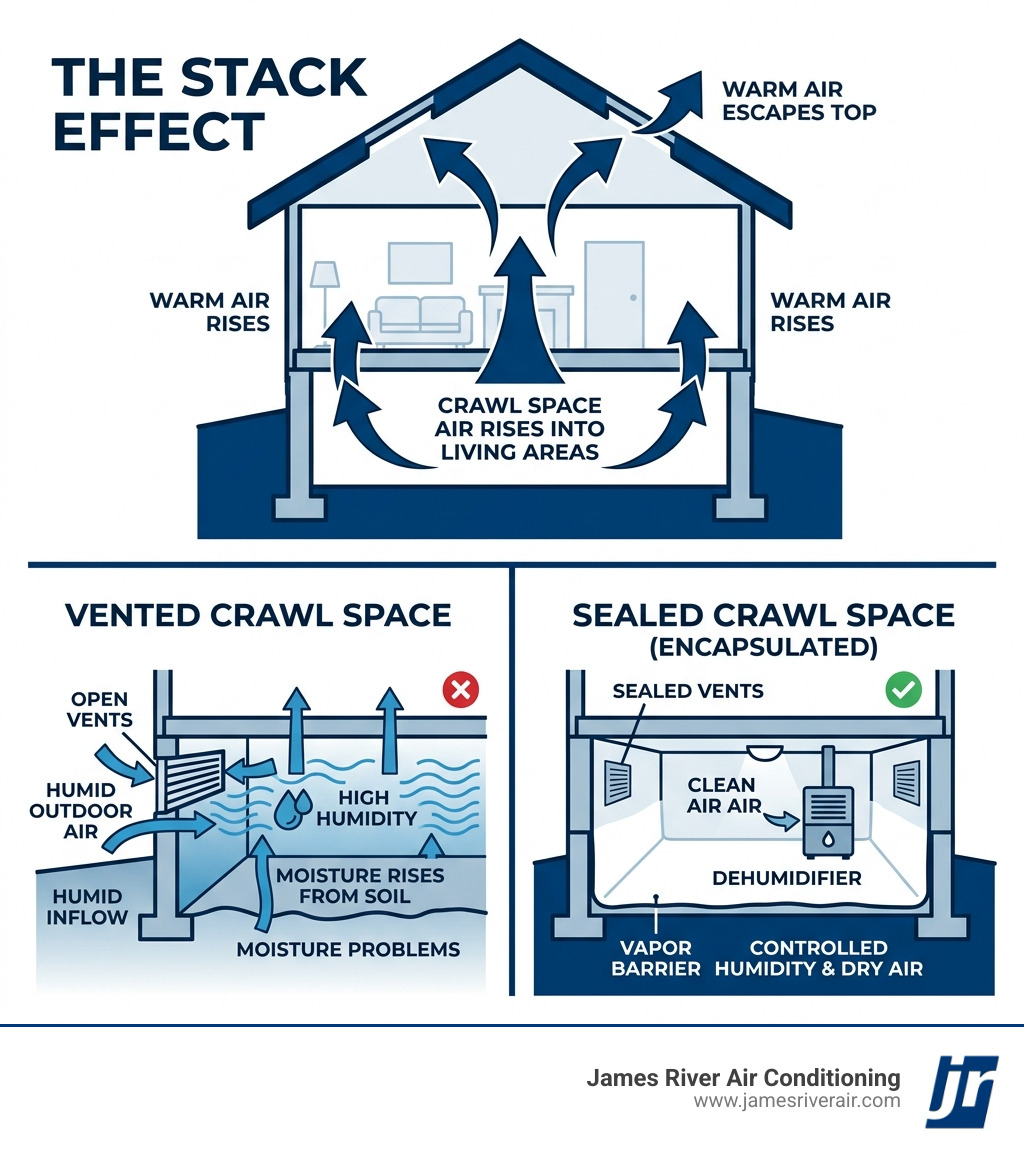
The core problem is this: moisture from bare soil evaporates constantly. Without a barrier, that vapor rises into floor joists, ductwork, and insulation. Research from Building Science Corporation shows that in hot-humid climates, vented crawl spaces actually increase moisture levels rather than reducing them — promoting mold, wood rot, and poor indoor air quality. In fact, because of the stack effect, an estimated 40–50% of the air in your first floor can originate directly from your crawl space.
For Richmond homeowners, getting this right is not optional — it is a matter of structural integrity, energy efficiency, and the air your family breathes every day.
What is a Crawl Space Vapor Barrier and How Does It Work?

At its simplest, a crawl space vapor barrier is a specialized plastic membrane designed to stop vapor diffusion. Think of the soil under your home as a giant sponge that never stops off-gassing moisture. Even if the dirt looks bone-dry on the surface, capillary action is constantly pulling water from deep in the Richmond water table up to the surface, where it evaporates into your floor joists.
A high-quality barrier, technically known as a Class I vapor retarder, acts as a physical shield. To be effective and meet modern building codes (like the 2021 IRC), these barriers must have a permeance rating of 0.1 perms or less. While you might see thin 6-mil plastic at big-box stores, we generally recommend a thickness of 12-mil to 20-mil for long-term durability. Thicker materials, often reinforced with polyester string, are much harder to puncture when technicians crawl over them to service your plumbing or HVAC systems.
When we install these barriers, we aren’t just “laying down plastic.” We are managing three types of moisture:
- Capillary action: Water wicking through porous foundation walls.
- Bulk moisture: Standing water from leaks or poor grading.
- Vapor diffusion: Gaseous water molecules passing through materials.
If you aren’t sure if your current setup is doing its job, check out these Warning Signs Your Crawl Space is Impaired to see if you have hidden moisture issues brewing beneath your feet.
Crawl Space Moisture Barriers and Ventilation Explained: Vented vs. Unvented
For decades, the “standard” way to build a home in Virginia involved installing foundation vents. The theory was that cross-ventilation would allow air to “dry out” the crawl space. However, building science has evolved, and we now know that in humid climates like ours, this approach often backfires.
| Feature | Vented Crawl Space | Unvented / Encapsulated Space |
|---|---|---|
| Air Source | Uncontrolled outdoor air | Conditioned indoor air / Dehumidifier |
| Moisture Control | Passive (unreliable in summer) | Active (dehumidifier maintains <50% RH) |
| Energy Efficiency | Low (HVAC ducts work harder) | High (15–30% HVAC energy reduction) |
| Summer Condition | Often damp, high dew point | Dry and stable |
| Winter Condition | Cold floors, risk of frozen pipes | Warmer floors, protected pipes |
In a vented crawl space, you are at the mercy of the dew point. When 90-degree air with 70% humidity enters a 65-degree crawl space, it hits its dew point and turns into liquid water (condensation) on your cold pipes and floor joists. This is why many Residential Crawl Spaces in the Mid-Atlantic struggle with mold even if they have plenty of vents.
How Crawl Space Moisture Barriers and Ventilation Explained Systems Impact Air Quality
You might think your crawl space is a separate world, but your house acts like a giant chimney. This is called the stack effect. Warm air rises and escapes through your attic, creating a vacuum that pulls air upward from the lowest point—your crawl space.
When that air is filled with mold spores, musty odors, and fungal growth, it doesn’t stay under the floor. It migrates into your bedrooms and kitchen. If you have wood rot occurring in your joists, you aren’t just dealing with a structural issue; you are breathing the byproducts of that decay. A properly sealed system stops this upward migration, ensuring the air your family breathes is filtered and dry.
Comparing Crawl Space Moisture Barriers and Ventilation Explained for Mid-Atlantic Climates
In Richmond and surrounding areas like Midlothian and Glen Allen, our “hot-humid” climate classification is the deciding factor. During a typical Virginia July, the outdoor dew point is often higher than the temperature inside your crawl space. This means opening a vent is literally like turning on a humidifier under your house.
By switching to an unvented or encapsulated model, homeowners can see a 15-30% reduction in HVAC-related energy costs. Why? Because your air conditioner’s ductwork is no longer sitting in a swamp. When ducts are surrounded by dry air, they don’t lose as much cooling capacity, and the equipment doesn’t have to work nearly as hard to dehumidify the upstairs living area.
Why Traditional Ventilation Fails in Humid Virginia Summers
If you’ve ever walked into your crawl space in August and seen “sweating” ductwork or beads of water on the insulation, you’ve seen the failure of traditional ventilation firsthand.
When outdoor humidity is high, the “fresh air” coming through those vents carries gallons of water. In a 1,500-square-foot crawl space, humid air can deposit 20 to 40 gallons of water per week through condensation alone. This keeps the wood moisture content (WMC) of your floor joists dangerously high.
Building science tells us that:
- WMC below 12%: Ideal for structural wood.
- WMC above 17%: Fungal growth becomes a significant risk.
- WMC above 20%: Wood rot and structural damage begin to occur.
Traditional vents also contribute to negative pressure. As your HVAC system runs, any leaks in the return ducts pull that damp, dirty crawl space air directly into your home’s ventilation system. This air infiltration forces your AC to work overtime to remove the extra moisture, leading to higher bills and shorter equipment lifespans.
Proper Installation Steps for a Durable Moisture Barrier
Installing a vapor barrier is a precise process. If you leave even 5% of the ground exposed, you can lose 50% of the barrier’s effectiveness. Here is the professional “how-to” for a lasting installation:
- Debris Removal: Clear out all rocks, sharp sticks, and construction debris. Anything left under the plastic can cause a puncture later.
- Grading & Drainage: Ensure the ground slopes away from the foundation. If there is standing water, a sump pump must be installed before the plastic goes down.
- The 12-Inch Overlap: Never just butt the sheets of plastic together. We overlap seams by at least 12 inches to ensure no vapor can bypass the barrier.
- Seam Sealing: Use high-quality, waterproof seam tape (not duct tape!) to bond the layers together.
- Wall Turn-Up: The barrier must go up the foundation walls at least 6 to 12 inches. It should be fastened and sealed to the masonry with specialized mastic or termination strips.
- Pier Wrapping: Every support column (pier) must be wrapped and sealed just like the perimeter walls.
- Penetration Sealing: Use a “target-and-cover” patch method for plumbing pipes and HVAC lines to ensure an airtight fit.
Essential Installation Tools
- Heavy-duty 10-20 mil polyethylene
- Waterproof seam tape (4-inch width)
- Foundation pins or masonry anchors
- Professional-grade sealant/mastic
- Digital hygrometer (to monitor results)
DIY vs. Professional Installation Considerations
Can you do this yourself? Technically, yes. However, crawl spaces are tight, dark, and often home to unwanted guests (spiders and rodents). A professional assessment is usually recommended because we look for things a homeowner might miss, such as active plumbing leaks, “hidden” mold behind insulation, or complex drainage needs.
Furthermore, professional-grade materials (ASTM E1745 rated) are significantly more durable than what is typically available at retail stores. For long-term durability and the best ROI on your home’s value, a professional installation ensures the seals are vapor-tight and code-compliant.
Encapsulation: The Modern Alternative to Simple Ventilation
While a vapor barrier is a great start, encapsulation is the gold standard for home health. Encapsulation turns your crawl space into a conditioned space, much like a finished basement.
Key components of a modern encapsulation system include:
- Full Air Sealing: Closing off all foundation vents and sealing the rim joist with spray foam to stop air leaks.
- Wall Insulation: Using rigid foam board on the foundation walls rather than fiberglass batts in the ceiling (which tend to sag and trap moisture).
- Active Dehumidification: Installing a specialized crawl space dehumidifier. Unlike the units you buy for a bedroom, these are designed to operate in low temperatures and can move hundreds of cubic feet of air.
- Drainage Systems: Integrating a sump pump and interior French drains if the home is prone to groundwater seepage.
The goal of encapsulation is to maintain a 50% relative humidity target. At this level, mold cannot grow, dust mites die off, and your wood framing remains as dry as the day it was milled. You can find more details on our Residential Crawl Spaces page regarding how we transform these areas.
Frequently Asked Questions about Crawl Space Moisture
Do vapor barriers cause mold?
This is a common myth. A vapor barrier itself does not cause mold; in fact, it is a primary tool for preventing it. However, if you have a massive plumbing leak above the barrier or you seal the vents without addressing high humidity, you can trap moisture. This is why a balanced approach—combining the barrier with proper air sealing and a dehumidifier—is essential. If mold is already present, mold remediation must be performed before the barrier is installed.
Is a vapor barrier necessary in every crawl space?
If your crawl space has exposed earth, the answer is almost always yes. Even in drier climates, the earth releases moisture. In Virginia, it is a absolute necessity. Most modern building codes require a Class I vapor retarder in any unvented crawl space to prevent structural decay and protect indoor air quality.
What is the difference between a moisture barrier and a vapor barrier?
While people often use the terms interchangeably, there is a technical difference. A moisture barrier (or water-resistive barrier) is designed to stop liquid water. A vapor barrier is designed to stop water vapor (gas). In a crawl space, you need a product that does both. A heavy-duty 20-mil polyethylene sheet is an excellent vapor barrier because it has almost zero permeability, meaning neither liquid nor gas can pass through it.
Conclusion
Protecting your Richmond home starts from the ground up. Understanding crawl space moisture barriers and ventilation explained is the first step toward a healthier, more efficient household. Whether you are dealing with musty odors in Chesterfield or high energy bills in Henrico, the solution lies in controlling the environment beneath your feet.
At James River Air Conditioning, we have spent over 57 years helping Virginia homeowners improve their home performance and protect their structural integrity. From simple vapor barrier refreshes to full-scale encapsulation systems, our team ensures your crawl space stays dry, your air stays clean, and your HVAC system runs at peak efficiency.
Don’t let moisture undermine your home’s value. Explore our services for Residential Crawl Spaces and take control of your home’s health today.
