

Surviving the Seasons: How Virginia’s Climate Impacts Your Home Systems
How Central Virginia Climate Affects Your Home Systems — And What to Do About It
How central virginia climate affects your home systems is a question every Richmond-area homeowner eventually faces. The short answer: the region’s humid subtropical climate creates year-round stress on your HVAC equipment, insulation, windows, and more — driving up energy bills and shortening system lifespans.
Here’s a quick overview of the key impacts:
| Home System | Primary Climate Threat | Key Risk |
|---|---|---|
| HVAC | High summer humidity (70%+ relative humidity) | Overwork, mold in ducts, shortened lifespan |
| Heat Pump | Constant mode-switching in shoulder seasons | Early component fatigue (avg. 12–15 year lifespan) |
| Insulation & Air Sealing | Freeze-thaw cycles, moisture infiltration | 25–40% energy loss through air leakage |
| Windows | Mixed-humid Zone 4A conditions | Heat gain, condensation, thermal inefficiency |
| Crawlspace & Foundation | Ground moisture and humidity swings | Structural damage, mold, poor indoor air quality |
Central Virginia sits in IECC Climate Zone 4A — officially classified as “mixed-humid.” That label doesn’t quite capture what living here feels like. A July afternoon in Charlottesville or Richmond can feel like stepping into a steam room, while a January night can bring hard frost and freeze-thaw damage. As one local HVAC perspective puts it, you might need heat in the morning and cooling by the same afternoon.
This atmospheric tug-of-war is not getting easier. The amount of electricity needed to keep a Virginia home comfortably cool has increased by roughly one-third since 1970 — and rising temperatures are pushing that number higher every decade.
This guide walks you through exactly how each season challenges your home systems, what warning signs to watch for, and which upgrades deliver real results in the Piedmont region.
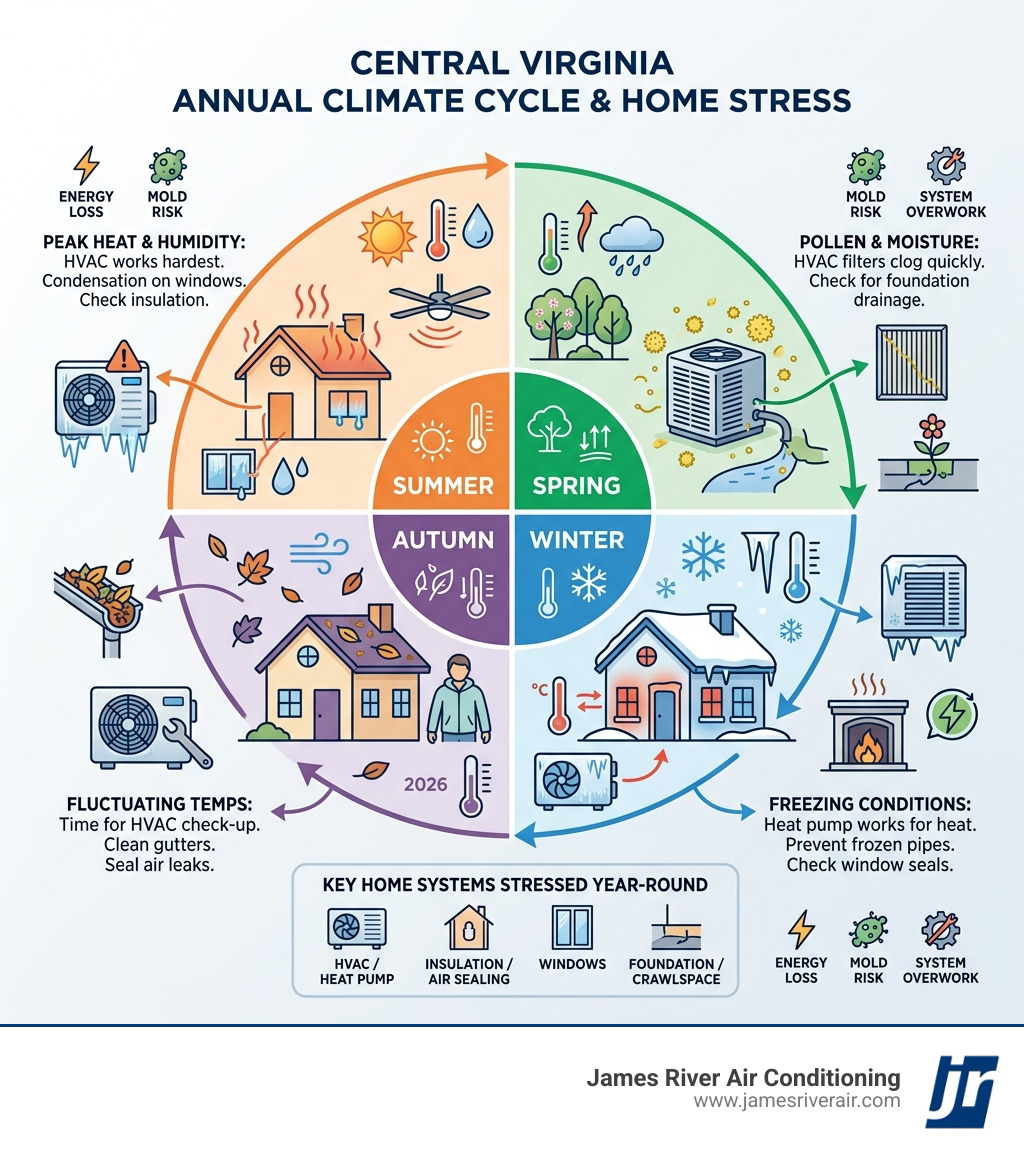
How Central Virginia Climate Affects Your Home Systems Year-Round

Living in the Piedmont region means dealing with a climate that is never quite settled. Because we fall into the mixed-humid Zone 4A classification, our home systems have to be “jacks of all trades.” Unlike the desert southwest or the frozen north, Central Virginia demands that your HVAC system be equally adept at bone-dry heating and swamp-like cooling.
This atmospheric tug-of-war is more than just an inconvenience; it’s a major driver of energy consumption. Statistics show that the energy required to cool a home in Virginia has jumped by about 33% since the 1970s. As we head toward 2040, electricity consumption in the state could nearly triple due to regional growth and data center expansion, making efficiency more than just a “green” choice—it’s a financial necessity.
To navigate these changes, it helps to speak the language of home comfort. Whether you are dealing with SEER2 ratings or HSPF2 values, understanding the terminology is the first step in defending your home. For a deeper dive, check out Your Guide to HVAC Home Comfort Terms.
Understanding why the Central Virginia climate affects your home systems during winter
Winter in places like Midlothian or Henrico isn’t just about the cold; it’s about the fluctuation. We frequently deal with “freeze-thaw cycles,” where the temperature dips below freezing at night and hits the 50s by noon. This causes building materials to expand and contract rapidly, stressing window seals and siding.
Inside the home, these temperature swings create a humidity crisis. When cold outdoor air meets a warm window pane, you get condensation. If your indoor humidity isn’t kept within the ideal 30-50% range, you risk mold growth on windowsills and dampness in your walls. Furthermore, our occasional winter storms mean you need to be proactive. Snow and ice can block your heat pump’s airflow, leading to emergency shutdowns. We recommend following these 6 Tips Protecting HVAC from Snow to keep the heat running when the flakes start falling.
How Central Virginia climate affects your home systems and HVAC equipment lifespan
In a perfect world, a heat pump might last 20 years. In Central Virginia, the reality is usually 12-15 years. Why the discrepancy? It’s the “system fatigue” caused by our humidity. In the summer, your AC isn’t just cooling the air; it’s working overtime to wring gallons of water out of it.
If you live in the eastern parts of our service area, near the coastal influence, salt air can also accelerate the corrosion of aluminum fins and copper coils. Neglected systems in these high-stress environments may even fail as early as 10 years. However, well-maintained systems can regularly reach the 18-year mark. The secret is consistency. Understanding the Benefits of Regular HVAC Maintenance can help you add years to your equipment’s life, even in our tough climate.
Managing the “Steam Room” Effect: Humidity and Indoor Air Quality
If there is one word that defines the Central Virginia summer, it’s humidity. With average relative humidity often exceeding 70%, our air carries a massive “latent heat” load. This means your HVAC system has to work twice as hard—once to lower the temperature and again to remove the moisture.
When humidity stays above 50% inside your home, it’s not just uncomfortable—it’s a health hazard. High moisture levels are an open invitation for dust mites and mold. This is particularly true in your home’s lowest points. If you notice musty smells or damp spots, you should check for Warning Signs Your Crawl Space is Impaired. Often, a vapor barrier or full crawlspace encapsulation is the only way to stop the “stack effect” from pulling humid, moldy air up into your living spaces.
The impact of variable humidity on structural integrity
Humidity doesn’t just affect your lungs; it affects your house’s bones. Wood is hygroscopic, meaning it absorbs moisture from the air. In a humid Richmond August, your hardwood floors may expand, leading to “cupping” or crowning. When the dry winter air hits, that same wood shrinks, leading to unsightly gaps and cracks in your drywall.
Low humidity (below 30%) in the winter brings its own set of problems:
- Static Electricity: That annoying zap when you touch a doorknob.
- Health Issues: Dry skin, scratchy throats, and increased susceptibility to respiratory infections.
- Wood Damage: Furniture and musical instruments can crack or warp as they lose essential moisture.
Maximizing Heat Pump Performance in the Piedmont Region
For many years, the standard advice was that heat pumps didn’t work well in the cold. That has changed. Modern variable-speed heat pumps are designed specifically for climates like ours. They can modulate their output, running at lower speeds to maintain a steady temperature rather than blasting on and off.
| Feature | Traditional AC + Furnace | Modern Variable-Speed Heat Pump |
|---|---|---|
| Efficiency | High for heating, varies for cooling | Industry-leading SEER2 and HSPF2 |
| Humidity Control | Standard | Superior (longer, slower run cycles) |
| Redundancy | High (two fuel sources) | Moderate (unless paired with gas backup) |
| 2026 Standards | Must meet new SEER2 minimums | Built for future efficiency mandates |
Starting in 2026, the Department of Energy is enforcing even stricter efficiency standards (SEER2 and HSPF2). These ratings use real-world testing that better reflects the ductwork pressure found in typical Virginia homes. For those who want the best of both worlds, a dual-fuel system (combining an electric heat pump with a gas furnace) is often the gold standard for the Piedmont. It uses the efficient heat pump during our mild 40-degree days and switches to gas when a true “Polar Vortex” hits. To see how these systems hold up during the worst of it, read about AC Performance Extreme Heatwave Richmond.
Why shoulder seasons are the hardest on Virginia HVAC systems
In April and October, Central Virginia weather goes through an identity crisis. You might wake up to a 38-degree morning (Heat Mode) and come home to a 75-degree afternoon (Cool Mode). This “mode switching” is incredibly stressful for HVAC components.
It often leads to “short cycling,” where the system turns on and off too quickly to complete a full dehumidification cycle. This is the time of year when your thermostat calibration is most critical. If your system is over 10 years old and a major repair comes up, we often suggest the “50% Rule”: if the repair cost is more than half the value of a new system, it’s time to upgrade. Give your unit some attention during these transitions with these 5 Tips to Show Your HVAC System Love.
Sealing the Gaps: Insulation and Window Efficiency for Virginia Homes
You can have the most expensive HVAC system in the world, but if your home is “leaky,” you’re just cooling the neighborhood. Air leakage accounts for 25-40% of the energy used for heating and cooling in a typical home. In Central Virginia, the most common culprits are unsealed attics, rim joists, and old windows.
Improving your insulation—especially using spray foam in the attic—creates a thermal envelope that keeps the humidity out and the conditioned air in. If you are tired of seeing your money disappear every month, check out these High Energy Bill Tips.
Choosing the right window ratings for Climate Zone 4
Windows are often the weakest link in a home’s thermal defense. When shopping for replacements in Richmond or Chesterfield, look at two specific numbers:
- U-Factor (Goal: 0.30 or lower): This measures how well the window keeps heat inside. In our Zone 4 climate, a lower U-factor is vital for those chilly winter nights.
- SHGC (Goal: 0.40 or lower): The Solar Heat Gain Coefficient measures how much heat from the sun enters your home. Low-E glass is essential here, as it can block up to 70% of solar heat, preventing that “greenhouse effect” in your living room during July.
Protecting Your Investment with 2026 Rebates and Maintenance
The good news for homeowners in 2025 and 2026 is that the financial landscape for upgrades has never been better. Thanks to the Inflation Reduction Act, you can take advantage of the 25C Tax Credit, which allows you to claim 30% of the cost (up to $2,000 per year) for qualifying heat pumps. Additionally, the Virginia HEAR Program provides point-of-sale discounts for income-qualified households looking to switch to high-efficiency electric systems.
Beyond big upgrades, a preventative maintenance routine is your best defense against the Virginia weather. Here is our essential seasonal checklist:
- Monthly: Change your air filters. Clogged filters are the #1 cause of system failure.
- Spring: Clean the outdoor condenser coils of pollen and debris; check the condensate drain line for clogs.
- Summer: Monitor indoor humidity; ensure the crawlspace vents (if not encapsulated) are clear.
- Fall: Schedule a professional furnace/heat pump inspection; check weatherstripping around doors.
- Winter: Keep the outdoor unit clear of snow and ice; check for “ice bridging” on the coils.
Frequently Asked Questions about Virginia Home Systems
What is the ideal indoor humidity for a Richmond home in winter?
The sweet spot is 30% to 50%. If it drops below 30%, you’ll deal with dry skin and static. If it climbs above 50%, you’ll see condensation on your windows, which can lead to mold and damage to your wood trim and respiratory health.
How long should a heat pump last in Central Virginia?
The average lifespan is 12-15 years. However, with the Piedmont’s weather stress, we see neglected units fail at 10 years, while those with biannual professional maintenance can push toward 18 years.
Which home improvements offer the best ROI for Virginia weather?
- Attic Insulation & Air Sealing: This has the fastest payback period by immediately lowering utility bills.
- Smart Thermostats: These help manage the wild temperature swings of our shoulder seasons.
- Crawlspace Encapsulation: Essential for managing the high humidity that causes structural rot and poor air quality in our region.
Conclusion
At James River Air Conditioning, we have been the Richmond home experts for over 57 years. We understand that your home is your sanctuary, and we bring an entrepreneurial spirit to every job, whether it’s a quick AC repair in Midlothian or a full electrical panel upgrade in Henrico. Our legacy is built on world-class service and a deep understanding of how central virginia climate affects your home systems.
Don’t wait for a record-breaking heatwave or a sudden cold snap to find out your systems are struggling. Schedule your Central Virginia home system evaluation today and let us help you keep your home comfortable, efficient, and safe all year long.
