

The Central Virginia Homeowner Guide to Getting the Right Size HVAC
Why Getting the Right Size HVAC for Central Virginia Homes is Essential
For homeowners in Central Virginia, getting the right size HVAC for Central Virginia homes is a critical decision that impacts comfort, energy bills, and system longevity. Many residents face the challenge of keeping their homes comfortable year-round, from our hot, humid summers to our cold winters. An HVAC system that’s too big or too small can lead to constant discomfort, higher energy use, and even premature system failure. Studies show that a large number of HVAC systems are improperly sized or installed, creating unnecessary problems for homeowners. Understanding the proper sizing process ensures your home remains a sanctuary, efficiently and effectively.
Learn more about our services and schedule a consultation today.
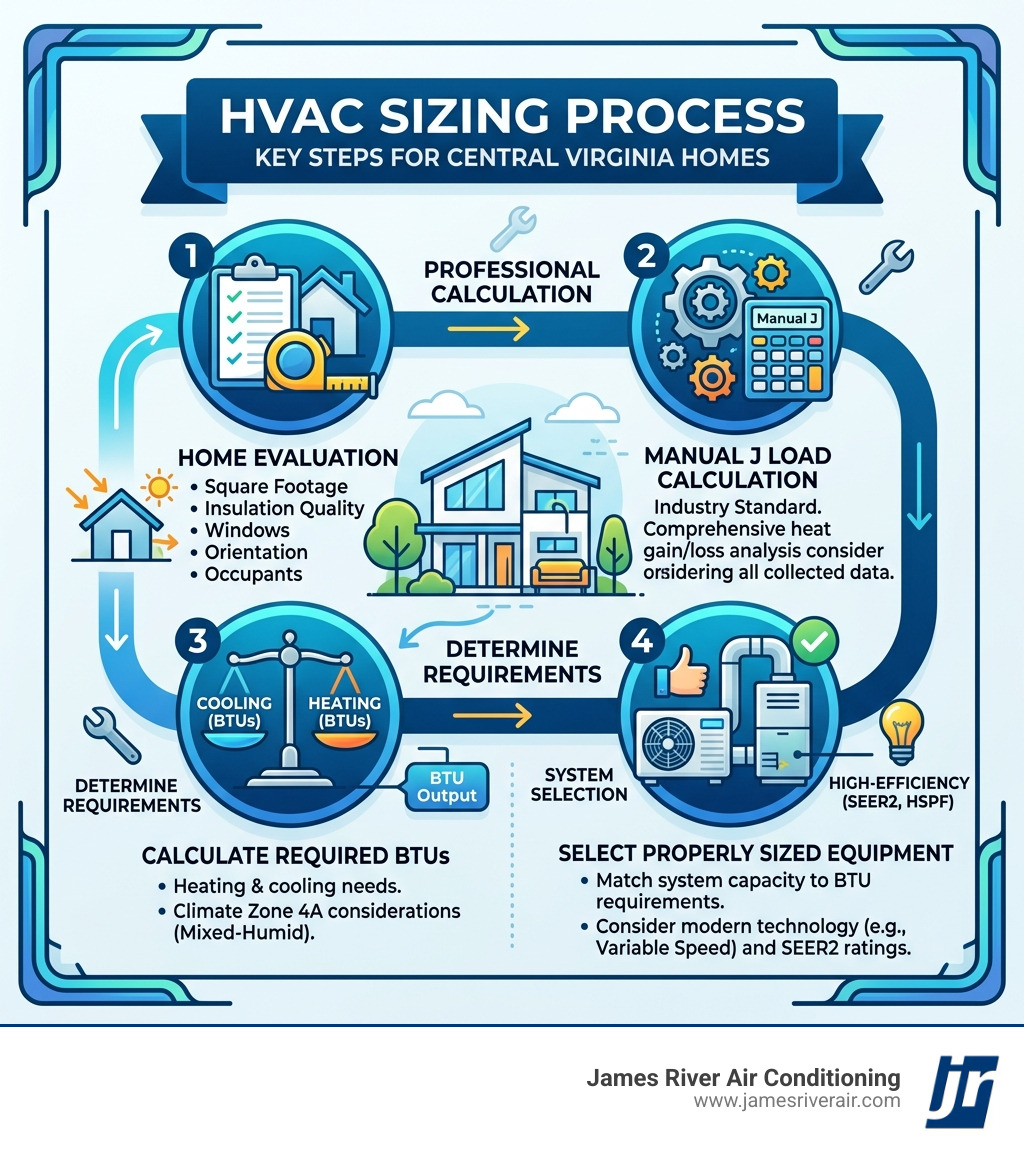
To find the right HVAC size for your Central Virginia home, focus on these key factors:
- Manual J Load Calculation: This is the industry gold standard. It’s a detailed assessment that considers every unique aspect of your home, not just its size.
- BTUs per Square Foot: As a general guideline for Central Virginia (Climate Zone 4A, Mixed-Humid), homes typically need about 20-25 BTUs per square foot. However, this is a starting point, not a definitive measurement.
- Home-Specific Factors: Insulation quality, window efficiency, sun exposure, ceiling height, and even the number of people living in the home all play a significant role in determining the final BTU requirements.
- Avoid Guesswork: Up to 90% of HVAC systems are improperly sized or installed. Relying on simple rules of thumb, online calculators alone, or the size of your old unit can lead to wasted energy, poor dehumidification, and reduced system lifespan.
Ensure your comfort and savings by scheduling a professional HVAC assessment with James River Air Conditioning.
The Role of Energy Efficiency in 2026
As we move through 2026, energy efficiency standards have never been higher. For those of us living in areas like Henrico, Midlothian, or Chesterfield, modern HVAC technology offers incredible opportunities to save on utility costs. The Seasonal Energy Efficiency Ratio (SEER2) is the current benchmark for cooling efficiency. While the minimum standards have risen, many homeowners are opting for high-efficiency units with SEER ratings of 16, 18, or even higher.
Choosing an ENERGY STAR certified system is another way we help our customers ensure they are getting a unit that is up to 15% more efficient than standard models. In the Richmond climate, this can translate to saving over $100 per year on cooling costs alone. However, even the most efficient unit will underperform if it isn’t sized correctly. This is why Benefits of Regular HVAC Maintenance are so closely tied to initial sizing; a properly sized unit doesn’t have to work as hard, making your maintenance efforts even more effective.
Impact on Indoor Air Quality
In Central Virginia, “it’s not just the heat, it’s the humidity” is a phrase we live by. Getting the right size HVAC for Central Virginia homes is the primary defense against indoor moisture issues. An oversized unit will cool your home so quickly that it doesn’t run long enough to remove moisture from the air. This leaves you feeling “clammy” and creates a breeding ground for mold and dust mites.
Properly sized systems provide superior humidity control by running longer, lower-intensity cycles that effectively “squeeze” the water out of the air. To keep your air clean and your system running smoothly, we recommend following these 5 Tips to Show Your HVAC System Love, which include regular filter changes and keeping your outdoor unit clear of debris.
Understanding the Metrics: BTUs and Tonnage

When we talk about HVAC size, we aren’t talking about the physical dimensions of the box. Instead, we use terms like “BTUs” and “Tons.” Understanding these is the first step in Your Guide to HVAC Home Comfort Terms.
A BTU (British Thermal Unit) is a measure of heat energy. Specifically, it’s the amount of heat required to raise the temperature of one pound of water by one degree Fahrenheit. In HVAC terms, it represents how much heat the system can remove from (or add to) your home per hour.
A Ton is simply a larger unit of measurement. One ton of cooling capacity is equal to 12,000 BTUs per hour. This terminology dates back to the days when buildings were cooled using actual tons of ice!
Converting BTUs to Tonnage for Your Home
Most residential systems in Virginia range from 1.5 to 5 tons. If a calculation determines your home needs 36,000 BTUs of cooling, you are looking for a 3-ton unit. Because systems typically come in half-ton increments, a professional will help you determine whether to “round up” or look for a variable-speed system that can adjust its capacity.
| Home Square Footage | Estimated Tonnage (VA Climate) | BTU Requirement |
|---|---|---|
| 600 – 1,000 sq. ft. | 1.5 Tons | 18,000 BTUs |
| 1,000 – 1,300 sq. ft. | 2.0 Tons | 24,000 BTUs |
| 1,300 – 1,600 sq. ft. | 2.5 Tons | 30,000 BTUs |
| 1,600 – 1,900 sq. ft. | 3.0 Tons | 36,000 BTUs |
| 1,900 – 2,200 sq. ft. | 3.5 Tons | 42,000 BTUs |
| 2,200 – 2,600 sq. ft. | 4.0 Tons | 48,000 BTUs |
| 2,600 – 3,200 sq. ft. | 5.0 Tons | 60,000 BTUs |
Why the 20 BTUs Per Square Foot Rule is Only a Start
While the “20 BTUs per square foot” rule is a common starting point, it is often inaccurate for Central Virginia. Depending on the age of your home in Richmond or the ceiling heights in a new build in Short Pump, you might actually need 35-40 BTUs per square foot to handle a 95-degree July afternoon.
Relying solely on square footage is one of the biggest High Energy Bill Tips we give: don’t guess. If you use a generic online calculator, you might end up with a system that drives your bills through the roof because it can’t keep up with the unique heat load of your specific property.
Critical Factors and Professional Standards
At James River Air Conditioning, we know that a home is more than just its footprint. To get the sizing right, we look at the “envelope” of the building. This includes the quality of your insulation (R-values) and the efficiency of your windows. As a James River Air BPI Gold Star Accredited contractor, we take a whole-house approach to energy efficiency.
How Local Climate Impacts Getting the Right Size HVAC for Central Virginia Homes
Central Virginia sits in Climate Zone 4A, classified as “Mixed-Humid.” This means we experience both significant heating and cooling seasons. Our summers are characterized by high dew points, while our winters can see temperatures drop well below freezing.
Because of this mix, your HVAC system must be a “jack of all trades.” It needs enough “oomph” to cool the house during a heatwave but must also be sized correctly for the heating side (whether it’s a furnace or a heat pump). In Richmond’s climate, we often find that cooling requirements dictate the size of a heat pump, but we must verify that the heating capacity is sufficient for those January nights in Hanover or Powhatan.
Professional Standards for Getting the Right Size HVAC for Central Virginia Homes
The only way to ensure 100% accuracy is through a Manual J Load Calculation. This is a rigorous protocol developed by the Air Conditioning Contractors of America (ACCA). Unlike a “rule of thumb,” a Manual J calculation accounts for:
- Orientation: Which way does your house face? South-facing windows bring in much more heat.
- Building Materials: Is your home brick, siding, or stone?
- Occupancy: How many people live in the home?
- Lighting and Appliances: Modern LED lighting generates less heat than old incandescents, affecting the cooling load.
- Ductwork: Leaky ducts can reduce efficiency by 20-30%, which must be factored into the HVAC Replacement Cost.
We also use Manual S to select the specific equipment that matches the Manual J results and Manual D to ensure your ductwork is sized to handle the airflow the new unit will provide.
The Consequences of Incorrect Sizing
Up to 90% of systems are sized or installed incorrectly, and the results are rarely pleasant. Here are the signs that your system isn’t a perfect fit:
- Short Cycling: The unit turns on and off every few minutes.
- Clammy Air: The temperature is low, but the humidity is high.
- Hot and Cold Spots: Some rooms feel like a sauna while others are like a walk-in freezer.
- High Energy Bills: The system is constantly starting up (which uses the most power) or running non-stop.
The Dangers of Oversized Systems
Many homeowners think “bigger is better,” but in the HVAC world, an oversized system is a liability. Because it cools the house too fast (short cycling), it never reaches its peak efficiency. This leads to increased wear and tear on the compressor, a shorter system lifespan, and significant mold risks due to poor dehumidification. You pay more for the unit upfront and more in repairs later.
Why Undersized Units Fail in Virginia Heat
An undersized unit is like a small engine trying to pull a heavy trailer. During a Central Virginia heatwave, it will run 24/7 and still fail to reach the set temperature on your thermostat. This constant operation leads to frozen coils, blown motors, and a home that simply isn’t comfortable when you need it most.
Frequently Asked Questions About HVAC Sizing
What is a Manual J load calculation?
It is a professional-grade software analysis that determines the exact amount of heat your home gains in the summer and loses in the winter. It is the only standard recognized by the Department of Energy and local building codes for accurately getting the right size HVAC for Central Virginia homes.
Can I size my new HVAC based on my old unit?
We strongly advise against this. Your old unit may have been sized incorrectly from the start. Additionally, if you have added new windows, upgraded your insulation in the attic, or added a room, your home’s “load” has changed. We often find that after a home is well-insulated, a smaller, more efficient unit is actually the better choice.
How does sun exposure affect my BTU needs?
Sun exposure is a massive factor. A room with large, west-facing windows can require significantly more cooling than a north-facing room of the same size. Strategic landscaping with shade trees can actually reduce your cooling needs by up to 30%, potentially allowing you to install a smaller, less expensive HVAC system.
Conclusion
At James River Air Conditioning, we’ve been serving the Richmond area for over 57 years. We understand the unique architectural styles of homes in the Fan, the sprawling layouts in Midlothian, and the historic needs of properties in Petersburg and Ashland. Getting the right size HVAC for Central Virginia homes isn’t just about a calculation; it’s about ensuring your family’s comfort for the next 15 to 20 years.
Don’t settle for a “guesstimate.” Trust our BPI Gold Star Accredited team to perform a comprehensive assessment of your home. We’ll help you navigate the technicalities of BTUs, SEER ratings, and Manual J calculations to find the perfect fit for your lifestyle and budget.
Ready to experience “world-class service with an entrepreneurial spirit”? Contact us today to schedule your professional sizing consultation and take the first step toward a more comfortable, efficient home. For more information on the terms we use, check out Your Guide to HVAC Home Comfort Terms.
