
The Quickest Way to Keep Your Home Comfortable Year-Round
Knowing how to maintain your heating and cooling system can save you hundreds of dollars a year and prevent breakdowns when you need your system most. Here’s a quick overview of the essential steps:
- Replace or clean air filters every 30-90 days depending on your household
- Clear debris from around your outdoor unit, keeping at least 2 feet of clearance
- Clean vents and registers regularly to keep airflow unrestricted
- Inspect exposed ductwork for leaks and seal any gaps you find
- Schedule professional tune-ups twice a year — spring for cooling, fall for heating
- Check your thermostat settings and consider upgrading to a smart thermostat
- Clear the condensate drain line every few months to prevent clogs and water damage
- Listen and smell — unusual noises or odors are early warning signs to act on
For Richmond and the broader Mid-Atlantic region, your heating and cooling system works hard. Humid summers, cold winters, and everything in between put real stress on HVAC equipment. Nearly half of the average home’s annual energy bill goes directly to heating and cooling costs. Yet fewer than half of homeowners have had their system serviced in the past year.
That gap between what systems need and what they get is where problems start. Dirt and neglect are the leading causes of HVAC failure — not age, not bad luck. A little consistent care goes a long way toward keeping your home comfortable and your energy bills in check.
Why Regular Maintenance is Crucial for Mid-Atlantic Homes
Living in areas like Henrico, Chesterfield, or Glen Allen, we experience the full spectrum of the four seasons. By April 2026, many of us have already seen how unpredictable Virginia weather can be. This volatility is exactly why regular maintenance isn’t just a suggestion; it’s a necessity for your home’s “heart.”
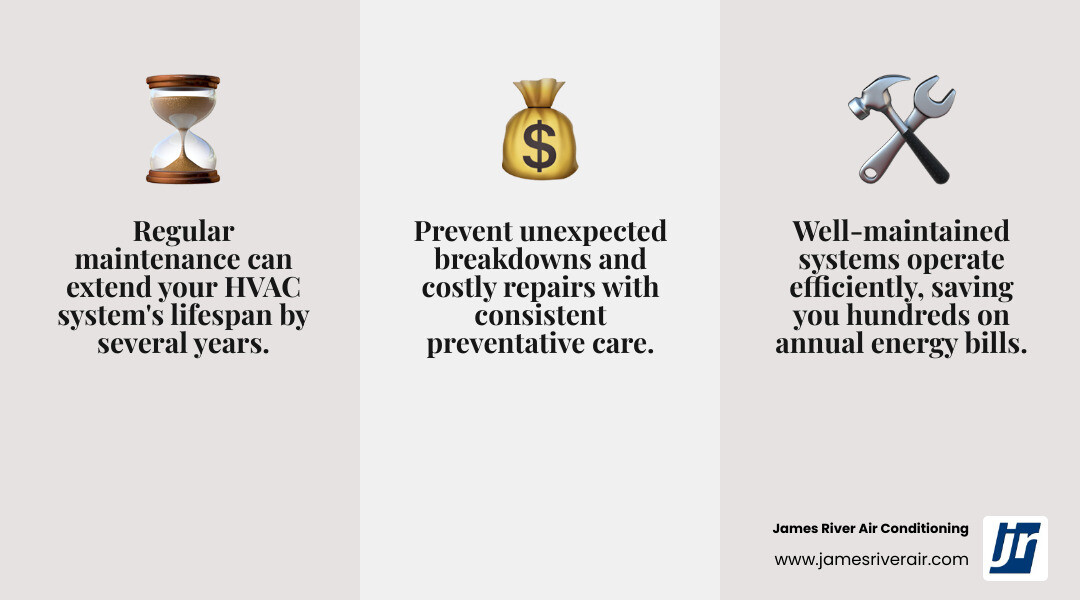
First, let’s talk about the numbers. The average American home spends roughly $1,900 a year on energy bills, and about 50% of that goes toward heating and cooling. When your system is bogged down by dirt or faulty components, it has to work overtime to reach the temperature you’ve set on your thermostat. This extra effort translates directly into higher utility costs. If you’ve noticed your costs creeping up, check out these High Energy Bill Tips to see if your HVAC might be the culprit.
Beyond the monthly bill, there is the matter of longevity. A well-maintained HVAC system can last anywhere from 15 to 25 years. However, neglecting it can shave years off that lifespan, forcing an expensive replacement much sooner than expected. Regular upkeep is a form of preventative care that protects your investment. In fact, installing a modern, high-efficiency system can even raise your home’s value by up to 7%.
There are also significant Benefits of Regular HVAC Maintenance regarding your indoor air quality. Your HVAC system is responsible for circulating the air you breathe. If the internal components are coated in dust or mold, those particles end up in your living room. Maintenance ensures your home remains a healthy sanctuary, free from excessive allergens and pollutants.

Essential Steps for How to Maintain Your Heating and Cooling System
Maintaining your system is a partnership between you and your professional technician. While some tasks require specialized tools and training, there is plenty you can do to keep things running smoothly between visits.
One of the most important factors in HVAC health is airflow. When airflow is restricted, your system suffocates. This leads to frozen coils in the summer and overheating furnaces in the winter. To prevent this, we recommend a few simple “acts of love” for your system. You can find more details in our guide on 5 Tips to Show Your HVAC System Love.
A major part of maintaining airflow is keeping the area around your outdoor condenser unit clear. We suggest maintaining at least a two-foot clearance from plants, shrubs, and debris. In the Mid-Atlantic, where we have fast-growing vegetation, it’s easy for a bush to overtake your unit in a single season.
To help you understand the landscape of HVAC care, here is a quick comparison of what you can handle and what should be left to the pros:
| Task Type | Homeowner (DIY) | Professional Technician |
|---|---|---|
| Air Filters | Inspect and replace monthly | Verify proper fit and MERV rating |
| Outdoor Unit | Clear leaves, grass, and debris | Deep clean coils and straighten fins |
| Vents/Registers | Vacuum and keep unobstructed | Inspect internal ductwork for leaks |
| Drain Lines | Flush with vinegar/water | Clear major clogs and inspect pans |
| Electrical | Check thermostat batteries | Tighten connections and measure voltage |
| Moving Parts | Visual inspection | Lubricate motors and check belts |
If some of these terms seem unfamiliar, don’t worry. You can brush up on the lingo with Your Guide to HVAC Home Comfort Terms.
How to maintain your heating and cooling system through filter care
The air filter is your system’s first line of defense. Its primary job isn’t actually to clean the air you breathe (though it does help with that); it’s to keep dust and hair from coating the sensitive internal components of your furnace or air handler.
When a filter is clogged, the blower motor has to work much harder to pull air through, which can reduce efficiency by up to 15%. We recommend checking your filter every month. If you live in a dusty area, have pets that shed, or suffer from allergies, you may need to replace it as often as every 30 days.
Pay attention to the MERV (Minimum Efficiency Reporting Value) rating. Higher MERV ratings catch smaller particles but can also restrict airflow if your system isn’t designed for them. Most residential systems do best with a MERV 8 to MERV 11 filter. Always ensure the arrow on the filter frame points toward the unit, indicating the direction of airflow.
Cleaning coils and clearing drains
Your system has two main sets of coils: the evaporator coil (usually indoors) and the condenser coil (outdoors). Even with regular filter changes, the indoor coil can accumulate a layer of dust over time, which prevents it from absorbing heat effectively. While a professional should deep-clean these, you can help by ensuring your indoor unit’s cabinet is kept clean and dry.
The outdoor condenser coil is exposed to the elements. You can gently spray it with a garden hose to remove grass clippings and pollen, but be careful not to use high pressure, as this can bend the delicate aluminum fins. If you do notice bent fins, a professional can use a “fin comb” to straighten them out, restoring proper airflow.
Finally, don’t forget the condensate drain. As your AC or heat pump removes humidity from the air, that water has to go somewhere. It collects in a pan and flows out through a PVC pipe. If this pipe gets clogged with algae or debris, it can back up, causing water damage to your home or triggering a safety switch that shuts your system down entirely. A periodic flush with a mixture of water and a little vinegar can help keep these lines clear.
Seasonal Preparation for Richmond’s Climate
In the Mid-Atlantic, we don’t just “set it and forget it.” Our climate requires a proactive approach. We generally recommend scheduling your cooling tune-up in the late winter or early spring (March/April) and your heating tune-up in the late summer or early fall (September/October).
For those in areas like Moseley, VA, heat pumps are incredibly common. These systems work year-round, which means they need even more consistent attention. You can learn more about Heat Pump Maintenance in Moseley, VA to ensure your dual-purpose system is ready for the switch between seasons.
Seasonal prep also involves protecting your equipment from the elements. While you might be tempted to wrap your outdoor unit in a tarp for the winter, be careful! If you have a heat pump, it must stay uncovered because it needs to pull heat from the outside air even in the winter. For central AC units, a cover can protect against falling icicles, but a full wrap can actually trap moisture and encourage rust or provide a home for rodents. Check out our 6 Tips Protecting HVAC from Snow for more localized advice.
Professional tips on how to maintain your heating and cooling system for winter
When the frost hits Tuckahoe or Mechanicsville, you want to know your heating system is safe and efficient. If you use a gas furnace, safety is the top priority. A professional inspection will check for cracked heat exchangers, which can leak dangerous carbon monoxide into your home. They will also ensure the burner flame is a crisp, steady blue—yellow or orange flames can indicate improper combustion.
For heat pump owners, winter maintenance involves checking the defrost cycle. Because the outdoor unit can frost over in cold weather, the system periodically reverses itself to melt the ice. If this fails, your unit can become a solid block of ice, leaving you in the cold. For residents in the West End, Expert Heat Pump Care in Tuckahoe, Virginia: What You Need to Know provides a deep dive into these specific requirements.
Preparing your air conditioner for summer humidity
Virginia summers are legendary for their humidity. Your air conditioner is actually a giant dehumidifier. To prepare for the “dog days” of July and August, a technician will check your refrigerant levels. Too much or too little refrigerant makes the system inefficient and can eventually lead to compressor failure.
They will also clean and adjust the blower components. Airflow problems can reduce your system’s efficiency by up to 15%, and in high humidity, poor airflow can lead to “slugging,” where liquid refrigerant returns to the compressor and causes damage. If you’re in the Hanover area, consider scheduling Expert Heat Pump Maintenance in Hanover, VA to beat the heat before it arrives.
Recognizing When You Need Professional HVAC Repair
Even with the best DIY care, mechanical parts eventually wear out. Knowing the warning signs can help you call for a Residential HVAC Service before a minor fix turns into a total system replacement.
Keep an eye (and ear) out for these red flags:
- Unusual Noises: Squealing, banging, or grinding sounds often indicate a failing belt or motor bearing.
- Electrical Smells: A “burning” odor can mean wiring is overheating or a motor is burning out.
- Short Cycling: If your system turns on and off every few minutes without reaching the set temperature, it’s struggling and needs an expert eye.
- Inconsistent Temperatures: If the bedroom is a sauna while the kitchen is an icebox, you likely have ductwork issues or a failing blower.
- High Humidity: If your home feels “stuffy” or clammy even when the AC is running, the system isn’t effectively removing moisture.
For our neighbors in the southern parts of the metro area, we offer specialized Heat Pump Maintenance for Colonial Heights Homes to address these issues quickly.
Frequently Asked Questions
How often should I clean or replace my HVAC air filters?
For most homes in the Richmond area, every 60 to 90 days is standard. However, if you have multiple pets, smokers in the home, or severe allergies, you should check the filter every 30 days. A simple “light test” works well: hold the filter up to a bright light. If you can’t see light through it, it’s time for a change.
What does a professional HVAC tune-up involve?
A comprehensive professional tune-up includes more than just a quick look. It involves tightening electrical connections, lubricating moving parts, checking refrigerant charges, inspecting the condensate drain, testing system controls, and cleaning the coils. For gas systems, it also includes a critical safety check of the heat exchanger and gas pressure.
Why is my energy bill suddenly so high?
If your habits haven’t changed, a spike in your energy bill usually points to a drop in HVAC efficiency. This could be caused by a heavily soiled air filter, a refrigerant leak, or leaky ductwork. 20% to 30% of the air moving through your ducts can be lost due to holes or poor connections.
Conclusion
Taking the time to learn how to maintain your heating and cooling system is one of the smartest moves you can make as a homeowner. From the simple task of swapping out a filter to the essential step of scheduling seasonal professional care, every bit of effort helps ensure your home remains the comfortable haven it’s meant to be.
At James River Air Conditioning, we’ve been the Mid-Atlantic’s trusted partner for over 57 years. Our team serves everyone from Ashland to Petersburg and everywhere in between, including Midlothian, Powhatan, and Short Pump. We bring an entrepreneurial spirit and a commitment to world-class service to every home we visit.
Don’t wait for a heat wave or a cold snap to find out your system is struggling. Invest in your home’s future today. Whether you need a simple check-up or more intensive Residential Preventive Maintenance, we are here to help.
Schedule your professional HVAC service today and breathe easy knowing your comfort is in expert hands.
