
The HVAC Crossroads: How to Decide Between Repair and Replacement
The Real Answer to “Should I Repair or Replace My HVAC System?”
Should I repair or replace my HVAC system is one of the most stressful decisions a homeowner can face — especially when it happens in the middle of a Richmond summer or a cold January night. You’re uncomfortable, you’re under pressure, and someone is asking you to make an expensive call on the spot.
Here’s a quick-reference guide to help you decide:
Repair your HVAC system if:
- The system is under 10 years old (AC/heat pump) or under 15 years (furnace)
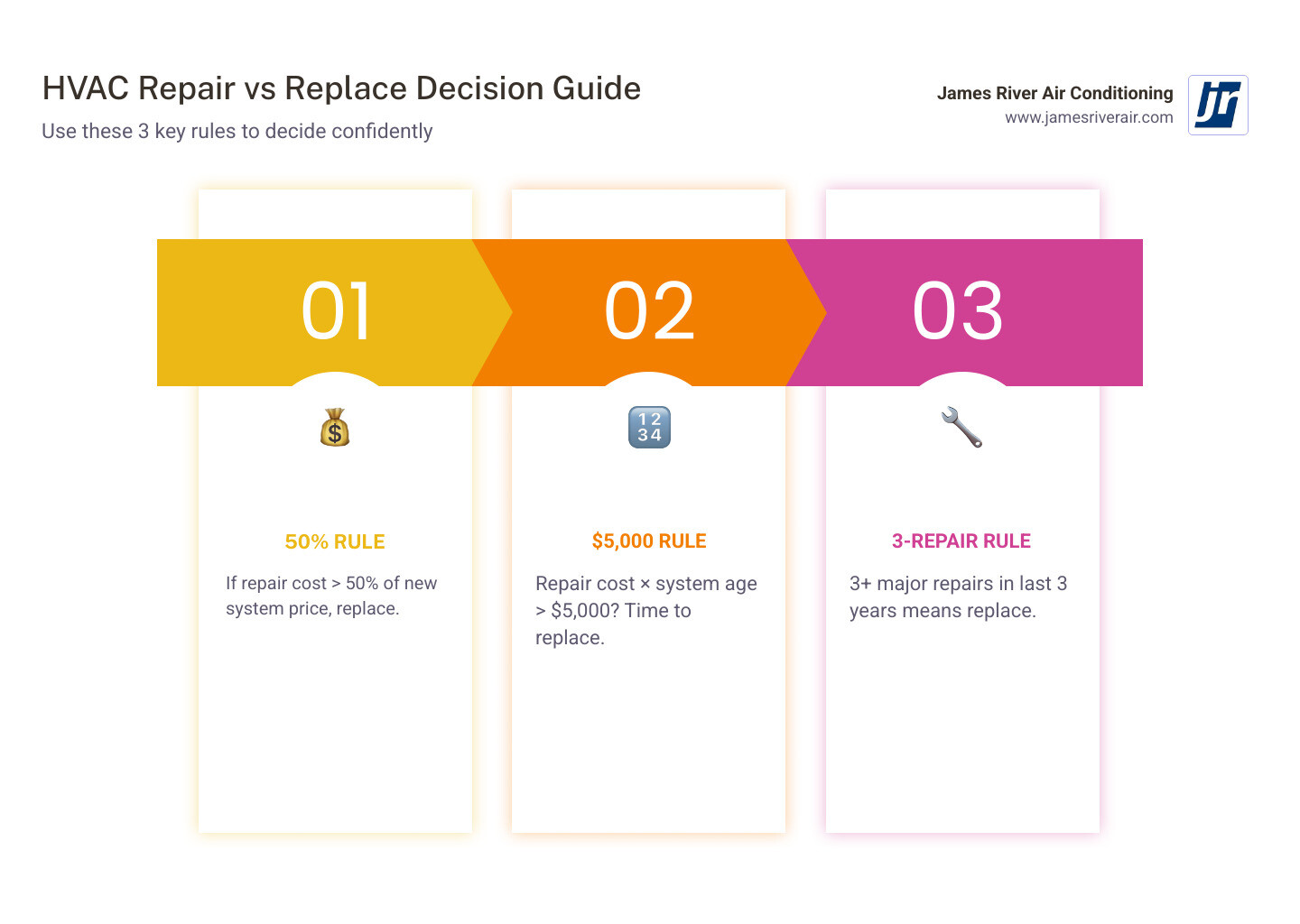
- The repair cost is less than 50% of the cost of a new system
- You’ve had fewer than 3 repairs in the past 3 years
- The system still heats and cools your home evenly
- The repair involves a minor component (capacitor, thermostat, contactor)
Replace your HVAC system if:
- The system is over 10-15 years old and needs a major repair
- Repair cost multiplied by system age exceeds $5,000 (the $5,000 rule)
- You’ve had 3 or more repairs in the last 3 years
- Your system uses R-22 refrigerant (phased out and increasingly costly)
- A core component has failed — compressor, heat exchanger, or evaporator coil
- Energy bills keep climbing despite no change in usage
The honest answer? Most homeowners end up repairing too long or replacing too soon. Neither is ideal. The right call depends on your system’s age, repair history, efficiency, and how long you plan to stay in your home. The sections below walk through each factor clearly so you can make a confident, informed decision.
Key Indicators: Should I Repair or Replace My HVAC System?

When we visit homes in Henrico or Midlothian, we often find that the question of should i repair or replace my hvac system isn’t about a single broken part; it’s about the overall health of the equipment. Think of your HVAC system like a car. A flat tire (a blown capacitor) is worth fixing regardless of the car’s age. But a blown engine in a 15-year-old sedan? That’s a different story.
System Age
Age is the most significant risk factor. In the Richmond climate, central air conditioners and heat pumps typically last 15 to 20 years, while gas furnaces can last 15 to 25 years. However, Energy.gov suggests that once a heat pump or AC passes the 10-year mark, or a furnace passes 15 years, you should start weighing the Benefits Of Regular Hvac Maintenance against the reality of declining performance.
Repair Frequency
Is your HVAC company on speed dial? If you have needed three or more repairs in the last three years, your system is likely in a “repair spiral.” This is where components begin to fail in a domino effect. While each individual fix might seem manageable, the cumulative cost often approaches the price of a new, reliable unit.
Performance Decline and Red Flags
Sometimes a system “works” but fails to provide comfort. If you notice these signs, replacement is often the more logical path:
- Uneven Temperatures: Some rooms are freezing while others are sweltering.
- Loud Noises: Grinding, squealing, or banging sounds often indicate serious mechanical failure.
- High Energy Bills: An unexplained spike in your utility bill usually means the system is working twice as hard to achieve the same results.
- Excessive Dust or Humidity: If your home feels clammy in the summer despite the AC running, the system has lost its ability to dehumidify effectively.
Major Component Failures: Should I Repair or Replace My HVAC System Now?
There are certain “catastrophic” failures where we almost always recommend replacement, especially if the warranty has expired. These components are the heart of your system, and replacing them is labor-intensive and expensive.
- Compressor Failure: As the “heart” of the AC or heat pump, a failed compressor in a unit older than 10 years is rarely worth fixing. The new compressor must be compatible with the old refrigerant and internal components, which often lead to further issues.
- Cracked Heat Exchanger: This is a major safety risk. A crack can allow carbon monoxide to leak into your home’s air supply. Because of the lethal nature of this failure, we generally recommend an immediate furnace replacement.
- Evaporator Coil Leaks: On older systems, these coils are often corroded. Replacing just the coil is a significant investment that doesn’t address the age of the rest of the unit.
For these major issues, our Jrac/Residential Services Jrac/Residential Hvac Service team can provide a full diagnostic to see if a repair is even a viable long-term option.
The R-22 Phase-Out: Should I Repair or Replace My HVAC System with Modern Refrigerant?
If your system was installed before 2010, there is a high chance it uses R-22 refrigerant (often called Freon). Because R-22 is an ozone-depleting substance, its production and import were banned in the U.S. in 2020.
Today, in April 2026, R-22 is extremely scarce and expensive. A simple refrigerant recharge for an old R-22 system can cost a significant portion of a new system’s price. If your technician identifies a leak in an R-22 unit, it is a massive red flag. Transitioning to a modern R-410A or R-454B system is not just an environmental choice; it’s a financial necessity to avoid the “money pit” of obsolete technology. Understanding these shifts is part of Your Guide To Hvac Home Comfort Terms that every homeowner should know.
Financial Decision Frameworks for Virginia Homeowners
To take the guesswork out of the decision, we use two industry-standard “rules of thumb” that help our neighbors in Chesterfield and Glen Allen make the right call.
The $5,000 Rule
This is a simple mathematical formula: Multiply the age of your system by the repair estimate.
- If the result is over $5,000, you should likely replace the unit.
- If the result is under $5,000, a repair is generally a safe investment.
Example: A 12-year-old AC needs a $500 repair. 12 x 500 = $6,000. Under this rule, replacement is the better move.
The 50% Rule
If the cost of a single repair exceeds 50% of the value of a brand-new system, replacement is the smarter financial move. Why spend half the money on a system with no warranty and an uncertain future when you could put that toward a brand-new unit with a 10-year parts warranty? You can learn more about these variables in our guide to Hvac Replacement Cost 2.
| Factor | Repair Often Wins | Replacement Often Wins |
|---|---|---|
| System Age | Under 10 Years | Over 15 Years |
| Repair Cost | < 30% of New System | > 50% of New System |
| Refrigerant | Modern (R-410A) | Obsolete (R-22) |
| Reliability | First repair in years | 3+ repairs in 3 years |
| Comfort | Home is comfortable | Constant hot/cold spots |
Efficiency Standards and Monthly Savings
One of the biggest arguments for replacement is the Return on Investment (ROI) through energy savings. Since 2023, the minimum efficiency standards for new air conditioners in the Southeast (including Virginia) have increased to 15 SEER (or 14.3 SEER2).
If you are upgrading from an old 10 SEER unit to a modern 16 or 18 SEER2 system, you could reduce your cooling energy consumption by 35% to 44%. Over the 15-year life of the system, these savings can actually pay back a large portion of the initial installation cost. For those looking to lower their bills right now, check out our High Energy Bill Tips and these 5 Tips To Show Your Hvac System Love.
Incentives and Modern Technology Upgrades
As of April 2026, there are more financial incentives than ever to choose a high-efficiency replacement. The Inflation Reduction Act provides significant tax credits (up to $2,000 for heat pumps) and rebates for homeowners who upgrade to ENERGY STAR certified equipment.
Furthermore, you aren’t limited to a standard central air unit. Many Richmond homeowners are asking: Is A Mini Split Better Than Central Air For Your Home? Ductless mini-splits offer incredible zoning control and efficiency. When you ask, Will A Mini Split Save You More Money Than Central Air, the answer often depends on your home’s layout and how much you use specific rooms. Plus, modern systems integrate seamlessly with smart thermostats, allowing you to manage your comfort from your phone while you’re away at a Richmond Flying Squirrels game.
Strategic Considerations for Long-Term Comfort
Beyond the math, there are personal factors to consider. If you plan on living in your home in Midlothian or Short Pump for the next 10 to 20 years, a new system provides peace of mind that repairs cannot buy. However, if you are planning to move in the next 12 to 24 months, a repair might be the more practical choice unless the system is completely non-functional, which could hurt your home’s resale value.
Indoor Air Quality and Humidity
Modern HVAC systems are significantly better at controlling indoor air quality. If someone in your family suffers from allergies or asthma, a new system with advanced filtration and variable-speed blowers can make a world of difference. Additionally, Virginia’s humidity is legendary. Older systems often struggle to pull moisture out of the air, leading to a “sticky” feeling indoors. A new, properly sized system will maintain a crisp, dry environment even in the dead of August.
Climate Impact on System Lifespan
Our local climate in Central Virginia is demanding. We experience “shoulder seasons” that are short, meaning our systems transition quickly from heavy heating to heavy cooling. This constant cycling puts more wear and tear on components than in milder climates.
The accumulative runtime of a Richmond HVAC system is high. This is why a professional diagnosis is so vital. A technician can tell you if your ductwork is sized correctly for a new high-efficiency unit. If your ducts are leaky or undersized, even the most expensive new AC won’t perform correctly. This is where our Jrac/Residential Services Jrac/Residential Preventive Maintenance program helps catch these issues before they turn into expensive surprises.
Frequently Asked Questions about HVAC Decisions
How long do AC units and furnaces typically last in Richmond?
In the Richmond area, air conditioners and heat pumps generally last 15 to 20 years. Gas furnaces can last slightly longer, typically 15 to 25 years. However, the high humidity and variable temperatures in Virginia can shorten this lifespan if the system isn’t maintained annually.
Are there federal tax credits for HVAC replacement in April 2026?
Yes! Under the Inflation Reduction Act, homeowners can claim a tax credit of 30% of the project cost, up to $2,000 annually, for high-efficiency heat pumps. There are also credits available for high-efficiency central AC units and furnaces, as well as potential state-level rebates based on household income.
Should I replace my system if I plan to sell my home soon?
If the system is working well, a repair is usually sufficient. However, if the system is over 15 years old or uses R-22 refrigerant, it may come up as a major “red flag” during a home inspection. In a competitive market like Richmond, having a brand-new, energy-efficient HVAC system with a transferable warranty can be a significant selling point that justifies a higher asking price.
Conclusion
Deciding should i repair or replace my hvac system doesn’t have to be a guessing game. At James River Air Conditioning, we’ve spent over 57 years helping our neighbors across Richmond, Midlothian, and Henrico navigate these exact crossroads. Our goal isn’t just to sell you a new unit; it’s to provide the world-class service and honest advice that has made us a trusted name in Virginia since 1967.
Whether you need a quick fix to get through the week or a comprehensive consultation on a new high-efficiency system, we approach every job with an entrepreneurial spirit and a commitment to your long-term comfort. If you’re still unsure which path is right for you, check out our HVAC Replacement Guide or give us a call. We’re here to help you find the most cost-effective and comfortable solution for your home.
