
Why Your Summer Utility Bills Are Higher Than They Need to Be
Understanding how high efficiency systems reduce summer costs starts with one uncomfortable fact: air conditioning accounts for anywhere from 40% to 70% of your total summer electricity bill. If you’re running an older, low-efficiency unit, a significant chunk of that spend is pure waste.
Here’s a quick breakdown of how high-efficiency AC systems cut summer costs:
| Mechanism | How It Saves Money |
|---|---|
| Higher SEER rating | Uses less electricity to deliver the same cooling output |
| Variable-speed compressor | Avoids energy-hungry start-up cycles and runs at lower power |
| Better dehumidification | Lets you set the thermostat higher while staying comfortable |
| Fewer on/off cycles | Reduces mechanical wear and peak power draws |
| Smart thermostat integration | Eliminates cooling an empty home |
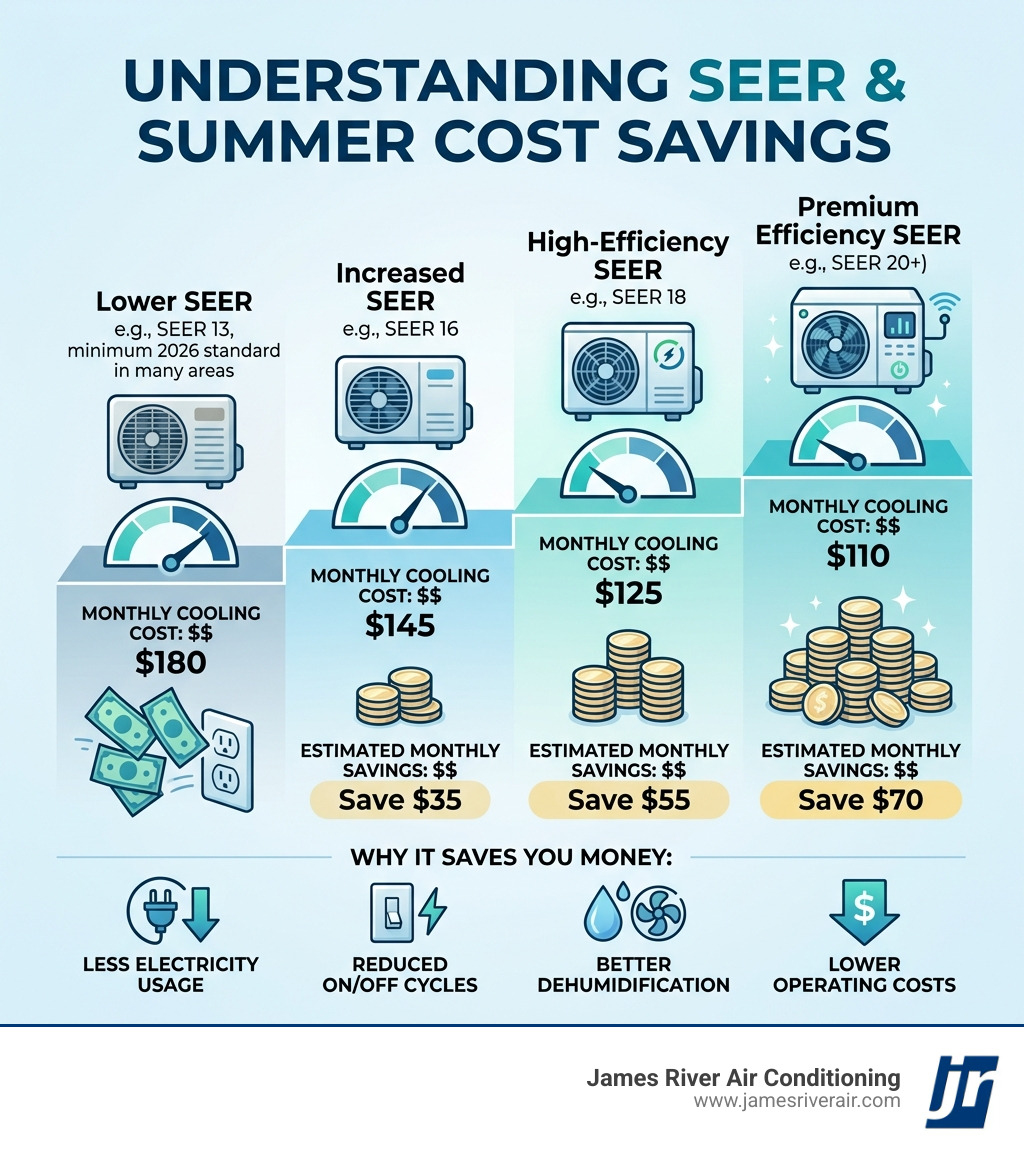
For Richmond homeowners, this isn’t just a theoretical conversation. Summer humidity here makes an already hard-working AC work even harder. An aging SEER 10 unit running through a Mid-Atlantic July isn’t just uncomfortable — it’s expensive. Switching to a modern high-efficiency system (SEER 16 or higher) can cut your cooling costs by 30% or more, with some households seeing reductions closer to 44%.
The good news is that getting there doesn’t require one dramatic move. It’s a combination of the right equipment, proper installation, smart habits, and regular maintenance — all of which we’ll walk you through below.
Understanding the Mechanics: How High Efficiency Systems Reduce Summer Costs
When we talk about how high efficiency systems reduce summer costs, the first term you’ll encounter is SEER2. Standing for Seasonal Energy Efficiency Ratio 2, this is essentially the “miles per gallon” for your air conditioner. As of 2026, the Department of Energy (DOE) has raised the bar for what qualifies as an energy-efficient unit.
In our region, including Henrico, Midlothian, and Chesterfield, the minimum standards have shifted to ensure homeowners aren’t stuck with energy-guzzlers. A system with a high SEER2 rating isn’t just a badge of honor; it represents a tangible reduction in the electrical input required to achieve a specific cooling output.
During an AC Performance Extreme Heatwave Richmond, a standard unit might struggle to keep up, running constantly and drawing massive amounts of power. High-efficiency systems, conversely, are engineered to meet these benchmarks with far less strain on the grid—and your wallet.
How High Efficiency Systems Reduce Summer Costs via Variable-Speed Tech
The secret sauce in many modern units is inverter technology, or variable-speed compressors. Traditional air conditioners are either “on” or “off.” Think of it like driving a car where you can only floor the gas or hit the brakes. Every time a standard unit kicks on, it requires a massive “start-up wattage”—sometimes up to 6,000 watts—before settling into a “running wattage” of about 2,500 watts.
High-efficiency systems act more like a car on cruise control. Instead of the energy-hungry cycle of stopping and starting 10 to 12 times a day, a variable-speed system might only cycle 3 to 8 times. It ramps up slowly and maintains a steady, low-power flow. This eliminates those expensive power surges and reduces the overall wattage consumed throughout the day. By matching its output precisely to your home’s cooling demand, the system avoids the “all-or-nothing” waste of older technology.
Superior Dehumidification for Mid-Atlantic Comfort
In places like Glen Allen and Tuckahoe, it’s often not the heat that gets you—it’s the humidity. Standard AC units often shut off once the temperature goal is met, leaving “latent heat” (moisture) hanging in the air. This is why you might feel clammy even when the thermostat says 72°F.
High-efficiency systems are masters of moisture removal. Because they run for longer, lower-power intervals, they have more time to pull humidity out of the air. When the humidity is lower, you can actually set your thermostat a few degrees higher—say, 75°F instead of 72°F—and feel just as comfortable. Since every degree you raise the thermostat can save you 10% to 15% on energy use, this superior dehumidification is a primary way how high efficiency systems reduce summer costs.
Calculating Your Return: The Real-World Savings of Modern HVAC
Is the upgrade worth it? Let’s look at the math. If you are switching from an old SEER 10 unit (common in many older homes in Mechanicsville or Petersburg) to a SEER 18 model, you are looking at a minimum of 30% savings on your monthly cooling bill. In some larger homes, that reduction can hit 44%.
We often see High Energy Bill Tips that focus on small habits, but the equipment itself is the heavy lifter. Over a five-year analysis, a homeowner in a 2,000-square-foot home could save roughly $80 per month during the cooling season. Over half a decade, that’s thousands of dollars that stay in your bank account rather than going to the utility company.
Reducing the Cooling Share of Your Utility Bill
As we mentioned, cooling is the lion’s share of your summer electricity bill. By upgrading to a system with a SEER rating of 16 or higher, you can significantly drop the “AC share” of your bill. While a standard unit might account for 70% of your costs in July, a high-efficiency unit might bring that down to 40% or 50%. This wattage reduction is the most direct path to lower bills. It’s not just about using the AC less; it’s about the AC using less power when it’s on.
Environmental Impact and Carbon Footprint
In May 2026, we are more conscious than ever about our environmental footprint. High-efficiency systems now utilize lower-GWP (Global Warming Potential) refrigerants that are much safer for the atmosphere. By reducing energy consumption, you’re also lowering CO2 emissions. Upgrading from a SEER 10 to a SEER 18 unit can eliminate between 1.5 to 3 tons of CO2 emissions per year. It’s a win for your budget and a win for the Virginia landscape we all love.
Maximizing Performance: How High Efficiency Systems Reduce Summer Costs Through Proper Installation
You could buy the most efficient air conditioner on the planet, but if it’s installed poorly, you won’t see those savings. Proper installation is the bridge between a laboratory rating and real-world performance.
At James River Air Conditioning, we emphasize the “Manual J” load calculation. This isn’t just a guess based on square footage. We look at your window orientation, insulation levels, and even local Richmond tree shade to determine the exact cooling load of your home. Following The Ultimate HVAC Maintenance Checklist for Mid-Atlantic Homeowners starts with getting the installation right on day one.
How High Efficiency Systems Reduce Summer Costs with Precise Sizing
We call it the “Goldilocks Problem.” If a system is too small, it runs forever and never cools the house. If it’s too large, it “short-cycles,” turning on and off rapidly. Short-cycling is an efficiency killer because, as we learned, the start-up phase uses the most electricity.
Furthermore, we must ensure your duct integrity is up to par. In many homes in Chester or Powhatan, leaky ducts can waste 20% to 30% of conditioned air before it ever reaches your living room. A high-efficiency unit needs a sealed, optimized duct system to deliver the savings it promises.
Why April is the Strategic Month for Upgrades
While we are currently in May 2026, we always advise homeowners that April is the “sweet spot” for upgrades. Beating the summer rush means you get the best installation quality without the pressure of a heatwave. It also allows for thorough system testing and gives you access to the best manufacturer promotions and seasonal rebates before the peak demand hits. If you missed the April window, don’t worry—getting an upgrade now in May still saves you from the brutal costs of July and August.
Sustaining Efficiency with Proactive System Care
Once your system is in place, you have to show it some love to keep those savings coming. We’ve shared 5 Tips to Show Your HVAC System Love before, and they remain the foundation of low utility bills. There are significant Benefits of Regular HVAC Maintenance that go beyond just preventing breakdowns; maintenance is what keeps your SEER rating from dropping over time.
The Critical Role of Airflow and Filtration
The simplest thing you can do? Change your air filter. A clogged filter forces your high-efficiency motor to work twice as hard to pull air through. Clearing a dirty filter can save you 5% to 15% on energy use instantly.
Outside, your condenser unit needs to breathe. Make sure there is at least a 2-foot clearance around the unit. Plants, tall grass, or debris from a Richmond storm can block airflow, causing the system to overheat and consume more power. Shading the unit with plants can actually make it 10% more efficient, provided they aren’t crowding the coils.
Why Professional Tune-Ups are Non-Negotiable
There are things a homeowner just can’t see, like refrigerant levels or capacitor health. Low refrigerant makes a system run longer to achieve the same cooling, while a failing capacitor can cause those expensive power surges.
This is Why Your AC Wants You to Sign a Maintenance Contract. A professional technician can clear out condensate drains—crucial in our humid climate to prevent water damage—and ensure every electrical connection is tight. A well-maintained high-efficiency system can last 15 to 20 years, maximizing your return on investment.
Amplifying Savings with Smart Home Strategies
A high-efficiency system is the engine, but smart home technology is the driver. You can amplify how high efficiency systems reduce summer costs by using complementary strategies that take the load off your HVAC.
Smart Thermostats and Behavioral Automation
A smart thermostat is one of the best partners for a high-efficiency AC. Features like geofencing can detect when you’ve left your home in Midlothian for work and automatically raise the temperature. When you’re 10 miles from home, it begins cooling things down gradually. This avoids the “panic cooling” that happens when you return to a 80-degree house and crank the AC down to 68. These adjustments can tack on an extra 10% to 15% in annual savings.
Passive Cooling and Home Envelope Improvements
Don’t make your AC do all the work!
- Ceiling Fans: Using a fan creates a wind-chill effect on your skin. This allows you to set the thermostat 4 degrees higher without losing comfort, potentially saving up to 40% on your cooling electricity.
- Window Coverings: In the heat of a Richmond afternoon, cellular shades can reduce solar heat gain by up to 80%.
- Insulation: Upgrading attic insulation is like putting a thermos around your house. It keeps the cool air in and the Virginia heat out, which can reduce cooling costs by another 40%.
Frequently Asked Questions about Summer Cooling Costs
What is the minimum SEER rating I should look for in 2026?
In 2026, you should look for a minimum of SEER2 14.3 (which is roughly equivalent to the old SEER 15). However, for true “high efficiency” and noticeable savings in our humid climate, we recommend aiming for SEER 16 or higher.
How much can I realistically save by upgrading an old SEER 10 unit?
Homeowners typically see a 30% reduction in cooling costs immediately. Over five years, this can add up to thousands of dollars in savings, often paying for a significant portion of the system’s cost.
Do high-efficiency systems really help with Richmond’s humidity?
Yes! Because high-efficiency systems use variable-speed technology, they run for longer, slower cycles. This allows them to pull significantly more moisture out of the air than older “on/off” units, making your home feel much more comfortable at higher temperatures.
Conclusion
At James River Air Conditioning, we’ve spent over 57 years helping our neighbors in Richmond, Ashland, and beyond stay comfortable without breaking the bank. Our entrepreneurial spirit drives us to stay on top of the latest 2026 standards, ensuring we provide world-class service that actually moves the needle on your utility bills.
Stop burning cash this summer. By choosing a high-efficiency system and following these High Energy Bill Tips, you can enjoy a cool, crisp home while keeping your hard-earned money where it belongs. Whether you’re in Sandston, Short Pump, or Chesterfield, we’re here to help you make the switch to a smarter, more efficient way to stay cool.
