
Does New HVAC Help Sell Your Home Faster?
Why Your HVAC System Matters More Than You Think When Selling
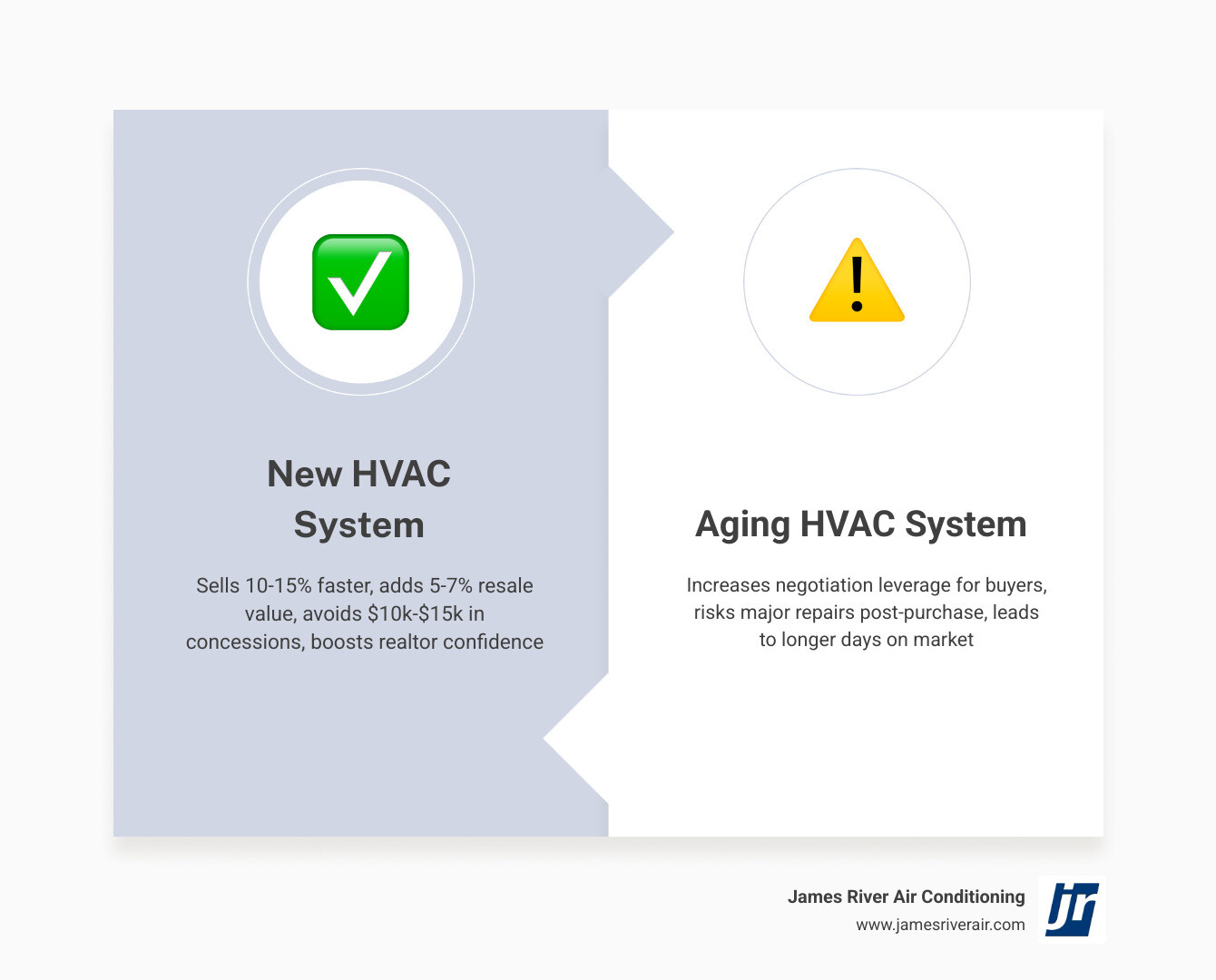
Does a new HVAC help sell your home faster? Yes — and the data backs it up. Homes with newer, efficient heating and cooling systems tend to sell 10 to 11 days faster than comparable homes with aging systems, and 89% of real estate agents say an efficient HVAC system can speed up a sale and increase offers by 2% to 5%.
Here’s a quick look at what the research shows:
| Factor | Impact of New HVAC |
|---|---|
| Days on market | Sells 10–15% faster |
| Resale value boost | Adds 5%–7% on average |
| Buyer concessions avoided | Up to $10,000–$15,000 |
| Realtor confidence | 89% say it speeds up sales |
| Cost recovery at resale | Up to 85% of installation cost |
When buyers walk through a home, they notice more than fresh paint. A working, efficient HVAC system tells them the home has been cared for — and removes one of the biggest fears buyers have: a major repair bill shortly after closing. An old or failing system, on the other hand, gives buyers leverage to ask for price reductions or walk away entirely.
In a competitive market like Richmond, VA, that difference can be the gap between a quick sale and weeks of price negotiations.
Does a New HVAC Help Sell Your Home Faster in the Richmond Market?
In the Central Virginia region—from the historic streets of Richmond to the growing suburbs of Midlothian and Short Pump—the real estate market remains highly discerning. While a renovated kitchen is a “show pony” that catches the eye, the HVAC system is the “workhorse” that makes the home livable.
When we look at marketability, the impact is clear. Does a new hvac help sell your home faster in our local climate? Statistics suggest that homes featuring updated mechanical systems sell approximately 10 to 11 days faster than those with units nearing the end of their lifespan. In a market where buyers are often stretching their budgets to cover down payments and closing costs, the prospect of inheriting a 15-year-old furnace is a major deterrent.

A new system acts as a shield against “post-purchase anxiety.” It signals to potential buyers in Henrico or Chesterfield that the property has been meticulously maintained. When a buyer sees a brand-new outdoor condenser or a spotless air handler, they aren’t just seeing a machine; they are seeing a home that won’t require a midnight emergency repair call in the middle of a humid July. This confidence often translates into stronger initial offers and a smoother path to the closing table. For more insights on how these upgrades impact your bottom line, explore Heating Up Your Resale Price With a New HVAC.
Why Modern Buyers Prioritize Energy Efficiency
As we move through 2026, buyer behavior has shifted significantly. Today’s house hunters are often more concerned with monthly utility bills than they are with the color of the granite countertops. They are looking for high SEER2 (Seasonal Energy Efficiency Ratio) ratings, which are the industry standard for measuring cooling efficiency.
A move-in-ready home in Glen Allen or Mechanicsville is expected to be efficient. Modern systems can reduce monthly energy consumption by 20% to 40% compared to units from just a decade ago. For a buyer, this represents a tangible “dividend” they receive every month in the form of lower electricity and gas bills.
Furthermore, having a system that is properly sized for the square footage of the home is critical. An oversized unit will short-cycle and leave the air humid, while an undersized unit will run constantly and wear out prematurely. To understand how to get this balance right, check out The Central Virginia Homeowner Guide to Getting the Right Size HVAC.
How a New HVAC Helps Sell Your Home Faster by Reducing Negotiations
One of the most stressful parts of selling a home in Virginia is the inspection period. This is where many deals fall apart or where “nickel-and-diming” begins. If an inspector flags an HVAC system that uses outdated R-22 refrigerant—which has been phased out and is incredibly expensive to service—the buyer will likely demand a massive seller concession.
By replacing the system before you list, you flip the narrative. Instead of a $10,000 liability, you have a featured selling point. You are “future-proofing” the home against upcoming environmental mandates, such as the transition to eco-friendly R-454B refrigerants. This proactive approach eliminates the buyer’s leverage to ask for price reductions. They can’t ask for $10,000 off for an old AC if the AC is brand new. This provides you, the seller, with immense peace of mind throughout the negotiation process.
Impact on Appraised Value vs. Buyer Appeal
It is important to distinguish between appraised value and marketability. While they are related, they aren’t the same thing. An appraiser looks at the “effective age” of your home’s systems. If your home is 30 years old but has a brand-new roof and a new HVAC system, its effective age is much lower, which can lead to a higher appraised value—often adding $2,000 to $5,000 or more in “contributory value.”
However, the “buyer appeal” impact is often much larger than the appraisal adjustment. A buyer might be willing to pay $15,000 more for a home with a new HVAC system because they are factoring in the cost, the hassle, and the risk of a failure.
| Buyer Perception: Old vs. New Systems | |
|---|---|
| Old System (12+ Years) | New System (0-3 Years) |
| Viewed as a looming “tax” or future debt. | Viewed as a premium “turn-key” feature. |
| Leads to low-ball offers to “cover the risk.” | Justifies a full-price or over-asking offer. |
| Causes anxiety during the home inspection. | Passes inspection with flying colors; builds trust. |
| Higher monthly utility costs for the buyer. | Lower utility costs; energy-efficient living. |
Does a New HVAC Help Sell Your Home Faster When Paired with Smart Tech?
In 2026, a “new HVAC” often means more than just the mechanical unit. It includes the entire ecosystem of home comfort. Modern buyers in areas like Short Pump and Tuckahoe love smart home integration. Features like smart thermostats (e.g., Nest or Ecobee) with geofencing—which adjusts the temperature based on your phone’s location—are high-demand items.
Zoned cooling, which allows for different temperatures on different floors, is another major selling point, especially in the multi-story homes common in Midlothian and Moseley. When you combine these features with Energy Star certification and transferable warranties, you create a package that is incredibly difficult for buyers to pass up. A transferable warranty, in particular, is a powerful closing tool, as it guarantees the buyer won’t pay for repairs for years to come.
Deciding Between Repair and Replacement Before Listing
We often hear from homeowners in Petersburg or Powhatan who are unsure whether to invest in a full replacement or just patch up their current unit. As a general rule, we suggest the “15-year rule.” If your system is over 15 years old, it is nearing the end of its reliable lifespan. Even if it is currently “working,” its efficiency is likely poor, and its components are prone to failure.
Performance gaps are another red flag. If the second floor of your home is consistently 10 degrees warmer than the first, buyers will notice this during the walkthrough. They will hear the “haunted house” groans of an old blower motor and see it as a sign of neglect.
To help you navigate this choice, we’ve put together two essential resources: The HVAC Crossroads: How to Decide Between Repair and Replacement and Should I Repair or Replace My Furnace or AC Right Now?.
Signs Your Current System Will Slow Down Your Sale
If you decide not to replace the system, you must at least ensure it is in top-notch condition. Nothing kills a sale faster than a dirty air filter or a rusted condensate pan. Buyers look for signs of “pride of ownership.”
- Strange Noises: Squealing, banging, or rattling suggests mechanical failure.
- Uneven Cooling: Hot and cold spots indicate ductwork issues or an aging compressor.
- High Utility Bills: If your bills are significantly higher than comparable homes, buyers will notice.
- Lack of Records: If you can’t produce a folder of maintenance receipts, buyers will assume the system has been ignored.
Maximizing Your Return with Modern Features and Incentives
If you do choose to replace, consider the “Gold Standard” for 2026: the high-efficiency heat pump. Heat pumps have surged in popularity across Central Virginia because they provide both heating and cooling with incredible efficiency. They are especially attractive to eco-conscious buyers.
Dual-fuel systems—which combine an electric heat pump with a gas furnace backup—are also highly valued in our region, providing the best of both worlds during our occasional Richmond cold snaps.
Don’t forget to highlight the financial incentives available in 2026:
- Federal Tax Credits: Many high-efficiency systems qualify for significant federal tax credits (sometimes up to 30% of the cost).
- Local Utility Rebates: Many local power and gas companies offer rebates for installing Energy Star-certified equipment.
- Transferable Warranties: As mentioned, these are a massive “trust builder” for buyers.
- Smart Home Compatibility: Ensure the system works with major smart home hubs.
Frequently Asked Questions about HVAC and Home Resale
What is the typical ROI for a new HVAC system when selling?
While you may not always see a dollar-for-dollar return (100%), homeowners typically recover between 60% and 85% of the installation cost directly through the higher sale price. However, when you factor in the “avoided loss”—meaning the $10,000 credit you didn’t have to give the buyer for a broken system—the total ROI often exceeds 100%.
Do appraisers give full credit for a new heating and cooling system?
Appraisers generally use “contributory value.” While they might not add the exact invoice price of the HVAC to the home’s value, they adjust the “effective age” of the home and compare it to other houses with older systems. This usually results in a valuation increase of several thousand dollars.
Are there specific tax credits available for HVAC upgrades in 2026?
Yes! Under current federal guidelines, high-efficiency heat pumps and certain Energy Star-certified central air units qualify for tax credits. These credits can help offset the initial investment, making the upgrade even more financially sound for a seller.
Conclusion
At James River Air Conditioning, we have spent over 57 years serving the Richmond community, from Ashland down to Colonial Heights and everywhere in between. We understand the local real estate market and the unique demands our Virginia climate puts on your home’s mechanical systems.
Our entrepreneurial spirit drives us to provide not just a service, but a strategy to help you maximize your home’s value. Whether you are in Henrico, Midlothian, or Sandston, we are your trusted local partner for ensuring your home is market-ready.
Don’t let an aging HVAC system be the reason your home sits on the market or sells for less than it’s worth. For more tips on choosing a partner you can rely on, read The Ultimate Guide to Choosing a Multi-Trade Company You Can Trust.
Ready to give your home the competitive edge it deserves? Schedule your professional HVAC evaluation today and let us help you cross the finish line with a “Sold” sign in your yard.
