

What “High SEER AC vs Standard SEER in Mid-Atlantic Four Season” Really Means
#
When comparing high SEER AC vs standard SEER in Mid-Atlantic four season climates, the short answer is: a high SEER system can save energy and improve comfort — but only if your home and installation support it. Here’s a quick breakdown:
| Factor | Standard SEER (14) | High SEER (18+) |
|---|---|---|
| Federal minimum (Northern region) | Yes (13.4 SEER2) | Above minimum |
| Best for | Tighter budgets, shorter ownership | Long-term savings, comfort-focused |
| Humidity control | Basic | Better (especially with two-stage/variable-speed) |
| Real-world efficiency gap | Smaller | Larger if home is leaky or fan runs constantly |
| Ideal home type | Any | Tight, well-insulated, properly sized |
If you own a home in Virginia, Maryland, or the D.C. area, the choice between standard and high SEER is not just about the number on the label. The Mid-Atlantic’s hot, humid summers and cold winters create real challenges that affect how much efficiency you actually get from your system.
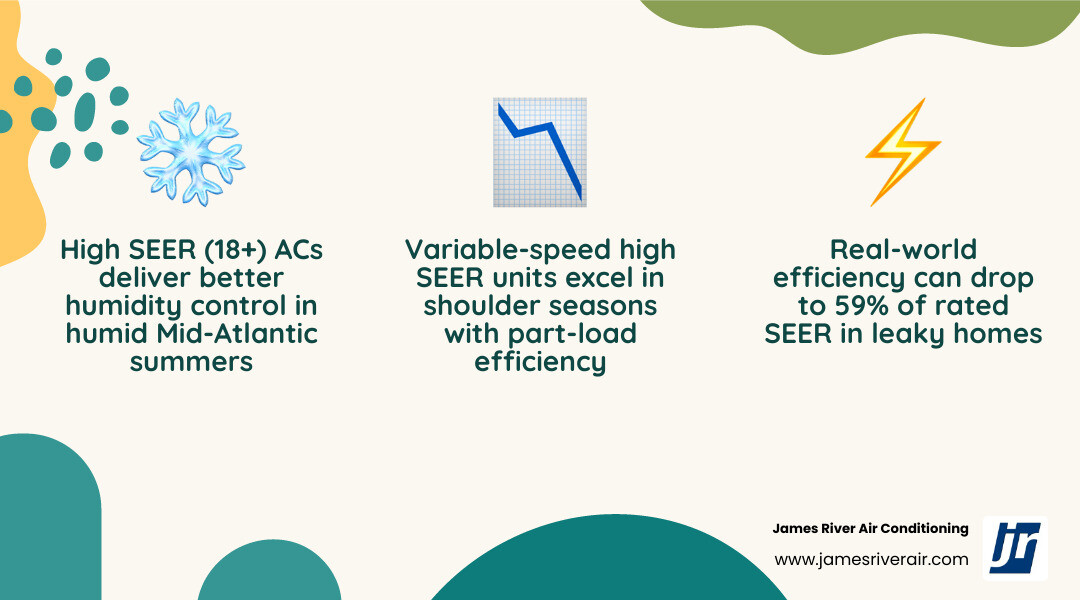
Research monitoring homes in DOE Climate Zones 4 and 5 — which cover much of the Mid-Atlantic — found that real-world seasonal efficiency can fall as low as 59% of a unit’s rated SEER. That gap matters when you’re deciding how much to invest in a new system.
This guide walks you through what SEER means, how high and standard SEER units actually perform in this region, and what factors determine whether upgrading makes sense for your home.
SEER stands for Seasonal Energy Efficiency Ratio. In simple terms, it tells us how much cooling an air conditioner delivers over a typical season compared with how much electricity it uses.
For homeowners in Richmond and the surrounding Virginia communities we serve, the phrase high seer ac vs standard seer in mid atlantic four season is really about one question: how much efficiency will you actually feel and see in a humid summer, a mild spring, and a shoulder season where the system rarely runs at full blast?
A few key 2026 benchmarks help:
- Standard efficiency for new central AC systems starts around the current federal minimum.
- In the Northern region, that minimum is 14 SEER or 13.4 SEER2 for new systems.
- High-efficiency central AC systems generally start around 18 SEER.
- Very high-efficiency models can reach 20+ SEER, often using variable-speed technology.
What Is SEER and How Is It Calculated?
SEER is calculated by dividing total seasonal cooling output in BTUs by total electrical energy used in watt-hours.
The basic formula looks like this:
- SEER = seasonal cooling output (BTUs) / seasonal electricity use (Wh)
Higher numbers mean better efficiency. If one unit has a higher SEER than another, it should use less electricity to provide the same amount of cooling under standardized test conditions.
It helps to know one related term too:
- EER measures efficiency at a fixed outdoor condition, typically a hot design day.
- SEER measures performance over a range of temperatures across a cooling season.
- EER2 and SEER2 are updated versions based on newer testing procedures.
So if SEER is the seasonal report card, EER is more like the pop quiz on a very hot afternoon.
What Counts as Standard SEER vs High SEER in 2026?
In today’s market, we generally look at systems this way:
- Standard SEER: around 14 SEER, which aligns with the federal minimum for many new installs
- Mid-range efficiency: roughly 15 to 17 SEER
- High SEER: 18+ SEER
- Premium high efficiency: 20+ SEER
The jump from standard to high efficiency usually comes from better equipment design, such as:
- Two-stage compressors
- Variable-speed compressors
- ECM blower motors
- Better humidity management controls
- More precise airflow and refrigerant control
A basic 14 SEER system can still be a solid choice. A high SEER system is not automatically “better” for every home. It is better when the home, duct system, controls, and installation are all working together.
Why SEER2 Matters More for New Mid-Atlantic Installs
SEER2 is the newer rating standard used for current equipment. It uses updated testing with higher external static pressure, which better reflects how systems operate in actual homes with real ductwork.
That matters because old SEER ratings were often a little too optimistic. Research suggests SEER2 numbers are typically lower than old SEER numbers for the same equipment because the test is tougher, not because the equipment suddenly got worse.
A few practical takeaways:
- Compare SEER to SEER and SEER2 to SEER2, not one to the other.
- Make sure the outdoor unit and indoor air handler or coil are a matched system.
- A mismatched setup can keep a system from reaching its rated efficiency.
How High SEER ACs Perform in a Mid-Atlantic Four-Season Climate
Virginia’s climate is a classic mixed-humid challenge. We deal with hot summers, sticky humidity, spring and fall shoulder seasons, and winters that still matter for total comfort planning.
That climate puts extra value on systems that perform well at part-load conditions, not just on the hottest day of the year.

High SEER AC vs Standard SEER in Mid-Atlantic Four Season Homes
In many Mid-Atlantic homes, high SEER systems can improve more than utility efficiency alone. They often help with:
- More even temperatures from room to room
- Longer, gentler cooling cycles
- Better humidity control
- Quieter operation
- Less temperature swing
This is especially useful during mild but muggy weather, which Virginia seems to specialize in. On those not-quite-hot days, a standard single-stage system may cool quickly and shut off before pulling enough moisture from the air. A higher-efficiency two-stage or variable-speed system can often run longer at lower output, which improves comfort.
That said, standard SEER systems still cool the home. If the system is sized well and installed properly, a 14 SEER unit can perform reliably and keep indoor conditions comfortable.
Why Variable-Speed and Two-Stage Systems Fit Four-Season Living Better
Many high SEER systems earn their rating because they can operate at lower capacity for longer periods. That is useful in four-season climates where cooling demand changes constantly.
These systems often include:
- Variable-speed compressors that adjust output instead of turning fully on or off
- Two-stage compressors with low and high settings
- ECM blowers that fine-tune airflow
- Better part-load efficiency during spring, summer mornings, and evenings
Benefits can include:
- Better dehumidification
- More stable indoor temperature
- Lower noise
- Improved air circulation without excessive energy use
In other words, they are better at handling “mostly warm and definitely humid,” which describes a lot of Mid-Atlantic weather.
When a Standard SEER System Still Makes Sense
A standard SEER system may be the better fit when:
- You do not use cooling heavily
- You plan to move sooner rather than later
- Your existing ductwork or home shell needs major improvements first
- You want a simpler replacement
- The expected efficiency gap in your home is small
If a home is very leaky, poorly insulated, or has duct issues, a premium system may not deliver premium results until those underlying problems are addressed.
Why Rated SEER and Real-World Mid-Atlantic Efficiency Can Be Very Different
This is where the conversation gets interesting. And by interesting, we mean “the number on the sticker is not the whole story.”
Field research in Mid-Atlantic-type climate zones found that real-world seasonal efficiency for high-efficiency two-stage systems ranged from about 59% to 84% of rated SEER. That is a major spread.
| Factor | Effect on Real-World Efficiency |
|---|---|
| Constant fan operation | Can reduce latent removal and seasonal efficiency |
| Leaky home envelope | Increases humidity load and runtime |
| Oversized equipment | Short cycles, weaker dehumidification |
| Duct restrictions or leakage | Raises static pressure and waste |
| Poor refrigerant charge | Lowers efficiency and capacity |
| Mismatched components | Prevents rated performance |
| Dirty coils and filters | Reduces airflow and heat transfer |
high seer ac vs standard seer in mid atlantic four season: Lab Ratings vs Field Results
In monitored homes in climate zones similar to ours, systems rated around 14 to 15 SEER produced measured seasonal performance of roughly 7.92 to 11.7 BTU/Wh in the field.
That means some homes came reasonably close to the rating, while others fell far short.
The research also found:
- Low-speed operation on high-efficiency dual-stage systems often performed closer to expectations
- High-speed performance varied much more
- Some homes with “high SEER” systems still used more cooling energy per square foot than the regional average
So yes, a high SEER label matters. But the home and setup matter just as much.
How Constant Fan Operation, Leaky Homes, and Humidity Reduce Actual Efficiency
Three common issues can shrink the real benefit of a high-efficiency system.
- Constant fan operation
Running the thermostat fan in “On” mode during summer can hurt efficiency and humidity control. Why? After the compressor shuts off, the indoor coil stays wet. If the blower keeps running, some of that moisture can evaporate back into the house.
One monitored home saw efficiency drop significantly with constant fan use. In plain English: the system worked harder and felt less comfortable. Not exactly a win.
- Leaky homes
Older homes in Virginia often have attic leakage, crawl space leakage, or air infiltration around doors, windows, and penetrations. When humid outdoor air keeps sneaking in, the AC has to remove that moisture too.
Research found that in the leakiest homes, latent loads were higher than expected, and indoor relative humidity stayed above 60% for long stretches. That makes it harder for even a high SEER system to deliver its promised comfort and efficiency.
- Humidity-heavy loads
In our region, cooling is not just about dropping temperature. It is also about moisture removal. If the home has high latent load, the system may spend a lot of energy pulling out water vapor, and that does not always show up as a dramatic thermostat temperature drop.
Proper Sizing and Installation Matter More Than the Number on the Label
A well-installed 14 SEER system will often outperform a poorly installed 18 SEER system.
The biggest factors include:
- Accurate load calculation
- Proper equipment sizing
- Correct airflow setup
- Refrigerant charge verification
- Duct design and static pressure management
- Matched indoor and outdoor components
- Commissioning at startup
Oversizing is especially risky. Research cited cooling systems oversized by 50% using more energy than properly sized units. Bigger is not better in air conditioning. Bigger is often just shorter runtime, worse humidity control, and more cycling loss.
If you want a plain-English refresher on HVAC terminology, this guide to home comfort terms is a helpful place to start.
Comfort, Humidity, and Maintenance: Where High SEER Can Shine
Where high SEER systems often stand out most is comfort. Not just “the house reaches 72 degrees eventually,” but “the house feels comfortable all day.”
Does a High SEER AC Remove More Humidity in Mid-Atlantic Summers?
Often, yes, especially when the system includes two-stage or variable-speed operation.
Longer runtimes at lower capacity can improve moisture removal because:
- The indoor coil stays cold longer
- The system avoids quick on-off cycling
- Low-speed airflow can support better latent removal
- Indoor temperature stays steadier
That said, there is an important caveat: if the home is very leaky, humidity control may still be disappointing. Research in mixed-humid climates found that even high-efficiency systems struggled in homes with high infiltration.
So the honest answer is:
- High SEER can improve humidity control
- But it cannot fully overcome a house that constantly pulls in humid outdoor air
high seer ac vs standard seer in mid atlantic four season: What Older Homes Should Expect
Older homes can absolutely benefit from a higher-efficiency system, but expectations should be realistic.
If your home has:
- Significant attic air leakage
- Unsealed ductwork
- Poor insulation
- High indoor humidity
- Uneven cooling between rooms
then the best results usually come from a whole-home approach. That may include air sealing, duct improvements, thermostat setup changes, and maintenance along with equipment replacement.
In these homes, the “performance gap” is often bigger. The unit may be high efficiency on paper, but field performance depends on the building around it.
How Maintenance Protects High-Efficiency Performance
High-efficiency systems are more sensitive to airflow, charge, and setup than many older basic systems. That does not make them fragile. It just means maintenance matters.
To protect performance:
- Change filters on schedule
- Keep coils clean
- Check blower operation
- Verify refrigerant charge
- Inspect drain lines and moisture removal
- Test controls and fan settings
Regular service helps any AC, but it is especially important for advanced systems that rely on precise operation to reach their efficiency potential.
For more on this, we recommend:
- Benefits of regular HVAC maintenance
- The ultimate HVAC maintenance checklist for Mid-Atlantic homeowners
- Why your AC wants you to sign a maintenance contract
- 5 tips to show your HVAC system love
- Don’t wait for the smoke to schedule your HVAC tune-up
- High energy bill tips
Tax Credits, Rebates, Resale Value, and Environmental Benefits
Higher-efficiency equipment may also bring financial and long-term benefits beyond monthly utility savings.
What Incentives May Be Available for High-Efficiency AC Upgrades
Depending on the year, equipment type, and efficiency tier, homeowners may qualify for:
- Federal tax credits
- Utility rebates
- Manufacturer promotions
- Other local efficiency incentives
Eligibility usually depends on:
- Meeting specific efficiency thresholds
- Installing qualifying matched equipment
- Keeping documentation from the installation
- Following program rules and deadlines
Because incentive programs can change, we always recommend checking current requirements before making a purchase decision.
Long-Term Benefits Beyond Utility Savings
A high-efficiency AC may also offer:
- Better day-to-day comfort
- Quieter operation
- Reduced electricity use
- Lower environmental impact from energy consumption
- Stronger resale appeal for energy-conscious buyers
Research has long shown that moving from very old equipment to modern minimum-efficiency equipment can reduce cooling costs substantially. For example, going from an 8 SEER unit to a 14 SEER unit can save roughly $42 out of every $100 previously spent on cooling in a four-season climate. The savings from 14 SEER to 18+ SEER are smaller, but they may still matter over time, especially for households with high summer runtime and comfort concerns.
Frequently Asked Questions About High SEER ACs in the Mid-Atlantic
Will a high SEER AC always lower bills more than a standard SEER unit?
Not always. It usually has more savings potential, but actual results depend on:
- How often you use cooling
- Whether your fan is set to Auto or On
- House leakage and insulation
- Duct condition
- Sizing and installation quality
- Maintenance habits
A high SEER system in a leaky home with constant fan use may not outperform expectations by much. A properly installed high SEER system in a tight home often will.
Is a high SEER system worth it if my house is older or drafty?
It can be, but we usually recommend addressing major air leakage and duct issues too. In older homes, air sealing and duct improvements can help you get the comfort and efficiency you are paying for.
Without those upgrades, the system may still cool the home better than an old unit, but the full benefit of the higher rating may not show up.
Should I leave my HVAC fan set to “On” in summer?
Usually no. In humid Virginia summers, “Auto” is often the better setting.
When the fan runs continuously after cooling stops, it can blow moisture back into the home from the wet coil. That can raise indoor humidity and reduce efficiency. Unless there is a specific reason your system was designed to run differently, Auto is generally the smarter choice for comfort and moisture control.
Conclusion: How to Choose the Right SEER for Your Mid-Atlantic Home
Choosing between standard and high SEER is really about fit.
If your home is fairly tight, you plan to stay for years, and you care about humidity control, quieter operation, and better all-season comfort, a high SEER system may be the right move.
If your home needs building-shell improvements first, your cooling use is modest, or you want a simpler replacement, a standard SEER system may be the smarter option right now.
The best answer is not just “buy the highest number.” It is to match the equipment to the home, the duct system, and the way you live.
At James River Air Conditioning, we have served homeowners in Richmond and surrounding Virginia communities for over 57 years, and we know that real comfort comes from getting the whole system right. If you are weighing your options, explore our residential installation services and talk with our team about the best fit for your home.
