
How Improperly Sized Systems Shorten Equipment Life
Why Improperly Sized Systems Shorten Equipment Life — And What Richmond Homeowners Need to Know
How improperly sized systems shorten equipment life is one of the most overlooked causes of early HVAC failure in homes across Richmond, VA. Most homeowners assume their system will last 15 to 20 years. But when a system is the wrong size — too big or too small — that lifespan can be cut nearly in half. Over 60% of residential HVAC systems are incorrectly sized, and the damage starts on day one.
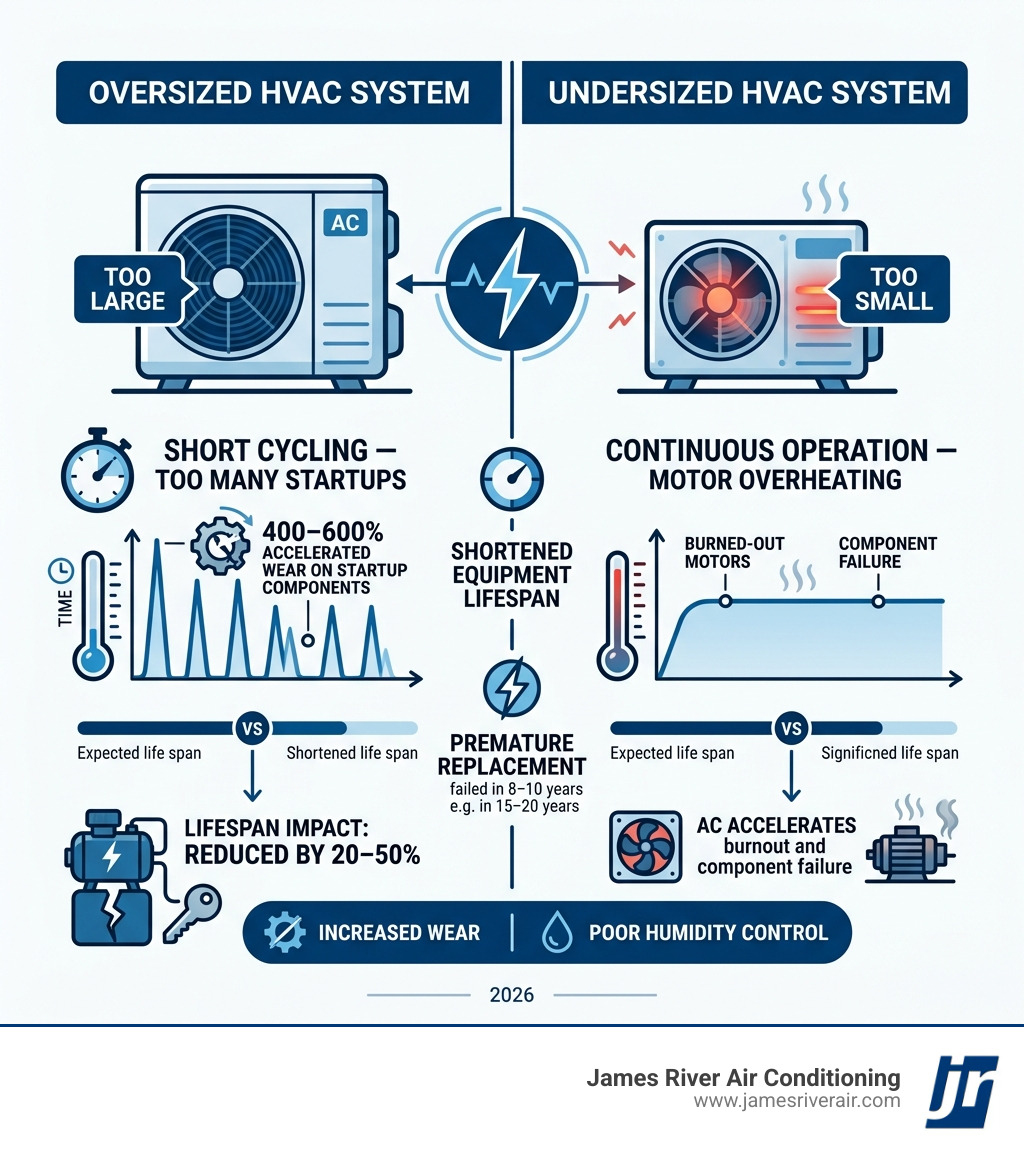
Here is a quick breakdown of how sizing directly affects how long your equipment lasts:
| Sizing Problem | Primary Failure Mechanism | Lifespan Impact |
|---|---|---|
| Oversized system | Short cycling — too many startups | Reduces lifespan by 20–50% |
| Undersized system | Continuous operation — motor overheating | Accelerates burnout and component failure |
| Both | Poor humidity control, increased wear | Equipment fails in 8–10 years instead of 15–20 |
An oversized system cools your home so fast it shuts off before finishing a full cycle. That rapid on-and-off pattern — called short cycling — forces the compressor to restart dozens of times per day. Each startup draws 6 to 10 times the normal electrical current, wearing down components at a rate 400 to 600% higher than a properly sized unit. An undersized system never gets a break, running nonstop trying to meet a demand it simply cannot reach — burning out motors, freezing coils, and driving up your energy bills in the process.
The result in both cases is the same: expensive repairs, premature replacement, and years of wasted energy.
What Does Improper HVAC Sizing Actually Mean?
In HVAC, “size” doesn’t refer to the physical dimensions of the unit sitting outside your home in Midlothian or Henrico. Instead, it refers to the system’s capacity to move heat, measured in British Thermal Units (BTUs) or “tons.” One ton of cooling capacity equals 12,000 BTUs per hour.
Many contractors still rely on “rules of thumb,” such as “one ton for every 500 square feet.” In May 2026, we know this is a recipe for disaster. Modern homes are built with better insulation, tighter building envelopes, and varying window orientations. A square footage estimate misses these critical details.
To get it right, we use a Manual J Load Calculation. This is the industry-standard “math” that looks at your home’s specific layout, the quality of your insulation, the number of occupants, and the local Richmond climate. If this calculation isn’t performed, you likely end up with a system that is either:
- Oversized: A unit with too much capacity that “blasts” the home with air and shuts off quickly.
- Undersized: A unit that lacks the “muscle” to keep up on a humid 95-degree day in Chesterfield.
Understanding these nuances is the first step in protecting your investment. For a deeper look at how to keep your system running smoothly, check out The Ultimate HVAC Maintenance Checklist for Mid-Atlantic Homeowners.
How Improperly Sized Systems Shorten Equipment Life Through Short Cycling
When a system is too large for the space it serves, it reaches the thermostat’s set point almost instantly. It turns on, delivers a massive burst of cold air, and turns off five minutes later. This is known as short cycling.
While it might seem like the unit is working “less” because it isn’t running long, the opposite is true. The most stressful moment for any electrical motor is the startup. Think of it like a car: driving 100 miles on the highway is much easier on the engine than stopping and starting 100 times in city traffic.
Oversized systems can experience 30 to 50 starts a day, compared to the 6 to 8 starts typical of a properly sized unit. This equates to 400-600% more “wear events.” This constant mechanical shock beats up the compressor—the “heart” of your AC—and leads to early failure. Even the Benefits of Regular HVAC Maintenance can only do so much if the system is fundamentally the wrong size.
The Mechanical Toll of Frequent Startups
Every time your HVAC system kicks on, it experiences a massive surge of electricity called inrush current. This current is 6 to 10 times higher than the normal operating current. This surge creates:
- Electrical Stress: It wears down contactors (the switches that start the motor) and capacitors (the “batteries” that give the motor a boost).
- Thermal Shock: Rapid heating and cooling of components causes metal to expand and contract too quickly, leading to cracks in heat exchangers.
- Oil Migration: The lubricant for the compressor needs time to circulate. In short cycles, the oil never properly coats the moving parts, leading to friction and “burnout.”
This is exactly Why Your AC Wants You to Sign a Maintenance Contract—to catch these failing components before they take the whole system down.
Why Oversized Units Fail to Control Humidity
In Richmond, we don’t just deal with heat; we deal with thick, heavy humidity. An air conditioner’s job is two-fold: it must lower the temperature (sensible cooling) and remove moisture (latent heat).
To remove moisture, the evaporator coil needs to stay cold for at least 10 to 15 minutes. This allows water vapor to condense on the coil and drain away. Because an oversized unit shuts off in under 10 minutes, it never reaches the dehumidification stage. You end up with a home that is “cold and clammy”—an environment where mold thrives and indoor air quality plummets.
The Dangers of Undersizing: Why Constant Operation Leads to Burnout
On the flip side, some homeowners think a smaller unit will save them money. Unfortunately, an undersized system is like a marathon runner trying to sprint for 24 hours straight. It simply isn’t designed for a 100% duty cycle.
| Feature | Oversized System | Undersized System |
|---|---|---|
| Runtime | Very short, frequent bursts | Constant, never-ending operation |
| Component Stress | Electrical (Capacitors/Contactors) | Mechanical (Bearings/Motors) |
| Humidity | High (Clammy) | Moderate to High (Struggling) |
| Primary Failure | Compressor Burnout | Blower Motor Overheating |
An undersized unit will run all day and night during a Richmond heatwave without ever reaching the temperature you set on the thermostat. This leads to a total system breakdown much sooner than expected. If you notice your system never stops, Don’t Wait for the Smoke to Schedule Your HVAC Tune-Up.
How Improperly Sized Systems Shorten Equipment Life by Overworking Motors
The blower motor in an undersized system is under immense pressure. Because the system is always “on,” the motor never has a chance to cool down. This leads to insulation breakdown within the electrical windings. Once that insulation fails, the motor shorts out.
Furthermore, constant operation wears down bearings and belts. In a commercial setting, this can be even more devastating, which is why Commercial Preventive Maintenance focuses so heavily on duty cycles and airflow resistance.
Signs Your System is Struggling to Keep Up
How do you know if your system is the wrong size? Look for these red flags:
- The “Never-Ending” Cycle: Your AC runs for 4 hours straight but the house is still 78 degrees.
- The “Popcorn” Cycle: The unit turns on and off every 5 minutes.
- Uneven Temperatures: The upstairs is a sauna while the downstairs is a refrigerator.
- The Humidity Spike: Your skin feels sticky even when the AC is running.
- Rising Energy Bills: You’re paying more for less comfort.
Protecting Your Investment with Proper Load Calculations
At James River Air Conditioning, we believe in “measure twice, install once.” Beyond the Manual J (load), we also use Manual S (to select the specific equipment that matches that load) and Manual D (to ensure your ductwork can actually handle the amount of air the unit moves).
If you put a 5-ton unit on ductwork designed for 3 tons, you create “static pressure” issues that act like a clogged artery, forcing the blower motor to work harder and fail faster. Proper James River Preventive Maintenance includes checking these pressures to ensure your system isn’t “choking.”
How Improperly Sized Systems Shorten Equipment Life and Void Warranties
One of the most painful “surprises” for homeowners is finding out their warranty is void. Many manufacturers require that the system be installed according to their specifications—which includes proper sizing and a matched AHRI-certified coil and condenser.
If a manufacturer determines that a compressor failed because the system was significantly oversized and short cycling, they may deny the warranty claim. Following 5 Tips to Show Your HVAC System Love starts with ensuring the installation was done right the first time.
Frequently Asked Questions about HVAC Sizing and Longevity
How long should a properly sized HVAC system last in 2026?
With professional installation and semi-annual maintenance, a standard central AC or heat pump should last 15 to 20 years. Gas furnaces can often reach 20 to 25 years. However, an improperly sized unit often fails between years 8 and 10.
What are the most common signs of an oversized air conditioner?
The most obvious sign is short cycling—the unit turning on and off more than 4 times an hour in moderate weather. Another major sign is high indoor humidity (above 50-60%) despite the air feeling cold.
Can regular maintenance extend the life of an improperly sized system?
Maintenance can help by keeping coils clean and ensuring electrical connections are tight, which mitigates some stress. However, maintenance cannot “fix” a sizing issue. It’s like putting premium gas in a car with a broken transmission; it helps the engine, but the core problem remains.
Conclusion
At James River Air Conditioning, we’ve served the Richmond community for over 57 years. We know that how improperly sized systems shorten equipment life is a technical reality that costs homeowners thousands of dollars. Whether you are in Glen Allen, Midlothian, or downtown Richmond, our goal is to ensure your home stays comfortable for the full 15-to-20-year life of your equipment.
Don’t settle for “rule of thumb” guesses. Protect your home and your wallet by insisting on a professional load calculation. If you’re confused by the industry jargon, our Your Guide to HVAC Home Comfort Terms is a great place to start.
Ready to ensure your system is the perfect fit for your home? Contact us today for an expert evaluation. Let’s make sure your HVAC system lives a long, efficient life!
