
Why HVAC Maintenance Mistakes Homeowners Make Cost More Than You Think
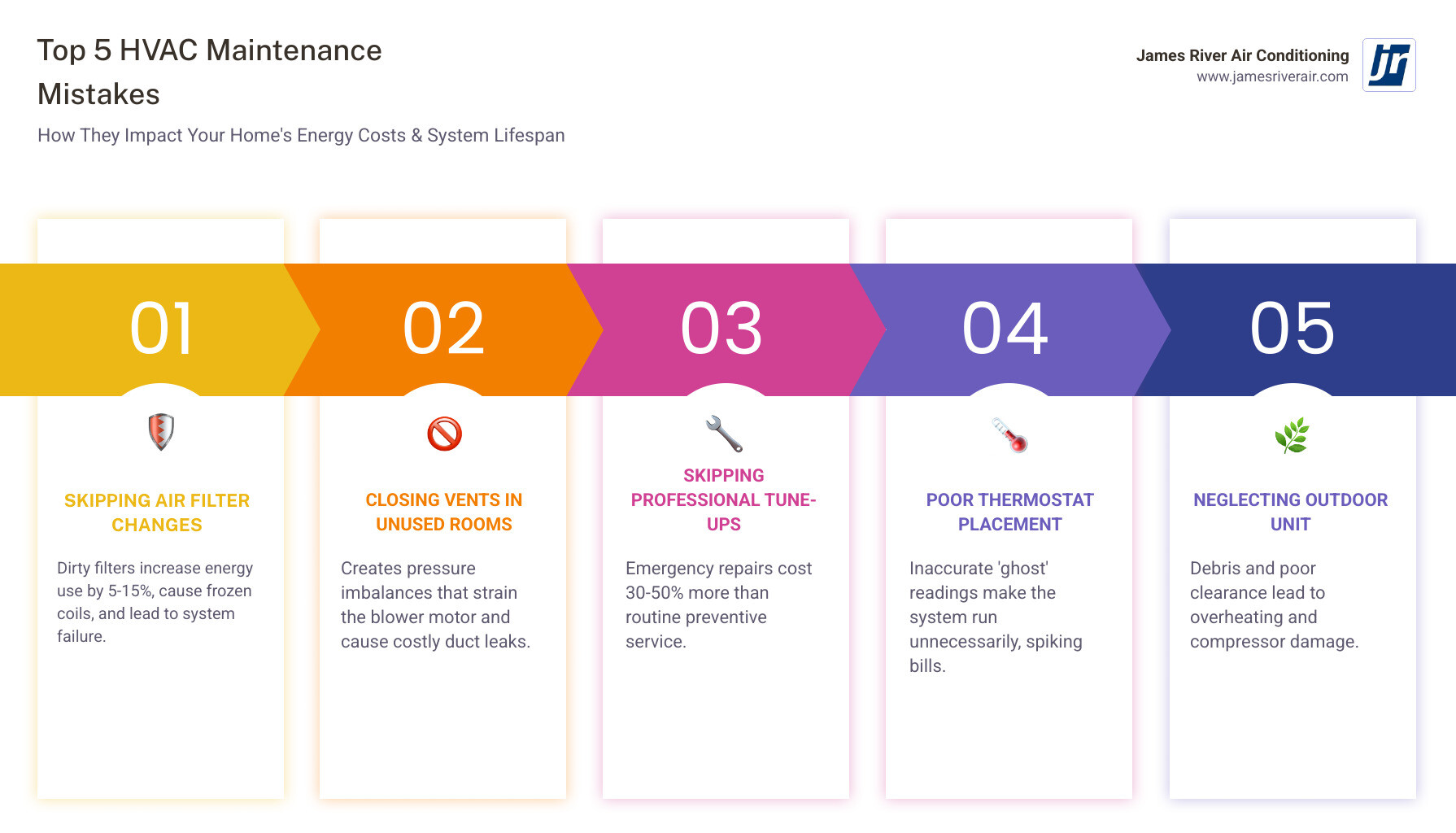
The most common hvac maintenance mistakes homeowners make include neglecting air filter changes, skipping annual professional tune-ups, closing vents in unused rooms, ignoring warning signs like strange noises or smells, and attempting complex DIY repairs. Here is a quick overview:
- Skipping air filter changes – Dirty filters can increase energy use by 5-15% and lead to frozen coils or system failure
- Skipping professional tune-ups – Emergency repairs cost 30-50% more than preventive service
- Closing vents in unused rooms – Creates pressure imbalances that strain the blower motor and cause duct leaks
- Poor thermostat placement or usage – Inaccurate readings cause the system to run when it shouldn’t
- Installing a wrong-sized system – Leads to short cycling, poor humidity control, and premature wear
- Neglecting the outdoor condenser unit – Debris and poor clearance cause overheating and compressor damage
- Ignoring unusual noises, smells, or moisture – Small issues escalate into major breakdowns fast
- DIY repairs on complex components – Risks voiding warranties, electrical hazards, and costlier damage
Heating and cooling account for nearly 50% of a home’s energy use. That makes your HVAC system one of the most expensive things in your house to run — and one of the most expensive to fix when it breaks down unexpectedly. The good news is that most of the damage homeowners accidentally cause is completely preventable. A few simple habits and one call to a professional each year can make a meaningful difference in how long your system lasts and how much you spend keeping your Richmond home comfortable.
The Most Common HVAC Maintenance Mistakes Homeowners Make

When we talk about the hvac maintenance mistakes homeowners make, we aren’t just talking about a minor inconvenience. We are talking about the health and longevity of one of your home’s most vital organs. Most modern HVAC systems are designed to last between 10 and 15 years, with heat pumps specifically averaging about that same range. However, that lifespan is a best-case scenario based on proper care.
Neglected maintenance can reduce your AC’s lifespan by up to 30%. In Richmond, where our summers are humid and our winters can be biting, your system works incredibly hard. When it isn’t maintained, it has to work even harder to achieve the same temperature, leading to a “death by a thousand cuts” for the internal components. By understanding the benefits of regular HVAC maintenance, you can transition from reactive repairs to proactive care, ensuring your home remains a sanctuary year-round.
Airflow and Filtration Errors
Airflow is the lifeblood of your heating and cooling system. If the air can’t move, the system can’t do its job. Unfortunately, some of the most frequent hvac maintenance mistakes homeowners make involve restricted airflow, often caused by the simplest of components: the air filter.
How Neglecting Air Filters Leads to Common HVAC Maintenance Mistakes Homeowners Make
It is easy to forget that a small, inexpensive piece of pleated material stands between your comfort and a system breakdown. However, dirty filters are the number one cause of HVAC issues. When a filter is clogged with dust, pet hair, and dander, your blower motor has to work overtime to pull air through the blockage. This increases energy use by 5% to 15% almost immediately.
Beyond the utility bill, a clogged filter can cause your evaporator coils to freeze over—even in the middle of a 95-degree Virginia July. When the airflow is restricted, the cold refrigerant in the coils doesn’t have enough heat to absorb, causing the moisture on the coils to turn into a block of ice.
| Household Type | Recommended Filter Change Frequency |
|---|---|
| Single occupant / No pets | Every 90 days |
| Average suburban home (1 pet) | Every 60 days |
| Multiple pets or allergy sufferers | Every 20–45 days |
| Vacation home / Seasonal use | Every 6–12 months |
Regularly swapping your filter is one of the best tips to show your HVAC system love. It protects the internal components from debris and ensures you aren’t paying for energy you aren’t actually using.
Closing Vents in Unused Rooms
There is a persistent myth that closing vents in rooms you aren’t using will save money. In reality, this is one of the most counterproductive hvac maintenance mistakes homeowners make.
Your HVAC system was engineered for “balanced airflow.” This means the blower motor is designed to push a specific volume of air against a specific amount of resistance. When you close vents, you increase the internal pressure within your ductwork. This doesn’t make the system “work less”; instead, it causes the air to seek the path of least resistance, often forcing conditioned air out of tiny leaks in your ducts. Furthermore, the added pressure strains the blower motor and can lead to it burning out prematurely. Keep your registers open and your interior doors ajar to allow the system to breathe as it was designed to.
Operational and Installation Oversights
Sometimes the mistakes aren’t about what you do to the machine, but how you interact with the controls or how the system was set up from day one.
Improper Thermostat Placement and Usage
Your thermostat is the “brain” of your HVAC system, but it can be easily fooled. If your thermostat is placed in direct sunlight, near a drafty window, or close to a heat-producing appliance like a lamp or a kitchen oven, it will give “ghost readings.”
For example, if a lamp is sitting right under your thermostat, the sensor will think the room is much warmer than it actually is. This causes your AC to run constantly while the rest of the house feels like a refrigerator. Similarly, many homeowners believe that “cranking” the thermostat down to 60 degrees will cool the house faster. It won’t. Your system provides a steady stream of cold air until the target temperature is reached; setting it lower just ensures it runs longer, wasting energy and increasing wear. For more ways to manage these “ghost” costs, check out our high energy bill tips.
Installing an Improperly Sized System
In HVAC, bigger is not always better. An oversized system will reach the target temperature too quickly, a phenomenon known as “short cycling.” Because the system doesn’t run long enough to complete a full cycle, it fails to remove humidity from the air, leaving your home feeling “clammy” or “sticky.”
Conversely, an undersized system will run perpetually, struggling to keep up with the heat. Both scenarios lead to high utility bills and premature component failure. When we help homeowners in the Richmond area, we perform detailed calculations based on square footage, insulation quality, and window placement to ensure the system is a perfect fit for the home.
Skipping Professional Care and DIY Risks
While there are many things you can do yourself, like changing filters or clearing leaves, your HVAC system is a complex piece of machinery involving high-voltage electricity, combustible gases, and pressurized refrigerants.
Skipping Professional Tune-Ups: One of the Costliest HVAC Maintenance Mistakes Homeowners Make
Many homeowners think, “If it isn’t broken, don’t fix it.” This mindset is why emergency repairs often cost 30% to 50% more than a scheduled maintenance visit. A professional tune-up is like an oil change for your car; it catches the small, cheap problems before they turn into the big, expensive ones.
During a professional inspection, a technician will:
- Clean the coils (dirty coils can spike energy use significantly).
- Tighten electrical connections.
- Lubricate moving parts to prevent friction.
- Check refrigerant levels (low levels indicate a leak, which is a major efficiency killer).
- Clear the condensate drain line.
Crucially, most manufacturers require proof of annual professional service to honor your equipment warranty. If your compressor fails in year five but you haven’t had a pro look at it since it was installed, you might be stuck with the bill. Don’t wait for the smoke to schedule your HVAC tune-up—stay ahead of the seasons.
Attempting Complex DIY Repairs
We love a good DIY project as much as anyone, but the internal components of your HVAC system are not the place for experimentation. Attempting to fix control boards, wiring, or refrigerant lines without proper training is dangerous and often ends up costing more in the long run.
Handling refrigerant without a license is actually a violation of federal law, and an accidental electrical short can fry the entire system’s electronics. For the complex stuff, our residential preventive maintenance services ensure the job is done safely and correctly the first time.
Neglecting the Outdoor Unit and Home Envelope
The outdoor condenser unit is half of the cooling equation. Its job is to release the heat collected from inside your home into the outside air. If the unit is buried under overgrown shrubs, clogged with grass clippings, or covered in fallen leaves, it can’t “exhale.” This causes the compressor to overheat. You should maintain at least two feet of clear space around your outdoor unit at all times.
In Virginia, we also have to deal with seasonal debris. After you mow the lawn, make sure you haven’t blown grass clippings into the unit’s fins. In the winter, it’s equally important to keep the area clear. Following tips for protecting your HVAC from snow can prevent the unit from being encased in ice, which can damage the fan blades.
Finally, don’t overlook your “home envelope.” Your HVAC system is only as good as the house it’s in. Poor insulation in your attic can add $200–$500 per year to your cooling costs. If your attic is under-insulated, the heat from the Virginia sun will radiate through your ceiling, forcing your AC to fight a losing battle.
Frequently Asked Questions about HVAC Maintenance
How often should I replace my air filter in Richmond?
In the Richmond area, we recommend checking your filter every 30 days. If you have pets or suffer from seasonal allergies (which are common in the Mid-Atlantic), you will likely need to replace it every 30 to 60 days. At an absolute minimum, a standard filter should be replaced every 90 days.
Does closing vents actually save money on utility bills?
No. Closing vents disrupts the pressure balance of your system, which can cause duct leaks and damage the blower motor. It is much more efficient to keep all vents open and use a programmable thermostat to manage the temperature of the entire home.
What are the signs of a clogged HVAC drain line?
Your AC removes moisture from the air, and that water has to go somewhere. If the drain line is clogged with algae or sludge, you might notice:
- Water pooling around the indoor unit.
- A musty or moldy smell near the vents.
- The system shutting down unexpectedly (triggered by a safety float switch).
- Dampness or water damage on the floor or ceiling near the unit.
Conclusion
Avoiding the most common hvac maintenance mistakes homeowners make doesn’t require a degree in mechanical engineering. It simply requires consistency. By changing your filters, keeping your vents open, and ensuring your outdoor unit has room to breathe, you are already ahead of the curve.
However, the most important step you can take for your home’s comfort and your wallet’s health is scheduling professional care. At James River Air Conditioning, we’ve spent over 57 years helping our neighbors in Richmond, Midlothian, Glen Allen, and beyond keep their systems running at peak performance.
Ready to cross “HVAC maintenance” off your to-do list? Review the ultimate HVAC maintenance checklist for Mid-Atlantic homeowners to see what your system needs, and then schedule your professional HVAC service in Richmond today. We are here to ensure your home stays comfortable, no matter what the Virginia weather throws your way.
