
Is It Time to Repair or Replace Your Furnace? Here’s How to Decide Fast
Knowing when furnace repair vs replacement when to decide is the right call can save you hundreds — or thousands — of dollars. Here’s a quick answer before we dive deeper:
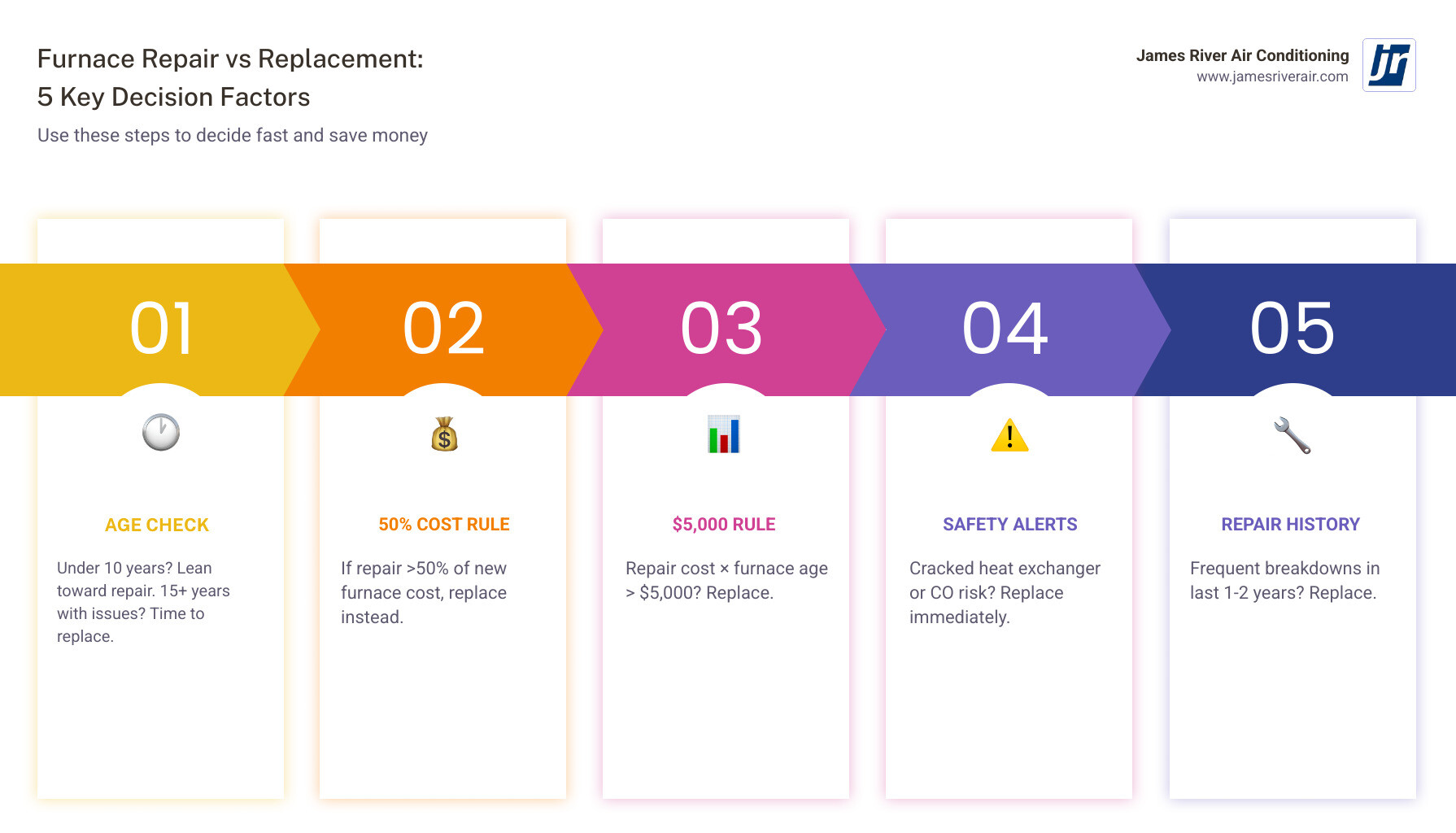
Quick Decision Guide:
| Situation | Recommended Action |
|---|---|
| Furnace is under 10 years old, minor repair needed | Repair |
| Repair cost is less than 50% of a new unit’s price | Repair |
| Furnace is 15+ years old with a major repair needed | Replace |
| Repair cost × furnace age exceeds $5,000 | Replace |
| Cracked heat exchanger or carbon monoxide risk | Replace immediately |
| Frequent repairs in the last 1-2 years | Replace |
There’s never a good time to find out your furnace is struggling — especially on a cold Richmond winter night. But that moment of dread, standing in front of a unit that’s making strange noises or refusing to heat your home evenly, is exactly when most homeowners face a tough choice: fix what you have, or invest in something new?
The answer isn’t always obvious. A furnace that seems “mostly fine” might be quietly draining your wallet through high energy bills and repeat service calls. And a single big repair estimate can feel alarming even when repair is genuinely the smarter move.
This guide cuts through the confusion. Whether your furnace is acting up for the first time or you’ve lost count of the service calls, you’ll find a clear framework here to make the right call with confidence.
Understanding the Lifespan of Your Heating System
Every mechanical system has an expiration date, and your furnace is no exception. In our experience serving the Richmond and Midlothian areas, we’ve found that furnaces typically last between 15 and 20 years. However, this isn’t a hard-and-fast rule; it’s more of a bell curve.
Gas vs. Electric Longevity
The type of fuel your system uses plays a significant role in its life expectancy.
- Gas Furnaces: These are the workhorses of Virginia homes. Because they involve combustion, they deal with high heat and chemical reactions that naturally wear down components over 12 to 20 years.
- Electric Furnaces: Since they lack burners and heat exchangers that can corrode or crack, electric units often boast a longer lifespan, sometimes reaching 20 to 30 years. However, they can be more expensive to operate month-to-month in colder climates.
The Role of Maintenance and Climate
In Central Virginia, our winters can be unpredictable. One week it’s a mild 50 degrees, and the next, we’re hitting sub-zero wind chills in Henrico or Hanover. This fluctuation puts a unique strain on your system.
The single biggest factor in reaching that 20-year milestone is Residential Preventive Maintenance. A furnace is like a car; if you never change the oil, you can’t expect it to hit 200,000 miles. There are numerous Benefits of Regular HVAC Maintenance, including keeping the blower motor clean and ensuring the safety sensors are responsive. Without it, wear and tear accelerate, often leading to a premature “toast” furnace by year 12.
The Math Behind Furnace Repair vs Replacement When to Decide
When you’re staring at a repair estimate, it’s easy to get emotional. To help our neighbors in Chesterfield and Glen Allen make objective choices, we recommend using two industry-standard “math rules.”
The 50% Rule
This is the simplest threshold. If a single repair estimate costs 50% or more of what a brand-new furnace would cost, replacement is almost always the better investment. Why? Because spending half the price of a new unit on a system that is already 15 years old doesn’t reset its “life clock.” You still have an old blower motor, an old circuit board, and an old heat exchanger waiting to fail next.
The $5,000 Rule
This formula factors in the age of your equipment to give you a clearer financial picture. The Formula: Age of Furnace × Cost of Repair = Total Score
- If the score is under $5,000: Repairing the unit is usually a safe bet.
- If the score is over $5,000: You should seriously consider a replacement.
Example: If you have a 12-year-old furnace in Mechanicsville and the repair quote is $500, your score is $6,000. Even though $500 feels manageable, the math suggests that at this age, you’re likely entering the “breakdown cycle” where repairs become frequent.
Cumulative Costs and ROI
Don’t just look at the current bill. Look at your records for the last two years. Furnaces often incur the most breakdowns in the final 24 months of their lives. If you’ve called for Residential HVAC Service three times in the last two seasons, those small bills are adding up to a down payment on a much more reliable, efficient system. This is one of the many reasons Why Your AC Wants You to Sign a Maintenance Contract; it helps you track these patterns before they become emergencies.
| Decision Factor | Repair Lean | Replacement Lean |
|---|---|---|
| System Age | Under 12 years | Over 15 years |
| Repair Cost | Under 1/3 of new unit | Over 1/2 of new unit |
| Repair Frequency | First issue in years | 2+ repairs in 2 years |
| Energy Bills | Consistent | Rising steadily |
| Comfort | Even heating | Cold spots/Noisy |
Critical Signs It’s Time for a New Furnace
Sometimes the signs aren’t on a balance sheet; they are happening right in your living room. If you’re trying to figure out furnace repair vs replacement when to decide, keep your ears and eyes open for these red flags.
- Strange Noises: If your furnace sounds like a percussion band — banging, popping, rattling, or squealing — it’s a sign that parts are loose, the motor is failing, or the inducer is struggling.
- Rising Utility Bills: Have your gas or electric bills in Richmond spiked even though the weather hasn’t been unusually cold? This indicates your furnace is running longer and harder to produce the same amount of heat, a clear sign of internal degradation.
- Uneven Heating: If the kitchen is a sauna but the bedrooms in your Short Pump home are iceboxes, your furnace may no longer have the “oomph” to push air through your ductwork effectively.
While you can try 5 Tips to Show Your HVAC System Love, such as changing filters and clearing vents, these are often symptoms of a system that is simply worn out. For those with Gas Furnaces, these signs can also point to more serious mechanical failures.
Safety Risks and Furnace Repair vs Replacement When to Decide
This is the most important section of this guide. Some furnace issues are not “optional” repairs. They are immediate triggers for replacement because they threaten your family’s safety.
- Cracked Heat Exchanger: This is the metal shield that keeps combustion gases (like carbon monoxide) separate from the air you breathe. If it cracks, those gases enter your home. Because the labor to replace a heat exchanger is so intensive, it is almost always more cost-effective to replace the entire furnace.
- Yellow Pilot Light: A healthy gas flame should be crisp and blue. A flickering or yellow flame indicates incomplete combustion, which produces carbon monoxide.
- Soot Accumulation: Finding black soot around the furnace registers or on the unit itself is a sign of a dirty, dangerous burn.
We tell our clients in Powhatan and Colonial Heights: Don’t Wait for the Smoke to Schedule Your HVAC Tune-Up. If a technician identifies a safety breach, the system must be shut down immediately for your protection.
Efficiency Gains and Furnace Repair vs Replacement When to Decide
Modern technology has come a long way since your current furnace was installed. Efficiency is measured by AFUE (Annual Fuel Utilization Efficiency).
- Older Furnaces: Often operate at 60% to 70% AFUE. This means for every dollar you spend on fuel, 30 to 40 cents is literally going up the chimney.
- New Furnaces: Modern high-efficiency models boast ratings of 90% to 98%.
Upgrading isn’t just about avoiding repairs; it’s about reducing your monthly overhead. Over the next decade, the energy savings from a high-efficiency unit can often pay for a significant portion of the installation. If you’re confused by the lingo, check out Your Guide to HVAC Home Comfort Terms to better understand how these ratings impact your wallet.
When to Choose Repair Over Replacement
We aren’t here to tell you that every broken furnace needs to be scrapped. There are many scenarios where a repair is the logical, budget-friendly choice.
- The System is Young: If your furnace is under 10 years old, it likely has a lot of life left. Most major components shouldn’t fail this early unless there was a lack of maintenance.
- Warranty Status: Check your paperwork! Many furnaces come with 5- or 10-year parts warranties. If the manufacturer is covering the cost of the part, you only have to worry about labor, making the repair much more attractive.
- Minor Component Failure: If the issue is a dirty flame sensor, a failed ignitor, or a simple thermostat malfunction, these are relatively quick and affordable fixes.
- Consistent Maintenance History: If you’ve followed The Ultimate HVAC Maintenance Checklist for Mid-Atlantic Homeowners, your system is likely in better “internal” health than an unmaintained unit of the same age.
If your system is generally reliable and this is its first hiccup in five years, go with the repair. It’s a great time to get the unit back on track and perhaps consider a service plan to prevent the next one.
Benefits of Upgrading to Modern Heating Technology
If the math or the safety risks have led you toward replacement, there is a silver lining: modern furnaces are incredible. They offer features that simply didn’t exist 15 years ago.
- Variable-Speed Blowers: Instead of being “all on” or “all off,” these motors ramp up and down slowly. This creates a much quieter home, eliminates the “blast” of cold air at the start of a cycle, and provides much more consistent temperatures.
- Smart Thermostat Compatibility: New systems integrate seamlessly with smart home tech, allowing you to control your heat from your phone while you’re at a Richmond Flying Squirrels game or heading home from work in Henrico.
- Improved Air Quality: Modern systems often feature advanced filtration options and better humidity control, which is essential for Virginia’s humid summers and dry winters.
- Noise Reduction: New cabinets are better insulated, meaning you won’t have to turn up the TV every time the heat kicks on.
When we provide Residential HVAC Service, we love seeing the look on a homeowner’s face when they realize how much more comfortable their home can actually be with the right technology.
Frequently Asked Questions about Furnace Replacement
What is the 50% rule for furnace repair?
The 50% rule states that if the cost of a single repair is 50% or more of the cost of a brand-new furnace, you should opt for replacement. This helps homeowners avoid “throwing good money after bad” on an aging system that will likely need more repairs soon.
How long does a typical gas furnace last in Virginia?
In the Richmond area, a gas furnace typically lasts 15 to 20 years. Factors like the humidity of our summers and the salt air (if you’re closer to the coast) can impact this, but regular maintenance is the biggest factor in longevity.
Is a cracked heat exchanger always a reason to replace?
Technically, a heat exchanger can be replaced, but it is rarely recommended for older units. The part is expensive, and the labor requires disassembling nearly the entire furnace. Given that a cracked heat exchanger is a major safety risk for carbon monoxide, and usually happens to older units, putting that money toward a new, warrantied system is almost always the smarter move.
Conclusion
Deciding between furnace repair vs replacement when to decide isn’t just about the immediate bill; it’s about your long-term comfort, safety, and financial health. While a repair might get you through tonight, a replacement might save you from a decade of high bills and mid-winter emergencies.
At James River Air Conditioning, we’ve spent over 57 years helping our neighbors in Richmond, Chesterfield, and beyond navigate these tough choices. We believe in providing honest, professional assessments so you can make the choice that’s right for your family and your budget. Whether you need a quick fix or want to explore the HVAC Replacement Cost for a new high-efficiency system, our team is here to help.
Don’t spend another night shivering or worrying about that strange clanking sound in the basement. Contact us today for a professional furnace evaluation and let’s make sure your home stays warm all winter long.
