
When Storms Strike: What Every Richmond Homeowner Needs to Know
Understanding how severe thunderstorms and hurricanes affect your systems could be the difference between a quick recovery and a costly disaster. Power surges, flooding, and extended outages can damage your HVAC, plumbing, electrical, and data systems — often in ways you won’t notice until something stops working.
Here’s a quick overview of the main ways storms impact home and business systems:
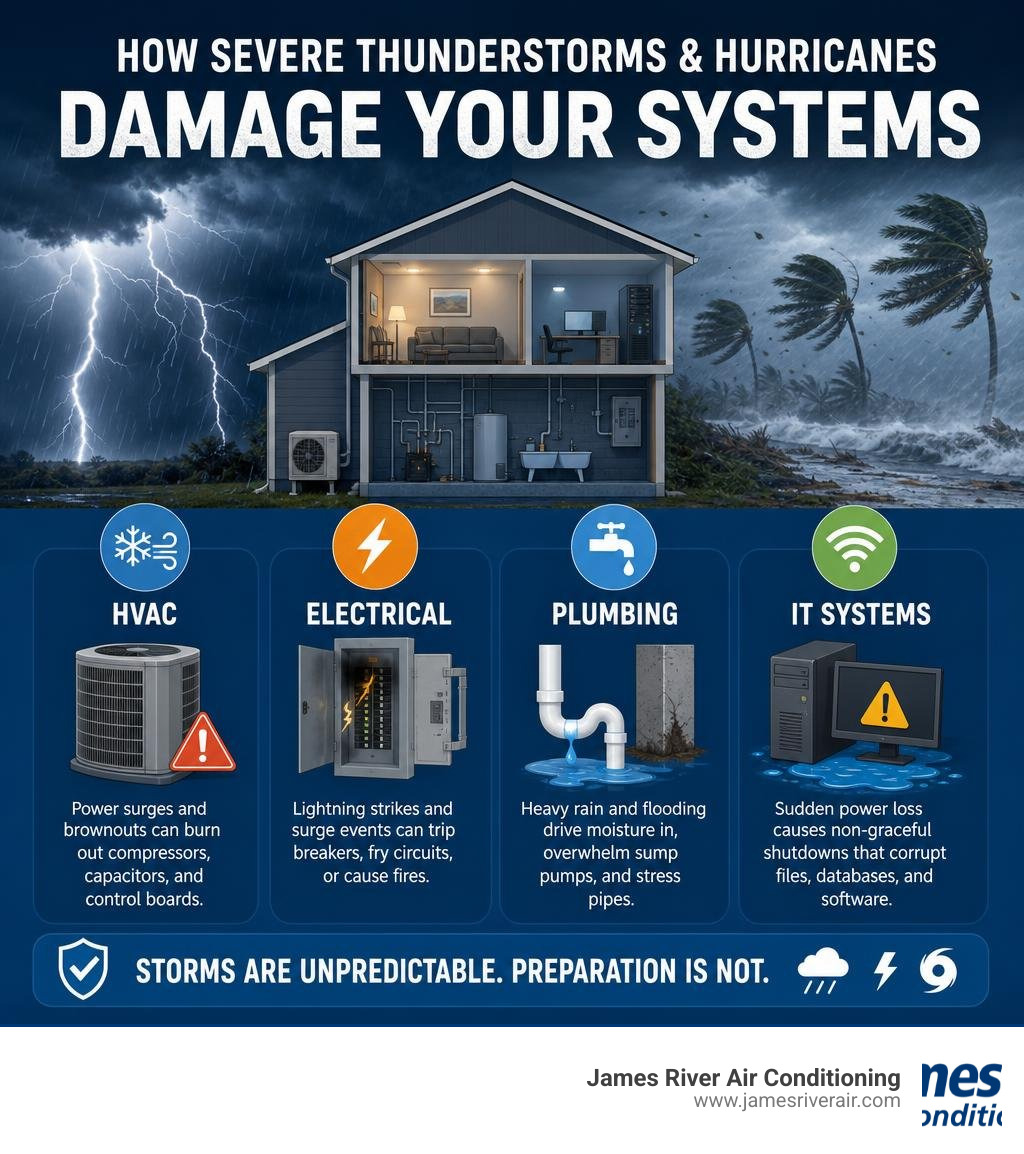
- HVAC systems — Power surges and brownouts burn out compressors, capacitors, and control boards
- Electrical panels and wiring — Lightning strikes and surge events can trip breakers, fry circuits, or cause fires
- Plumbing and crawl spaces — Heavy rainfall and flooding drive moisture into crawl spaces, overwhelm sump pumps, and stress pipes
- IT equipment and data — Sudden power loss causes non-graceful shutdowns that corrupt files, databases, and software
- Generators and backup power — Untested or poorly maintained systems fail exactly when you need them most
- Communication and phone systems — Fiber and cellular networks can go down simultaneously during major storms
In 2024, power interruptions tied to major weather events averaged nearly nine hours — more than double the average from the previous decade. Hurricane Beryl alone left 2.7 million Texas customers without electricity, with some areas dark for more than a week. Closer to home, Richmond and the broader Virginia region are no strangers to tropical remnants, severe thunderstorms, and the kind of sustained outages that expose every weak link in a building’s systems.
This guide covers what’s actually at risk, what fails first, and what you can do about it — before the next storm forms.
Know your how severe thunderstorms and hurricanes affect your systems terms:
- how freeze thaw cycles affect your plumbing
- how hot humid summers and cold winters stress your hvac
- how virginia weather extremes affect your home systems
How Severe Thunderstorms and Hurricanes Affect Your Systems

When severe weather sweeps through Central Virginia, it brings a cocktail of destructive forces. From the high winds of a late-summer hurricane to the sudden lightning strikes of a humid July thunderstorm, your property’s infrastructure faces immediate, intense stress. Understanding these dynamics is key to protecting your investments. For a deeper look at local climate risks, read about The Commonwealth Climate vs. Your House: What You Need to Know.
The primary physical and electrical threats to your systems during a storm include:
- Power Surges: A power surge is a spike in voltage that far exceeds the standard flow of electricity. This can be caused by direct lightning strikes, downing of utility lines, or the sudden re-energization of the grid after an outage. These spikes can instant-fry sensitive microprocessors in everything from your smart thermostat to your high-efficiency heat pump.
- Brownouts: Often overlooked, a brownout is a temporary drop in voltage. When voltage drops, motors (like those in your AC compressor or refrigerator) must draw more current to perform the same amount of work. This causes rapid overheating, insulation degradation, and premature system failure.
- Blackouts (Extended Outages): A total loss of power shuts down environmental controls. In Richmond’s humid summers, a multi-day blackout leads to rapid indoor humidity spikes, creating a breeding ground for mold and mildew.
- Physical Damage and Water Intrusion: Hurricanes and severe storms dump inches of rain in a matter of hours. Torrential downpours find their way into outdoor electrical enclosures, flood low-lying HVAC units, and saturate crawl spaces. High winds can also throw debris through outdoor condenser coils or tear external electrical conduits from your home’s exterior.
How Severe Thunderstorms and Hurricanes Affect Your Systems: Electrical and HVAC Vulnerabilities
Your HVAC system is particularly vulnerable during severe weather. It is a highly complex combination of high-voltage mechanical parts and low-voltage electronic controls. To understand how seasonal extremes push these components to their limits, see The Ins and Outs of How Hot Humid Summers and Cold Winters Stress Your HVAC.
During a thunderstorm, lightning does not need to strike your home directly to cause damage. A nearby strike can travel through utility lines, sending thousands of volts straight to your electrical panel.
The most common electrical and HVAC casualties include:
- AC Compressors: The compressor is the heart of your air conditioner. A severe power surge or repeated brownout can destroy the compressor’s electrical windings, causing immediate burnout.
- Capacitors: These small cylindrical components store and release electrical energy to start and run the system’s motors. They are highly sensitive to voltage fluctuations and frequently burst or lose their charge during electrical storms.
- Control Boards: Modern HVAC units rely on sophisticated circuit boards to manage operations. A minor surge can fry the delicate traces on these boards, rendering the entire system inoperable.
- Electrical Wiring and Panels: Overloaded circuits can lead to melted wire insulation, tripped main breakers, or even electrical fires within your main service panel.
How Severe Thunderstorms and Hurricanes Affect Your Systems: Plumbing and Crawl Space Risks
While electrical damage gets a lot of attention, water-related damage to your plumbing and crawl space can be just as devastating. Heavy rains from severe thunderstorms and hurricanes can quickly saturate the ground, raising the water table around your foundation.
If you want to protect your home’s structure and air quality, you must understand how moisture behaves. Learn more by reading Stop the Sog and Understand How Crawl Space Moisture Affects Your Home.
The primary plumbing and crawl space risks during major storms include:
- Sump Pump Overload: Your sump pump is your crawl space’s first line of defense. During a hurricane, torrential rains can overwhelm a pump, especially if it is older or poorly maintained. Worse, if the power goes out, a standard electric sump pump stops working entirely, allowing water to fill the crawl space.
- Crawl Space Flooding: Standing water in a crawl space damages floor joists, ruins insulation, and causes rot. Over time, this moisture migrates upward into your living spaces, compromising your indoor air quality.
- Pipe Stress and Damage: Shifting soil due to heavy saturation can put immense physical stress on underground water and sewer lines, leading to cracks or complete pipe ruptures. Additionally, if storm drainage systems back up, sewer lines can back up directly into your home.
Hardware and Software Failures During Storm-Related Outages
For businesses and home offices, storm-related power interruptions do more than turn off the lights — they actively threaten digital infrastructure. When power cuts out instantly, computer systems do not have time to perform their normal shutdown procedures.
This is known as a non-graceful shutdown. When a server or workstation is forced off mid-write, the consequences can be catastrophic for both physical hardware and logical data.
Common failures during storm-related outages include:
- Data Corruption: If a system is writing to a database or updating system files when the power drops, those files can become corrupted and unreadable. This logical corruption can prevent operating systems from booting or render critical business data useless.
- Hard Drive Crashes: While modern solid-state drives (SSDs) are more resilient, sudden power loss can still corrupt their internal controller firmware. For traditional mechanical hard drives (HDDs), a sudden power loss can cause the read/write head to drop onto the physical platter, causing permanent physical damage.
- UPS Battery Failures: Many organizations rely on Uninterruptible Power Supplies (UPS) to bridge the gap during power drops. However, UPS batteries degrade over time (typically lasting only 3 to 5 years). If they are not regularly tested and replaced, they will fail to provide the necessary runtime to shut down systems safely.
The differences between how your systems handle planned versus unplanned power losses are stark:
| Shutdown Feature | Graceful Shutdown (Planned) | Non-Graceful Shutdown (Storm Outage) |
|---|---|---|
| Data Integrity | Files closed safely; no data loss | Active files corrupted; databases broken |
| System Cache | All cached data written to disk | Cached data lost instantly |
| Hardware Stress | Zero physical stress on components | Power spikes can fry circuit boards |
| Recovery Time | Under 5 minutes | Hours to days (if data recovery is needed) |
Protecting Your Home and Business Systems from Storm Damage
Protecting your systems from severe weather requires a proactive, layered defense strategy. You cannot control the weather, but you can control how prepared your home or business is to handle it.
Here are the most effective ways to safeguard your systems:
- Whole-House Surge Protectors: While individual power strips offer some protection, a whole-house surge protector installed directly into your main electrical panel is your best defense. It intercepts massive voltage spikes at the source before they can travel to your HVAC, appliances, and electronics.
- Standby Generators: A whole-house standby generator is permanently installed outside your property. It connects directly to your electrical panel and runs on natural gas or liquid propane. Within seconds of a utility outage, an automatic transfer switch (ATS) detects the power loss, starts the generator, and restores power to your home or business.
- Uninterruptible Power Supplies (UPS): For sensitive electronics, computers, and network gear, a UPS provides immediate, battery-backed power. This prevents the non-graceful shutdowns discussed above, giving you 10 to 30 minutes of clean power to save your work and shut down systems safely.
- The 3-2-1 Backup Rule: To protect your critical data, always follow the 3-2-1 rule:
- Keep 3 copies of your data.
- Store them on 2 different types of media (e.g., local server and external drive).
- Keep 1 copy completely off-site or in the cloud, ideally in a different geographic region unaffected by the storm.
Pre-Storm, Mid-Storm, and Post-Storm Action Plan
When a severe storm or hurricane is heading toward Richmond, having a clear action plan keeps you safe and minimizes property damage. Routine maintenance is the foundation of this plan; to see what happens when you neglect these steps, read What Happens If You Skip HVAC Maintenance: 7 Key Consequences.
Follow this checklist before, during, and after a storm to protect your home and business systems:
1. Pre-Storm Prep (72 to 24 Hours Before Landfall)
- Schedule Preventative Maintenance: Before hurricane season begins, have a professional inspect your HVAC electrical connections, clean your sump pump, and test your standby generator under load.
- Verify Your Backups: Run a manual backup of all critical systems and verify that the data can be successfully restored.
- Clear the Area: Move outdoor patio furniture, toys, and loose debris away from your outdoor HVAC condenser to prevent them from becoming windborne projectiles.
- Check Your Sump Pump: Pour a bucket of water into your sump pit to ensure the float switch activates the pump and drains the water quickly.
2. Mid-Storm Action (During the Event)
- Switch to Storm Mode: If you do not have a whole-house surge protector and a storm is directly overhead, proactively shut down your HVAC system at the thermostat and unplug sensitive electronics.
- Avoid Water Contact: Never touch electrical panels, switches, or appliances if you are standing in water or if your hands are wet.
- Let the Generator Work: If you have a standby generator, let it run automatically. Do not attempt to service or adjust it in the middle of a storm.
3. Post-Storm Recovery (After the Storm Passes)
- Perform a Visual Inspection: Before turning anything back on, check your outdoor HVAC unit for physical damage, mud, or standing water. Look for any fallen tree branches resting on electrical or utility lines.
- Execute a Safe Power-Up Sequence: When utility power returns, do not plug everything back in immediately. Power grid voltage can fluctuate wildly for the first 15 to 30 minutes. Wait until the power is stable, then turn on your systems one by one, starting with your main breakers, then your HVAC, and finally your computer systems.
- Address Crawl Space Water: If your crawl space flooded, do not enter it if there is standing water near electrical outlets or equipment. Call a professional to safely pump out the water and dry the space.
Frequently Asked Questions About Storm Impacts
How long can a standby generator run during an extended outage?
A professionally installed standby generator can run continuously for several days to a week, provided it has an adequate fuel supply. Generators connected directly to a natural gas line have an virtually unlimited fuel supply. For units running on liquid propane (LP), runtime depends on the size of your tank; a typical 500-gallon tank can power a home for up to a week of continuous operation.
That generators require routine maintenance during extended runs. We recommend checking the oil levels every 24 hours of continuous operation and changing the oil and filters after every 100 to 200 hours of run time.
Can storm-related power surges damage my HVAC system?
Yes, absolutely. Power surges are one of the leading causes of premature HVAC failure. A single major surge from a lightning strike can instantly burn out your compressor, melt control board circuitry, or destroy motor capacitors.
Even minor, repeated surges from utility grid switching can cause cumulative damage, slowly degrading the insulation on your system’s electrical windings until it fails completely. Installing a dedicated surge protector at your outdoor disconnect switch and your main electrical panel is highly recommended to protect your system.
What should I do if my crawl space floods after a hurricane?
If your crawl space floods, your immediate priority is safety. Never enter a flooded crawl space if there is any risk of electrical current running through the water. Once it is safe to proceed, the water must be pumped out as quickly as possible to prevent structural rot and mold growth.
After the standing water is removed, use professional-grade dehumidifiers and air movers to thoroughly dry the wood framing and soil. For help identifying potential issues in your foundation, read about the Warning Signs Your Crawl Space is Impaired.
Conclusion
Severe thunderstorms and hurricanes are an inevitable part of living in Virginia, but system damage doesn’t have to be. By understanding how severe thunderstorms and hurricanes affect your systems — from HVAC electrical failures to crawl space flooding and data corruption — you can take the necessary steps to safeguard your property before the clouds roll in.
For over 57 years, James River Air Conditioning has provided world-class HVAC, plumbing, electrical, and appliance services to homeowners and businesses throughout Richmond, Virginia, and surrounding areas like Henrico, Chesterfield, Hanover, and Glen Allen. Our team of certified professionals is dedicated to keeping your home comfortable, safe, and resilient against whatever weather comes our way.
Don’t wait for the next storm warning to find out if your systems can handle the stress. Schedule your professional storm preparedness inspection with James River Air Conditioning today and gain the peace of mind that comes with true preparation.
