

The Ins and Outs of How Hot Humid Summers and Cold Winters Stress Your HVAC
Why Understanding How Hot Humid Summers and Cold Winters Stress Your HVAC Could Save You Thousands
How hot humid summers and cold winters stress your HVAC is one of the most common — and costly — challenges facing Richmond homeowners. Your system isn’t just fighting the temperature. It’s battling humidity, freeze-thaw cycles, rapid swings between extremes, and relentless seasonal demand that pushes every component closer to its limit.
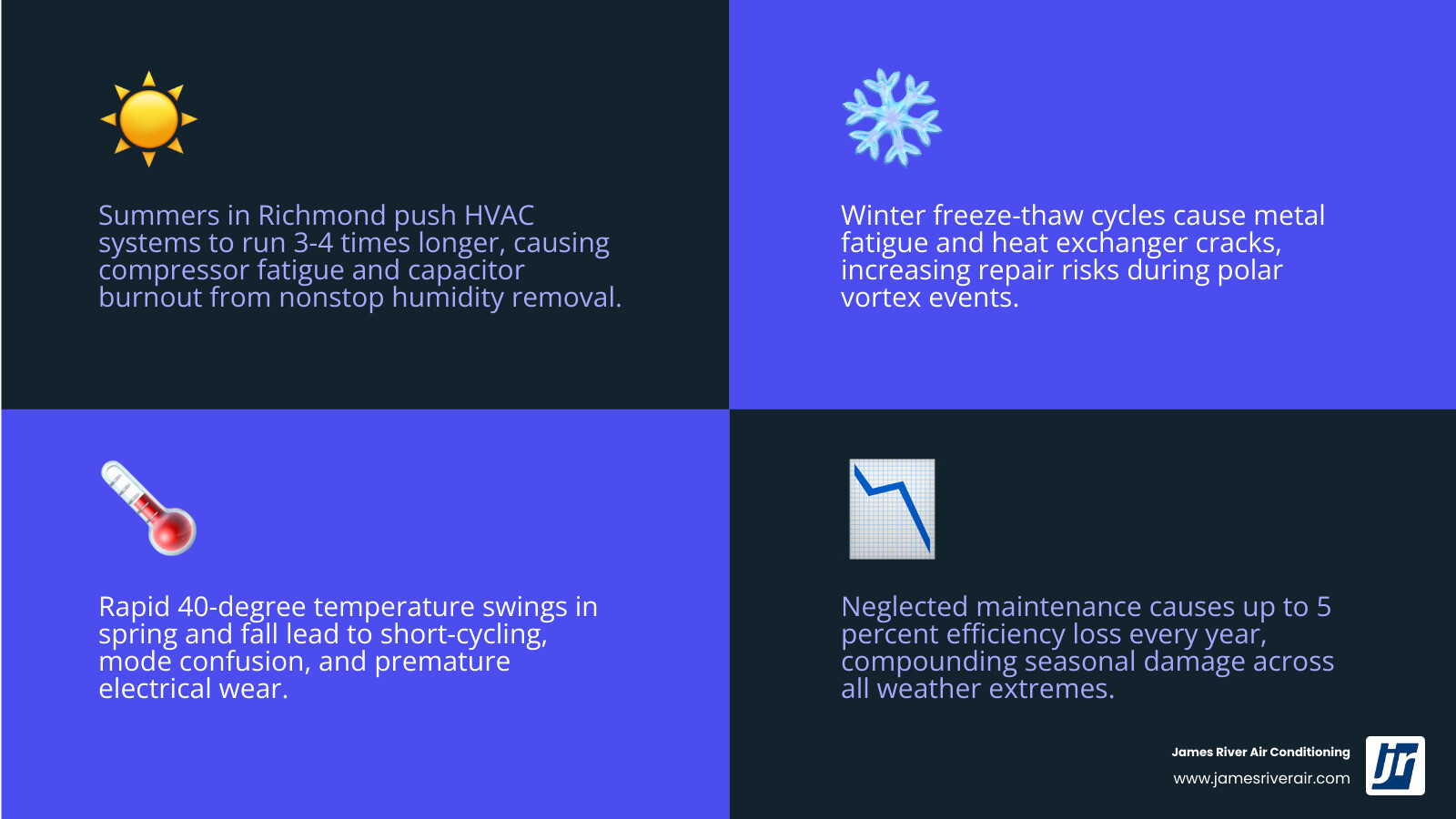
Here’s a quick summary of how each season damages your system:
| Season | Primary Stress | Key Risk |
|---|---|---|
| Summer | High humidity + heat forces longer run times | Compressor fatigue, capacitor burnout |
| Winter | Freeze-thaw cycles and extreme cold | Heat exchanger cracks, ignition failure |
| Spring/Fall | Rapid mode switching between heat and cool | Short-cycling, electrical component wear |
| Year-round | Neglected maintenance | Up to 5% efficiency loss per year |
Richmond sits squarely in a climate zone where all of these pressures hit hard. Summers bring sticky, high-dew-point air that forces your AC to work double duty — cooling the air and pulling moisture out of it. Winters deliver cold snaps and freeze-thaw cycles that crack metal, stress heat exchangers, and push heating systems to their limits. It’s no surprise that over 80% of regional HVAC service calls spike during extreme seasonal shifts.
The good news? Most of this wear is preventable with the right knowledge and the right maintenance plan.
The Science of How Hot Humid Summers and Cold Winters Stress Your HVAC

To understand how hot humid summers and cold winters stress your HVAC, we have to look at the physics of your home. Your heating and cooling system is essentially a giant heat exchanger. In the summer, it moves heat from inside to outside; in the winter, it does the opposite. When the weather in Central Virginia turns extreme, the “gradient”—the difference between the outdoor air and your desired indoor temperature—becomes a mountain your system has to climb.
Mechanical stress occurs because metal components expand and contract as they heat up and cool down. In a place like Richmond, where it might be 30°F in the morning and 70°F by the afternoon in May 2026, those components are constantly shifting. This thermal expansion leads to loose electrical connections and microscopic fatigue in the metal.
Furthermore, neglected systems in Virginia lose about 5 percent of their efficiency every single year. This means by the time your unit is five years old, it’s working 25% harder than it did on day one just to achieve the same results. This cumulative strain is often what leads to 7 Signs Your HVAC System Is Having a Mid-Life Crisis, where the unit begins to struggle even during moderate weather because the internal damage has already been done.
How hot humid summers and cold winters stress your hvac components in July
July in Richmond is legendary for its “air you can wear.” During these peak summer months, your system may consume up to 3-4 times more electricity than during milder seasons. This isn’t just because it’s hot; it’s because of the “latent heat load”—the energy required to remove moisture from the air.
The components most at risk during a Richmond heatwave include:
- The Compressor: Known as the heart of the system, the compressor works overtime to circulate refrigerant. When it runs nearly 24/7, the internal seals can dehydrate and the motor can overheat.
- Capacitors: These are like small batteries that give your motors the “kick” they need to start. High temperatures are the natural enemy of capacitors, often causing them to pop or lose their charge, leaving you without air on a 95°F afternoon.
- The Blower Motor: With high humidity making the air “heavier,” the blower motor has to work harder to push air through your ductwork.
One of the simplest ways to reduce this July stress is to Stop Guessing and Start Changing Your HVAC Filter on Time. A dirty filter adds resistance, making an already stressed system work even harder to breathe.
How hot humid summers and cold winters stress your hvac during Virginia’s freeze-thaw cycles
While summer is about endurance, winter is about survival. In regions like Henrico and Midlothian, we often experience freeze-thaw cycles where snow or ice melts during the day and refreezes at night. This is particularly brutal for heat pumps.
When moisture freezes on the outdoor coils, the system must enter a “defrost cycle.” This essentially reverses the system into cooling mode for a few minutes to melt the ice, using expensive auxiliary heat to keep your home warm in the meantime. Frequent defrosting stresses the reversing valve and the compressor.
For gas furnaces, the primary concern is the heat exchanger. The rapid expansion and contraction caused by the intense heat of the burners against the freezing intake air can lead to metal fatigue. Over time, this can cause cracks. A cracked heat exchanger isn’t just a repair issue; it’s a major safety hazard that can leak carbon monoxide into your home. When these issues arise, homeowners often find themselves at The HVAC Crossroads: How to Decide Between Repair and Replacement.
Why High Humidity is the Silent Killer of Cooling Efficiency
In Virginia, humidity is often a bigger problem than the actual temperature. When the dew point exceeds 65°F, your AC has to spend a significant portion of its energy just turning water vapor into liquid condensate. This is why you might notice your system running for a long time even if the thermostat says it’s only 75°F inside.
High humidity causes several specific problems:
- Evaporator Coil Icing: If your system is low on refrigerant or has a dirty filter, the high moisture content in the air can actually freeze onto the indoor coil, turning it into a block of ice and stopping all airflow.
- Mold and Mildew: Moisture that doesn’t drain properly becomes a breeding ground for biological growth inside your dark, cool ductwork.
- Efficiency Loss: Salt and moisture in the air can lead to corrosion on the outdoor fins, which has been shown to reduce heat transfer efficiency by up to 30%.
This is exactly Why Your AC Wants You to Sign a Maintenance Contract. Professional technicians can ensure your condensate lines are clear and your coils are clean, allowing the system to shed moisture efficiently rather than drowning in it.
The Impact of Rapid Temperature Swings on System Cycling
Richmond weather is famous for its indecisiveness. It is not uncommon to see a 40-degree swing in a single 24-hour period. These fluctuations force your HVAC system into a state of “thermostat confusion.”
| Weather Condition | System Behavior | Impact on Longevity |
|---|---|---|
| Consistent 85°F | Long, steady cycles | Moderate wear, high efficiency |
| Volatile 50°F to 90°F | Frequent “Short-Cycling” | High wear on starter components |
| Extreme Cold Snap | Continuous operation | High risk of component failure |
When a system cycles on and off frequently (short-cycling), it never reaches its peak operating efficiency. It’s like driving a car in stop-and-go traffic versus cruising on the highway. The “startup” phase is the most electrically demanding part of the cycle and causes the most wear on the motor windings.
Rapidly switching between heating and cooling modes also stresses the reversing valves in heat pumps and the control boards in modern high-efficiency units. To prevent these swings from breaking your system, Don’t Wait for the Smoke to Schedule Your HVAC Tune-Up. Catching a weak capacitor or a loose wire during a mild spring day is much better than dealing with a total failure during a heatwave.
Proactive Strategies to Protect Your Richmond Home from Seasonal Wear
You can’t change the Richmond weather, but you can change how your home responds to it. Protecting your system involves a mix of smart technology and basic “elbow grease.”
- Seal Your Ducts: Typical duct systems in older Richmond homes lose 20 to 30 percent of conditioned air through gaps and poor connections. This is air you’ve already paid to heat or cool, leaking into your attic or crawlspace. Sealing these leaks reduces the overall workload on your unit.
- Smart Thermostats: Modern thermostats use “adaptive recovery” to learn how long it takes to heat or cool your home. By syncing with local weather data, they can prevent the system from overworking during the hottest part of the day.
- Clear the Perimeter: Ensure your outdoor unit has at least two feet of clear space. Leaves, overgrown shrubs, and “Richmond dust” can clog the fins, forcing the compressor to run hotter and longer.
- The Right Schedule: Following The Ultimate HVAC Maintenance Checklist for Mid-Atlantic Homeowners ensures you’re checking the right components at the right time—like inspecting the furnace in October and the AC in April.
The Benefits of Regular HVAC Maintenance far outweigh the effort. A well-maintained system in Virginia can last 15–20 years, while a neglected one may give out in as little as 10.
Frequently Asked Questions about Weather-Related HVAC Stress
What are the warning signs that my system is struggling with the heat?
The most obvious sign is a system that runs constantly without ever reaching the set temperature on the thermostat. You should also listen for unusual noises—grinding or squealing often indicates a motor under stress, while banging can mean a failing compressor. If you notice uneven temperatures between rooms or a sudden spike in your utility bill that doesn’t match your usage, your system is likely crying for help. Follow these 5 Tips to Show Your HVAC System Love to help ease the burden.
How does winter ice accumulation affect my heat pump?
A light coating of frost is normal, but heavy ice accumulation is a red flag. Ice acts as an insulator, preventing the heat pump from extracting heat from the outdoor air. This forces the system into “Emergency Heat” or “Auxiliary Heat” mode, which uses electric resistance strips—a very expensive way to heat a home. If the ice gets thick enough, it can actually bend the fan blades or damage the delicate copper coils.
Can a smart thermostat really reduce seasonal wear and tear?
Yes, absolutely. By using algorithms that account for outdoor humidity and temperature, a smart thermostat can manage “recovery times” more efficiently. Instead of the system “blasting” on at full power when you get home, the thermostat can gradually adjust the temperature, reducing the number of high-wear start-up cycles.
Conclusion
At James River Air Conditioning, we’ve spent over 57 years helping our neighbors navigate the unique challenges of the Virginia climate. From the humid banks of the James River to the chilly winter nights in Powhatan and Hanover, we know exactly how hot humid summers and cold winters stress your HVAC.
Whether you need a quick tune-up to prepare for the July humidity or a full system evaluation after a brutal winter, our team is dedicated to keeping your home comfortable and your energy bills manageable. Don’t let the next Richmond weather swing catch you off guard.
Schedule your professional HVAC maintenance in Richmond today and ensure your system is ready for whatever the Virginia sky throws at it.
