
The Mid-Atlantic Survival Guide to HVAC Mold Prevention
Why Mid-Atlantic Homeowners Can’t Afford to Ignore HVAC Mold Prevention
Understanding how your HVAC system prevents mold in the Mid-Atlantic four season climate is one of the most important things you can do to protect your Richmond home. Here’s a quick answer:
How Your HVAC System Prevents Mold — At a Glance
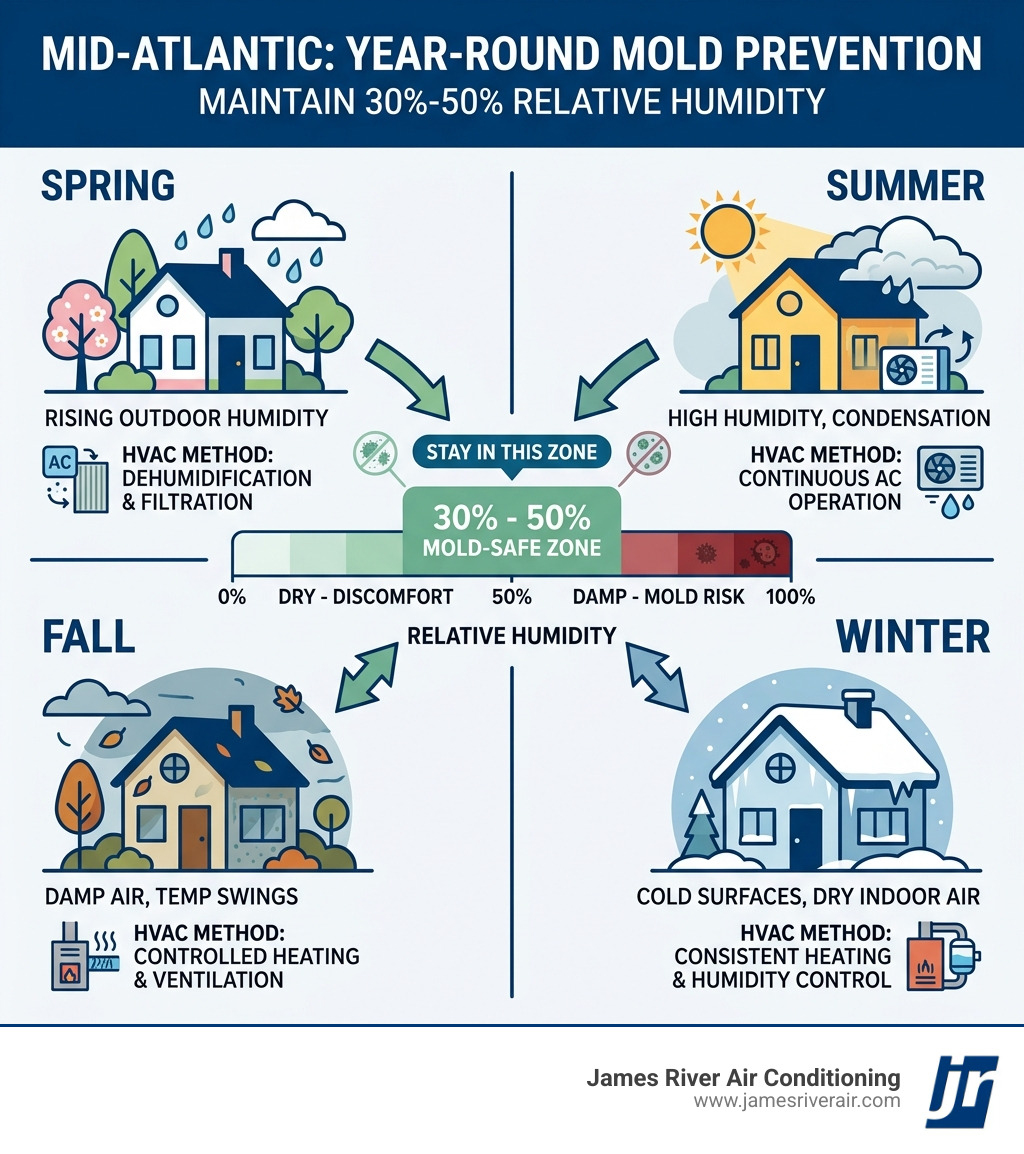
| Season | Primary Mold Risk | How Your HVAC Helps |
|---|---|---|
| Summer | High humidity, condensation on coils | AC removes moisture from air as it cools |
| Fall | Damp air, temperature swings | Heating raises dew point, reducing surface condensation |
| Winter | Cold surfaces, infiltrating damp air | Consistent heating keeps indoor humidity stable |
| Spring | Rising outdoor humidity, pollen | AC and filtration manage moisture and airborne particles |
The core principle: A well-maintained HVAC system keeps indoor relative humidity between 30% and 50% — the range where mold simply cannot get a foothold.
Richmond’s four-season climate is beautiful. It’s also relentless when it comes to moisture. Humid summers regularly push outdoor humidity above 80%. Damp fall rains soak into building materials. Winter cold creates condensation on walls and windows. Then spring arrives with a fresh wave of moisture before summer starts the cycle all over again.
That musty smell creeping from your vents when the AC kicks on isn’t just unpleasant — it’s often a warning sign that moisture is winning the battle inside your system. Mold can begin colonizing HVAC components within just 24 to 48 hours under the right conditions, and once it takes hold, it spreads spores through every room every time your system runs.
Your HVAC system is your first and most powerful line of defense. But only when it’s working correctly and maintained regularly.
Understanding the Richmond Climate: Why Four Seasons Mean Four Mold Risks
Living in the Mid-Atlantic region, specifically around Richmond, Glen Allen, or Midlothian, means we experience a true “mixed climate.” We don’t just deal with heat; we deal with a shifting moisture profile that changes every three months. Each season presents a unique challenge to your home’s structural integrity and your family’s health.
In the summer, the air is thick enough to wear. This high outdoor humidity infiltrates our homes through every tiny gap in the building envelope. If your AC isn’t pulling that moisture out, your indoor humidity will quickly exceed 60%, the “danger zone” where mold growth becomes nearly inevitable.
As we transition into fall and winter, the risks don’t disappear; they just change shape. Cooling temperatures can lead to “window sweat” and condensation on cold surfaces. When warm, humid indoor air hits a cold wall or window, it reaches its dew point and turns into liquid water—a feast for mold spores. Furthermore, many homeowners don’t realize that The Secret To Fresh Air Is Hiding Under Your Floorboards. In the Mid-Atlantic, damp crawl spaces are a primary source of indoor moisture. High humidity in these dark, confined spaces can migrate upward into your living area, making The Foundation Of Health Why Professional Crawl Space Services Matter a year-round priority for Virginia residents.
How Your HVAC System Prevents Mold in Mid Atlantic Four Season
At its core, your HVAC system is a giant dehumidifier. While we usually focus on the “temperature” on the thermostat, the “humidity” control is arguably more important for preventing biological growth. Mold thrives when indoor relative humidity (RH) exceeds 50% for extended periods. A properly functioning system in the Mid-Atlantic keeps your home between 30% and 50% RH, which is the mold-safe zone.
Stagnant air is mold’s best friend. When air sits still, moisture accumulates in corners, behind furniture, and inside closets. Your HVAC system prevents this by maintaining constant air circulation. By keeping the air moving and passing it through filtration and cooling coils, the system ensures that moisture never has the chance to settle and soak into your drywall or carpet.
However, the system can only do this job if the building envelope is relatively tight and the ducts are clean. To understand the full scope of how to protect your home, we recommend checking out The Ultimate Guide To Keeping Your Ducts And Lungs Mold Free. Keeping your system in top shape is the cornerstone of Jrac/Residential Services Jrac/Residential Indoor Air Quality.
How your hvac system prevents mold in mid atlantic four season during humid summers
During a Richmond July, your air conditioner is doing double duty. It is handling the “sensible load” (lowering the temperature) and the “latent load” (removing moisture). As warm, humid air is pulled across the cold evaporator coil, the moisture in the air condenses into liquid water, which then drips into a pan and is carried away.
A common issue we see in Virginia is “short-cycling.” This often happens with oversized AC units. A unit that is too large for the home will cool the air very quickly and shut off before it has had a chance to run through a full dehumidification cycle. It typically takes at least three minutes of operation for an AC to reach its full moisture-removal capacity. If your system is constantly clicking on and off, it may be leaving your home feeling “clammy” and humid, even if the temperature is 72 degrees.
To maximize mold prevention in the summer:
- Check your SEER rating: Modern units with a SEER of 14 or higher are generally better equipped for enhanced moisture removal.
- Thermostat Settings: Aim for a range between 68 and 72 degrees Fahrenheit.
- Fan Mode: Always keep your fan set to “Auto” rather than “On.” When the fan is set to “On,” it continues to blow air over the wet coils even after the cooling cycle ends, which can re-evaporate that moisture back into your home.

How your hvac system prevents mold in mid atlantic four season through filtration and drainage
While the cooling process removes the moisture, the filtration and drainage systems ensure that the moisture (and the food mold eats) doesn’t stay in your home. Mold needs three things to grow: moisture, warmth, and a food source (like dust, skin cells, or organic debris).
- MERV Filters: High-quality air filters (we recommend MERV 8 to 13) trap the organic dust that mold uses for food. By keeping your coils and ducts clean, you are essentially starving any potential mold spores.
- Condensate Lines and Drip Pans: This is the most common site for HVAC mold. If your drain line is clogged with “bio-film” or algae, water will back up into the pan. This standing water in a dark, warm environment is a perfect incubator for mold.
- Airflow Velocity: Proper airflow ensures that moisture doesn’t linger on the coils longer than necessary.
In our region, the crawl space often dictates the health of the HVAC system. If your unit is located in a damp crawl space, it is under constant threat from external moisture. This is why we integrate Jrac/Residential Services Jrac/Residential Crawl Spaces into our comprehensive air quality strategy.
Seasonal Strategies: Preventing Condensation from Autumn to Spring
When the humidity of summer fades, many Richmond homeowners think they are in the clear. However, the “shoulder seasons” and winter bring their own risks.
In the fall and winter, the primary goal shifts to preventing condensation. Condensation occurs when warm, moist air (from cooking, showering, or even breathing) hits a surface that is below the “dew point.” In a Virginia winter, this often happens on windows or in corners of rooms with poor insulation.
Your heating system prevents mold by:
- Lowering Relative Humidity: Warm air can hold more moisture than cold air, which effectively lowers the relative humidity percentage.
- Circulating Air: Moving warm air across exterior walls prevents “cold spots” where condensation might form.
- Raising the Dew Point: By keeping surfaces warm, the heating mode ensures that moisture stays in the air as a gas rather than turning into a liquid on your walls.
It is also vital to keep an eye on the lower levels of your home during these months. Why Crawl Space Maintenance Is Essential For Virginia Homes And Beyond is a question we answer frequently in the winter, as cold dampness can seep into the structure. Learning the Warning Signs Your Crawl Space Is Impaired can save you from a massive mold remediation bill in the spring.
Advanced IAQ Solutions for Virginia Homeowners
Sometimes, a standard HVAC system needs a little help to keep up with the extreme Mid-Atlantic humidity. For homeowners in areas like Chesterfield or Powhatan, we often recommend advanced Indoor Air Quality (IAQ) upgrades.
- Whole-Home Dehumidifiers: These units work alongside your HVAC to pull gallons of water out of the air every day without over-cooling your home. They are the “gold standard” for mold prevention in Virginia.
- Energy Recovery Ventilators (ERV): In a “tight” modern home, an ERV is essential. It brings in fresh outdoor air while exhausting stale indoor air. Crucially, the ERV membrane trades moisture between the incoming and outgoing air, preventing the humid Virginia air from overwhelming your AC in the summer.
- UV-C Germicidal Lights: Installed near the evaporator coil, these lights disrupt the DNA of mold spores, preventing them from reproducing on the wet surfaces of your system.
- Photocatalytic Oxidation (PCO): This technology uses UV light and a catalyst to create scrubbing molecules that neutralize mold, bacteria, and odors throughout the entire home.
For those looking for the ultimate protection, exploring Jrac/Residential Services Jrac/Residential Installation Services/Indoor Air Quality is the best next step.
Identifying and Remediating Hidden HVAC Mold
How do you know if mold has already moved in? In the Mid-Atlantic, we often see these five red flags:
- The “Damp Basement” Smell: If you notice a musty odor specifically when the AC or heat first kicks on, mold is likely growing on the coils or in the ducts.
- Visible Spots: Look for fuzzy black, green, or white spots around your supply vents or on the ceiling near the registers.
- Allergy Spikes: If your family experiences increased sneezing, coughing, or itchy eyes that seem to improve when you leave the house, your HVAC may be circulating spores.
- Standing Water: Check your secondary drain pan (the metal tray under your unit). If there is water in it, your primary drain is clogged, and mold is likely already growing.
- Weak Airflow: Dust and mold buildup on coils can physically block airflow, making your system work harder and run longer.
If you suspect an issue, don’t wait. Mold can cause structural damage and significant health risks. It is important to Stop The Sog And Understand How Crawl Space Moisture Affects Your Home before the problem spreads to your upstairs living areas.
Frequently Asked Questions about Regional Mold Prevention
What is the ideal indoor humidity level for Virginia homes?
To prevent mold and maintain comfort, you should aim for a relative humidity between 30% and 50%. During the most humid parts of a Richmond summer, keeping it below 50% is critical. If your humidity consistently stays above 60%, mold can begin to grow on porous surfaces like drywall and wood.
Should I run my HVAC fan on “On” or “Auto” to prevent mold?
In the Mid-Atlantic, you should almost always use the “Auto” setting. When the fan is set to “On,” it runs continuously. After the cooling cycle ends, the fan will blow air over the still-wet evaporator coils, pushing that moisture back into your home. This can raise your indoor humidity by 10-15% in a matter of minutes.
How often should I schedule professional HVAC maintenance in the Mid-Atlantic?
We recommend professional maintenance twice a year—once in the spring before the cooling season and once in the fall before the heating season. In our four-season climate, your system faces different stressors every six months. Regular tune-ups ensure that your drain lines are clear, your coils are clean, and your system is actually capable of removing the humidity it was designed to handle.
Conclusion
Your HVAC system is more than just a temperature machine; it is a sophisticated environmental control system. Understanding how your HVAC system prevents mold in the Mid-Atlantic four season cycle is the first step toward a healthier, more comfortable home. From the humid heights of August to the damp chills of January, your system works tirelessly to manage moisture and keep your family safe.
At James River Air Conditioning, we have been the trusted name in Richmond for over 57 years. Our team of experts is ready to help you optimize your home’s air quality with world-class service and an entrepreneurial spirit. Whether you need a seasonal tune-up, a crawl space inspection, or an advanced IAQ upgrade, we are here to help.
Don’t let mold take over your home. Request expert indoor air quality services today and breathe easy knowing your Mid-Atlantic home is protected.
