
Why Knowing How to Prevent HVAC Emergencies with Maintenance Could Save You This Season
Understanding how to prevent HVAC emergencies with maintenance is one of the most valuable things you can do as a homeowner — especially in the Richmond area, where humid summers and cold winters push your system hard year-round.
Quick answer: How to prevent HVAC emergencies with maintenance
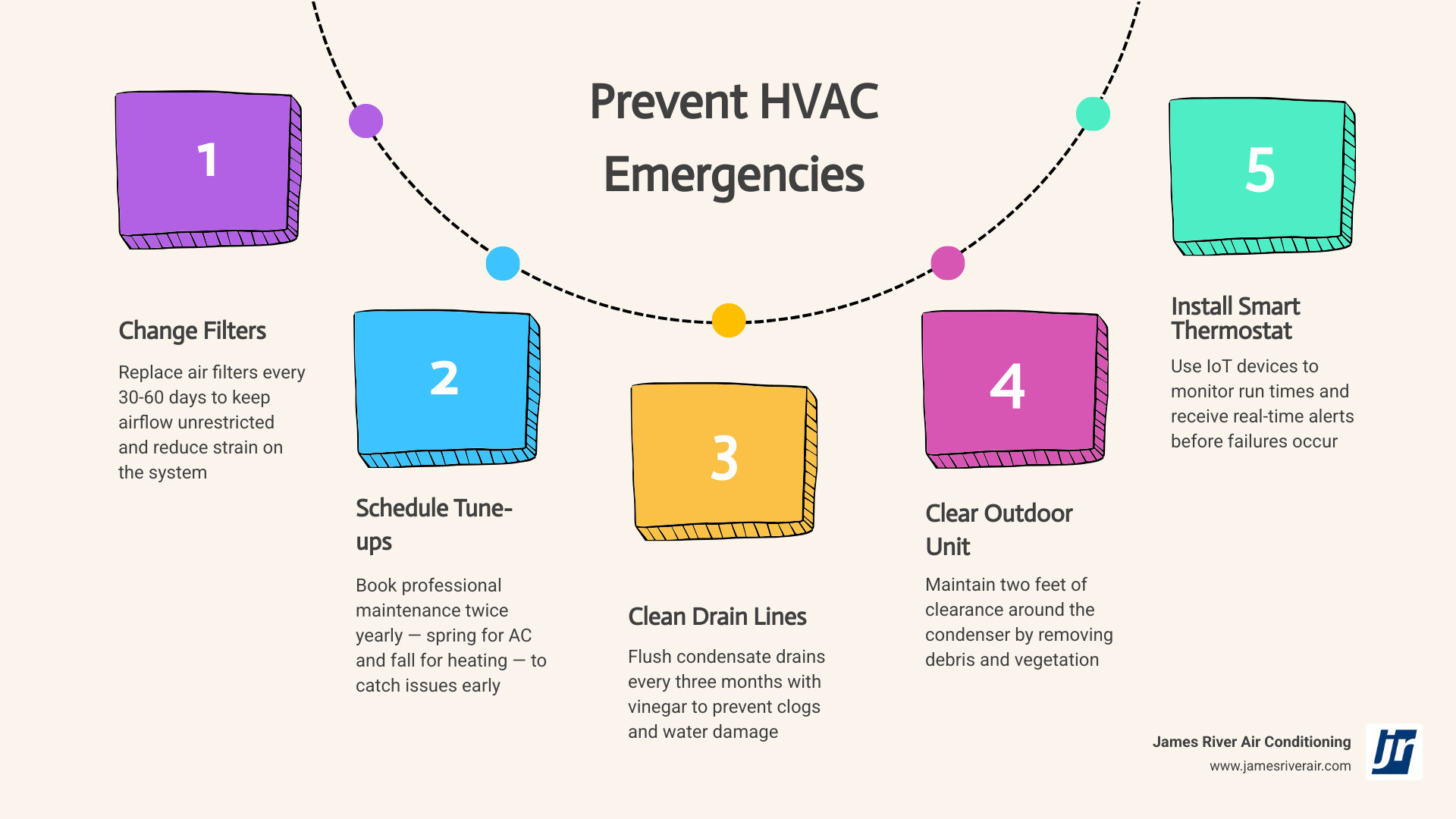
- Change air filters every 30–60 days to keep airflow unrestricted
- Schedule professional tune-ups twice a year — spring for your AC, fall for your heating system
- Clean the condensate drain line every three months to prevent clogs and water damage
- Keep the outdoor unit clear of debris with at least two feet of clearance on all sides
- Watch for warning signs like strange noises, weak airflow, odd smells, or rising energy bills
- Install a smart thermostat to detect unusual run times and get early alerts
- Seal duct leaks to stop the 20–30% of conditioned air that escapes in a typical home
Most HVAC emergencies don’t come out of nowhere. Research consistently shows that the vast majority of system failures trace back to gradual neglect — a dirty filter here, a skipped tune-up there — rather than sudden, unforeseeable breakdowns. In fact, homeowners who stick to regular maintenance are 50% less likely to face an unexpected breakdown, and consistent upkeep can cut the overall risk of a costly failure by as much as 95%.
Think of it this way: your HVAC system runs for thousands of hours every year, often under significant stress from heat, humidity, dust, and pollen. Without routine care, small problems quietly compound until something gives out — usually on the hottest day of July or the coldest night of January.
The good news? Most of this is entirely preventable.
Defining HVAC Emergencies vs. Routine Repairs
Not every HVAC hiccup is a crisis, but knowing the difference can save you from a dangerous situation or unnecessary panic. In our 57 years of serving the Richmond community, we’ve seen that homeowners often struggle to decide when to call for immediate help.
A routine repair is something that can usually wait until the next business day. Examples include a slightly noisy fan, a small increase in your utility bill, or a single room that feels a bit warmer than the rest of the house. These are “yellow flags” that need attention soon, but they aren’t threatening your home’s integrity or your family’s safety.
An HVAC emergency, however, is any situation that poses a direct threat to your health, safety, or property. Here is what we consider a true emergency:
- Extreme Temperatures: If your AC fails when it’s 95°F outside or your furnace quits when it’s below freezing, the indoor temperature can quickly reach unsafe levels, especially for children, the elderly, or pets.
- Safety Hazards: This includes the smell of gas (rotten eggs) or a burning odor (burning plastic or electrical ozone). If you see sparks or smoke coming from your unit, that is an immediate emergency.
- Carbon Monoxide Risks: If your CO detector goes off, or if you have a cracked heat exchanger in your furnace, this is a life-threatening situation.
- Major Water Damage: A clogged condensate drain can send gallons of water into your drywall, ceilings, or flooring. If you see significant pooling around your indoor unit, it’s time to act.
- Electrical Issues: If your system is constantly tripping the circuit breaker, do not keep resetting it. This indicates a serious electrical fault that could lead to a fire.
As we often say, Don’t Wait for the Smoke to Schedule Your HVAC Tune-Up. By the time you smell smoke or see ice on your lines, the damage is already underway.

How to prevent HVAC emergencies with maintenance through professional care
While DIY tasks are essential, there is no substitute for a professional set of eyes. A professional tune-up is like a wellness check for your home’s heart. When our technicians visit your home in Mechanicsville or Midlothian, we aren’t just looking for what’s broken; we are looking for what is about to break.
Statistics show that regular maintenance can cut the risk of costly breakdowns by up to 95%. Beyond just preventing a “no-cool” call, a well-maintained system operates 15-20% more efficiently than a neglected one. This means that while you are preventing an emergency, you are also paying yourself back through lower monthly utility bills.
Professional care also protects your wallet in the long run by extending the lifespan of your equipment. A neglected system in Virginia’s humidity typically lasts about 8-10 years. However, with consistent maintenance, that same system can easily last 15-20 years. For more on this, check out the Benefits of Regular HVAC Maintenance.
Many homeowners find that the most reliable way to stay on track is through a service agreement. It takes the guesswork out of scheduling and ensures you get priority service when everyone else is calling during a heatwave. You can learn more about Why Your AC Wants You to Sign a Maintenance Contract to see how it fits your needs.
How to prevent HVAC emergencies with maintenance by managing airflow
Airflow is the lifeblood of your HVAC system. When airflow is restricted, your system has to work twice as hard to move half the air. This leads to overheating, component wear, and eventually, a total shutdown.
The three main culprits of restricted airflow are:
- Dirty Filters: This is the #1 cause of HVAC failure. A clogged filter acts like a wall, forcing the blower motor to strain and eventually burn out. It can also cause your evaporator coils to freeze over, even in the middle of a Richmond July.
- Clogged Drains: Your AC doesn’t just cool the air; it dehumidifies it. That moisture has to go somewhere. If the condensate drain line is clogged with algae or debris, that water backs up. Modern systems have safety switches to shut the unit down to prevent flooding, which results in a sudden emergency “no-cool” situation.
- Neglected Coils: Outdoor coils covered in grass clippings or indoor coils coated in dust cannot exchange heat effectively. This causes the compressor to run at higher temperatures and pressures, significantly shortening its life.
To avoid these issues, we recommend you Stop Guessing and Start Changing Your HVAC Filter on Time. In Virginia, where pollen and humidity are high, checking your filter every 30 days is the gold standard.
How to prevent HVAC emergencies with maintenance using smart technology
It is May 2026, and the technology available to homeowners has never been better. We are now seeing smart thermostats and IoT (Internet of Things) devices that do much more than just change the temperature from your phone.
Modern smart thermostats now feature predictive diagnostics. These systems can detect if your unit is running 20% longer than it should to reach a certain temperature. If the AI detects a slow decline in performance, it can send an alert to your phone before you even notice the house is getting warm.
Remote monitoring allows us to see “runtime patterns.” For example, if your system is short-cycling (turning on and off rapidly), a smart thermostat can log this behavior. Catching a short-cycling issue early can prevent a blown compressor or a failed start capacitor—two of the most common emergency repairs we see in Short Pump and Glen Allen.
Essential DIY Maintenance Tasks for Richmond Homeowners
While we handle the technical side, there are several things you can do to keep your system happy between professional visits. These simple habits are the foundation of how to prevent HVAC emergencies with maintenance.
- Filter Replacement: Change your filters every 30 to 90 days. If you have pets (looking at you, Golden Retriever owners!) or live in a high-pollen area like Chesterfield, stick to a 30-day schedule.
- Condensate Drain Flush: Every three months, pour a cup of distilled vinegar down your condensate drain line. This kills algae and prevents the “slime” that leads to clogs and water damage.
- Outdoor Clearance: Keep shrubs, weeds, and tall grass at least two feet away from your outdoor unit. Your condenser needs to “breathe” to release heat. If it’s boxed in by landscaping, it will overheat.
- Vent Dusting: Keep your return and supply vents clear of dust and furniture. Blocking vents increases the static pressure in your ductwork, which can damage the blower motor.
For a deeper dive into these habits, read our guide on 5 Tips to Show Your HVAC System Love.
Seasonal Preparation for Mid-Atlantic Climates
In Virginia, we experience the full range of seasons. Each one requires a different strategy.
- Spring (February – March): This is the time for your AC tune-up. You want to beat the first 80-degree day. We check refrigerant levels, clean the outdoor coils, and test the capacitors.
- Fall (September – October): This is for your heating system. Whether you have a furnace or a heat pump, we check the heat exchanger for safety and ensure the backup heat strips are functioning.
- Winter Readiness: Snow and ice can be tough on heat pumps. Ensure that snow doesn’t pile up around the base of the unit, which can block the defrost cycle.
For a complete list of tasks tailored to our region, see The Ultimate HVAC Maintenance Checklist for Mid-Atlantic Homeowners and our specific advice on 6 Tips Protecting HVAC from Snow.
Warning Signs Your System is Heading Toward Failure
Most systems will try to “talk” to you before they quit. If you notice any of these signs, don’t wait for the total breakdown:
- Unusual Noises: Screeching (fan belt), grinding (motor bearings), or loud thumping (loose components) are all cries for help.
- Short Cycling: If your system turns on and off every few minutes, it’s likely overheating or has a failing sensor.
- Odd Smells: A “dirty sock” smell often indicates mold in the coils, while a metallic burning smell indicates electrical trouble.
- Weak Airflow: If you can barely feel air coming out of the vents, your blower motor or filter is likely the issue.
- Rising Utility Bills: If your usage hasn’t changed but your bill has spiked by 20% or more, your system is losing efficiency fast.
- Moisture Pooling: Any water around the base of your indoor unit is a sign of a clogged drain or a frozen coil.
Repair vs. Replace: Making the Right Call in 2026
As of 2026, the landscape of HVAC equipment has changed significantly. New SEER2 standards are now the law of the land, meaning new units are more efficient than ever, but they also require precise installation and maintenance.
How do you know when to stop repairing and start replacing? We generally use the “Rule of 5,000.” Multiply the age of the system by the cost of the repair. If the total is more than $5,000, a replacement is often the smarter financial move.
| Feature | Aging System (10+ Years) | Modern System (2026 SEER2) |
|---|---|---|
| Efficiency | Often 10-13 SEER | 15-20+ SEER2 |
| Reliability | High risk of peak-season failure | 10-year parts warranty |
| Energy Bills | Increasing as components wear | 15-20% lower than old units |
| Air Quality | Basic filtration | Advanced HEPA/UV options |
| Technology | Manual/Basic Programmable | AI-driven/Remote Diagnostics |
A typical home loses 20-30% of its conditioned air through duct leaks. Sometimes, the “emergency” isn’t the unit at all, but the ductwork. If you’re replacing your system, always have your ducts inspected and sealed to ensure you’re getting the efficiency you’re paying for.
Frequently Asked Questions about HVAC Maintenance
What are the signs of an impending HVAC emergency?
The most common signs include a sudden loss of airflow, ice forming on the copper refrigerant lines (even in summer), loud grinding or screeching noises, and a burning smell. If your thermostat display goes blank or your system is rapidly turning on and off (short-cycling), these are also major red flags that an emergency shutdown is imminent.
How often should I change my air filters in Virginia?
In the Richmond area, we recommend checking your filter every 30 days. Most homes should replace them every 60 days. However, if you have pets, suffer from seasonal allergies, or if it is peak pollen season, you should change them every 30 days. We recommend using high-efficiency MERV 11 or 12 filters to capture the fine particles common in our Virginia air.
Can smart thermostats really prevent system failures?
Yes! By 2026, smart thermostats have become powerful diagnostic tools. They can monitor how long your system takes to cool or heat your home. If the system starts taking 20% longer than usual to reach the set temperature, the thermostat can alert you to a potential issue like a refrigerant leak or a failing part before the system suffers a total breakdown.
Conclusion
At James River Air Conditioning, we believe that a little bit of prevention goes a long way. For over 57 years, we’ve helped our neighbors in Richmond, Henrico, and Chesterfield keep their homes comfortable through every heatwave and cold snap. Our entrepreneurial spirit drives us to stay ahead of the curve, utilizing the latest 2026 technology to keep your home safe.
If you want the ultimate peace of mind, we invite you to Protect Your Castle with the Bow Tie Service Plan. It’s the easiest way to ensure your system gets the professional attention it needs, twice a year, without you having to remember to call us.
Don’t wait for a crisis to happen. Take the first step in how to prevent HVAC emergencies with maintenance and Schedule Your Professional Maintenance Today. We look forward to serving you!
