

Is Your HVAC System Getting Too Old? Here’s What Richmond Homeowners Need to Know
How old is too old for an HVAC system is one of the most common questions homeowners face — and the short answer depends on what type of system you have. Here is a quick breakdown:
| System Type | Typical Lifespan | Start Planning at |
|---|---|---|
| Central Air Conditioner | 15-20 years | 12 years |
| Gas Furnace | 15-25 years | 15 years |
| Heat Pump | 10-16 years | 10 years |
| Electric Furnace | 20-30 years | 15 years |
| Boiler | 20-35 years | 20 years |
If your system is approaching or past these ranges, it is time to pay close attention.
Nearly one in three homeowners deals with a major HVAC breakdown before their system even reaches the end of its expected life. Most systems do not fail all at once. They slow down gradually — costing more to run, breaking down more often, and struggling to keep up on the hottest and coldest days of the year. By the time a system is 10 to 12 years old, it may already be running at only 80 to 85% of its original efficiency. That gap quietly shows up on your energy bill every single month.
Whether your system is pushing 15 years or you just want to know where you stand, this guide will help you make a clear-eyed decision about what comes next.
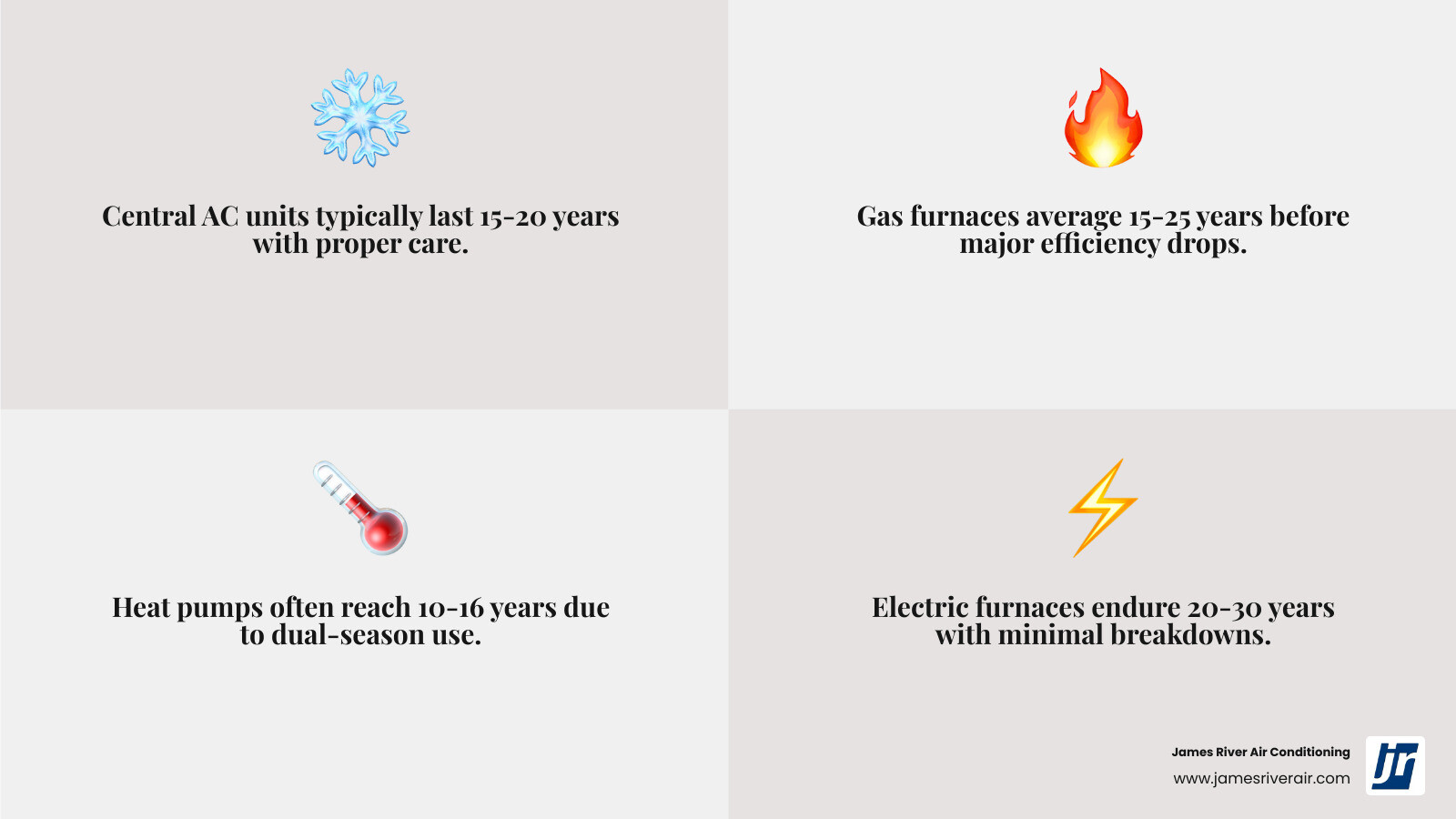
Average Lifespan of Residential Heating and Cooling Systems
No HVAC system expires on its birthday, but age does matter. Different types of equipment age at different rates because they run in different seasons, have different mechanical loads, and face different wear patterns.
Here is a practical comparison for homeowners in Richmond and surrounding Central Virginia communities:
| System Type | Average Lifespan | Why the Range Varies |
|---|---|---|
| Central AC | 15-20 years | Maintenance, humidity, coil condition, duct leakage |
| Gas Furnace | 15-25 years | Heat exchanger condition, maintenance, usage |
| Heat Pump | 10-16 years | Year-round operation for both heating and cooling |
| Electric Furnace | 20-30 years | Fewer combustion components, generally simpler design |
| Boiler | 20-35 years | Build quality, water conditions, maintenance history |
A few helpful takeaways:
- Central air conditioners usually have a median service life of about 12 to 15 years, even though some well-maintained units make it to 15 to 20 years.
- Heat pumps often wear out sooner than central AC because they pull double duty in our climate, handling both summer cooling and winter heating.
- Gas furnaces can last longer than AC systems, but after the mid-teen years, age becomes a bigger safety conversation, not just a comfort one.
- Boilers are usually the long-distance runners of the group, though efficiency and repair history still matter.
Maintenance plays a huge role here. Two systems installed on the same street can age very differently depending on filter changes, tune-ups, airflow, installation quality, and how hard the equipment has to run. If you want to extend system life, regular service is not optional maintenance fluff. It is what keeps small issues from turning into compressor strain, overheated motors, dirty coils, and premature failure. For more on that, see our preventive maintenance services.
How Old Is Too Old for an HVAC System?
The honest answer is this: most systems are not “too old” because of age alone. They become too old when age combines with declining efficiency, reliability problems, outdated refrigerant, or safety concerns.
That said, there are a few useful benchmarks.
- Around year 10 to 12, many systems hit an inflection point where wear starts to show up more often.
- Around year 15, replacement becomes a serious conversation for most central AC systems and many furnaces.
- Around year 20, many systems are well beyond the point where repair is the smartest long-term plan.
Think of year 12 as the warning stage and year 15 as the planning stage for many homes. Your equipment may still run, but it may not run well, quietly, safely, or efficiently.
Two big 2026 realities also affect the answer:
- R-22 refrigerant has been phased out since 2020. If an older air conditioner or heat pump uses R-22 and develops a leak, replacement often makes more sense than continuing to invest in aging equipment.
- Modern systems are built to newer efficiency standards, including SEER2 requirements. That means even a unit that still works may be far behind current performance expectations.

Decoding Serial Numbers to Determine How Old Is Too Old for an HVAC System
If you do not know how old your system is, the serial number is often your best clue.
Start by finding the nameplate on the equipment. On an outdoor condenser, it is usually on the side panel. On a furnace or air handler, it is commonly inside the cabinet door area or on an exterior label.
Look for:
- Model number
- Serial number
- Manufacture date
- Refrigerant type
Some units plainly list a manufacturing date. If not, the serial number often encodes it. A common format uses the first four digits to show the year and week of manufacture. For example, “1422” may mean the 22nd week of 2014. Other manufacturers use different formats, so decoding can be brand-specific.
If the sticker is faded, dirty, or written in what appears to be ancient HVAC hieroglyphics, we can help identify it during an inspection.
Also check the refrigerant listed on the nameplate:
- R-22 means the system is older and may be expensive to keep repairing if it leaks
- R-410A is newer than R-22, though the industry is continuing to evolve refrigerants in newer equipment
- If the label is missing, that alone may tell you the unit has been around the block a few times
Why Efficiency Loss Signals How Old Is Too Old for an HVAC System
Age does not just increase breakdown risk. It also chips away at efficiency.
Research shows that by year 10, many central air systems are operating at only about 80 to 85% of their original efficiency. A 12-year-old unit may have lost roughly 20 to 30% of its original performance. Over a full system life, older equipment can use 20 to 40% more energy than modern alternatives.
That happens because of:
- Coil buildup and restricted airflow
- Fan motor wear
- Compressor fatigue
- Duct leakage
- Refrigerant problems
- Electrical component degradation
And remember: leaky ducts can waste up to 30% of conditioned air. Sometimes the system is not just old. It is old and trying to cool your attic.
If your utility bills keep climbing without a major rate jump, that is often one of the earliest clues that your system is aging poorly. We cover more ways to spot that problem in these high energy bill tips.
Key Signs Your System Is Reaching Retirement
Age gives us context, but symptoms tell us what is happening right now. A system may be nearing retirement if you notice any of the following:
- Frequent repairs, especially if major parts keep failing
- Uneven temperatures between rooms
- Long run times or short cycling
- Strange noises like banging, squealing, rattling, or grinding
- Higher humidity indoors during summer
- More dust or poorer air quality
- Rising energy bills
- Trouble keeping up during Richmond’s hottest or coldest days
A classic warning sign is the “repair-of-the-month” pattern. First a capacitor. Then a contactor. Then a blower motor. Then something else. At that point, your system is not having one bad day. It is aging out.
Another common clue is comfort inconsistency. If one room feels like July and another feels like October, the issue may be airflow, duct leakage, equipment wear, or improper sizing. Either way, older systems struggle more to deliver even comfort.
If your system is showing these signs, do not wait for smoke signals. A professional tune-up or evaluation can help you decide whether you need maintenance, repair, or a replacement plan. This is a good time to read Don’t Wait for the Smoke to Schedule Your HVAC Tune-Up.
Safety Risks of Aging Equipment
For older HVAC systems, comfort and efficiency are only part of the conversation. Safety matters too.
For gas furnaces, one of the biggest concerns is a cracked heat exchanger. That can allow combustion gases, including carbon monoxide, to enter the home. A cracked heat exchanger is not a “keep an eye on it” issue. It requires immediate professional attention, and safety codes such as NFPA 54 treat it very seriously.
Other safety concerns with aging equipment include:
- Carbon monoxide risk from furnace damage or venting problems
- Electrical hazards from worn wiring, failing capacitors, or overheated components
- Fire risk from stressed motors or electrical failures
- Water damage from clogged drains or aging condensate components
- Refrigerant leaks that make an old AC impractical to repair
If you have an older gas furnace and have not had it inspected recently, annual service is one of the best ways to catch hidden issues before they become dangerous.
The Financial Math: Repair vs. Replace Decision Frameworks
Most homeowners do not ask whether an old HVAC system can be repaired. It usually can. The real question is whether it should be.
Two common decision rules help simplify that choice:
- The 50% rule: if a repair is 50% or more of the cost of replacement, replacement is often the wiser move.
- The $5,000 rule: multiply the age of the system by the repair amount. If the result is 5,000 or more, replacement usually deserves serious consideration.
Examples:
- A 5-year-old system with a modest repair usually leans toward repair.
- A 12-year-old system with a major repair often leans toward replacement.
- A 15-plus-year-old unit with repeated issues is usually telling you its story pretty clearly.
Other factors matter too:
- Is the system still under warranty?
- Does it use R-22 refrigerant?
- Has it needed several repairs in the last two years?
- Is it struggling to maintain comfort?
- Are your energy bills creeping up?
The goal is not to panic-replace every older unit. It is to avoid pouring good money into a system that is already sliding downhill. If you are weighing your options, our page on HVAC replacement planning can help you think through the next step.
The “Slow Bleed” of Recurring Repairs
Sometimes the problem is not one dramatic repair. It is the steady drip of repeated service calls.
This is the “slow bleed” version of HVAC aging:
- A capacitor fails in early summer
- A fan motor struggles later in the season
- The system needs refrigerant attention next
- Then airflow issues or a contactor problem show up
Each repair may seem manageable on its own, but together they can add up to a lot of disruption and frustration. You still end up with an older, less efficient system and no fresh warranty clock.
That is why maintenance contracts and routine tune-ups can be so valuable. They help catch wear patterns early and reduce the chances of surprise failures during peak weather. Learn more here: Why Your AC Wants You to Sign a Maintenance Contract.
Maximizing Longevity in the Richmond Climate
Richmond-area weather is not especially gentle on HVAC equipment. Our Mid-Atlantic climate brings:
- Hot, humid summers
- Damp shoulder seasons
- Winter cold snaps
- Long cooling seasons with significant humidity control demands
Humidity matters more than many homeowners realize. High moisture levels can make AC systems run longer, stress evaporator coils, and increase wear on components. Heat pumps in particular can age faster because they run year-round instead of taking a season off.
Salt air corrosion is mostly a bigger issue near the coast than inland Richmond, but humidity, pollen, debris, and heavy seasonal swings still take a toll here. Installation quality also matters a lot. Even the best equipment can have a shortened life if it is oversized, undersized, poorly charged, or connected to leaky ductwork.
Regular maintenance is one of the most reliable ways to push your system toward the high end of its lifespan range. Annual inspections, coil cleaning, airflow checks, and safety testing can prevent a lot of premature aging. For a deeper look, see Benefits of Regular HVAC Maintenance.
Proactive Steps for Homeowners
There is plenty you can do to help your system age gracefully instead of dramatically.
- Change filters on time to reduce strain on motors and airflow
- Keep at least two feet of clearance around the outdoor unit
- Gently rinse visible debris from the condenser coil when appropriate
- Do not close too many vents, which can increase duct pressure and air leakage
- Schedule professional tune-ups before peak heating and cooling seasons
- Watch for humidity problems, weak airflow, and unusual noises
- Seal leaky ducts so conditioned air reaches the rooms you actually live in
- Use a programmable or smart thermostat to avoid unnecessary runtime
- Keep return vents unblocked by furniture or rugs
- Start planning for replacement before the system fails in extreme weather
If you want help with the basics, these guides are useful:
- Stop guessing and start changing your HVAC filter on time
- 5 tips to show your HVAC system love
- The ultimate HVAC maintenance checklist for Mid-Atlantic homeowners
Frequently Asked Questions about HVAC Age
Can a well-maintained furnace really last 30 years?
Sometimes, yes, but it is the exception rather than the rule. Some electric furnaces and certain well-built older systems can last that long. But long life does not always mean good value. A furnace that reaches 30 years old may be far less efficient than modern equipment, and for gas models, safety becomes a bigger concern as the heat exchanger ages.
Does a heat pump last as long as a central AC?
Usually no. Heat pumps generally have shorter lifespans because they handle both heating and cooling. In Central Virginia, that means year-round work instead of mainly summer duty. A central AC often lasts around 15 to 20 years, while many heat pumps fall into the 10 to 16 year range.
Is a 10-year-old AC unit considered too old?
Not necessarily, but it is no longer young. Ten years is often the point when efficiency starts to slide and repair risk begins to rise. If the unit has been well maintained and is still reliable, it may have good years left. But it is smart to start planning, especially if you notice higher energy bills, comfort issues, or refrigerant-related concerns.
Conclusion
So, how old is too old for an HVAC system? For many homeowners, the answer is not one exact number. It is the point where age, efficiency loss, reliability issues, and safety concerns all start stacking up.
As a general rule:
- Start planning at 10 to 12 years for AC systems and heat pumps
- Take a hard look at many systems around the 15-year mark
- Treat systems nearing 20 years as replacement candidates unless they are performing unusually well
At James River Air Conditioning, we have served Richmond-area homeowners for more than 57 years with world-class service and an entrepreneurial spirit. If your system is aging, struggling, or simply making you wonder whether the next repair is worth it, we are here to help you evaluate it clearly and honestly.
