

Why Understanding How Seasonal Extremes Affect Your Crawl Space Could Save Your Home
How seasonal extremes affect your crawl space is something most Richmond homeowners never think about — until the floors start feeling soft, a musty smell creeps upstairs, or the heating bill spikes without explanation. By then, the damage is often already underway.
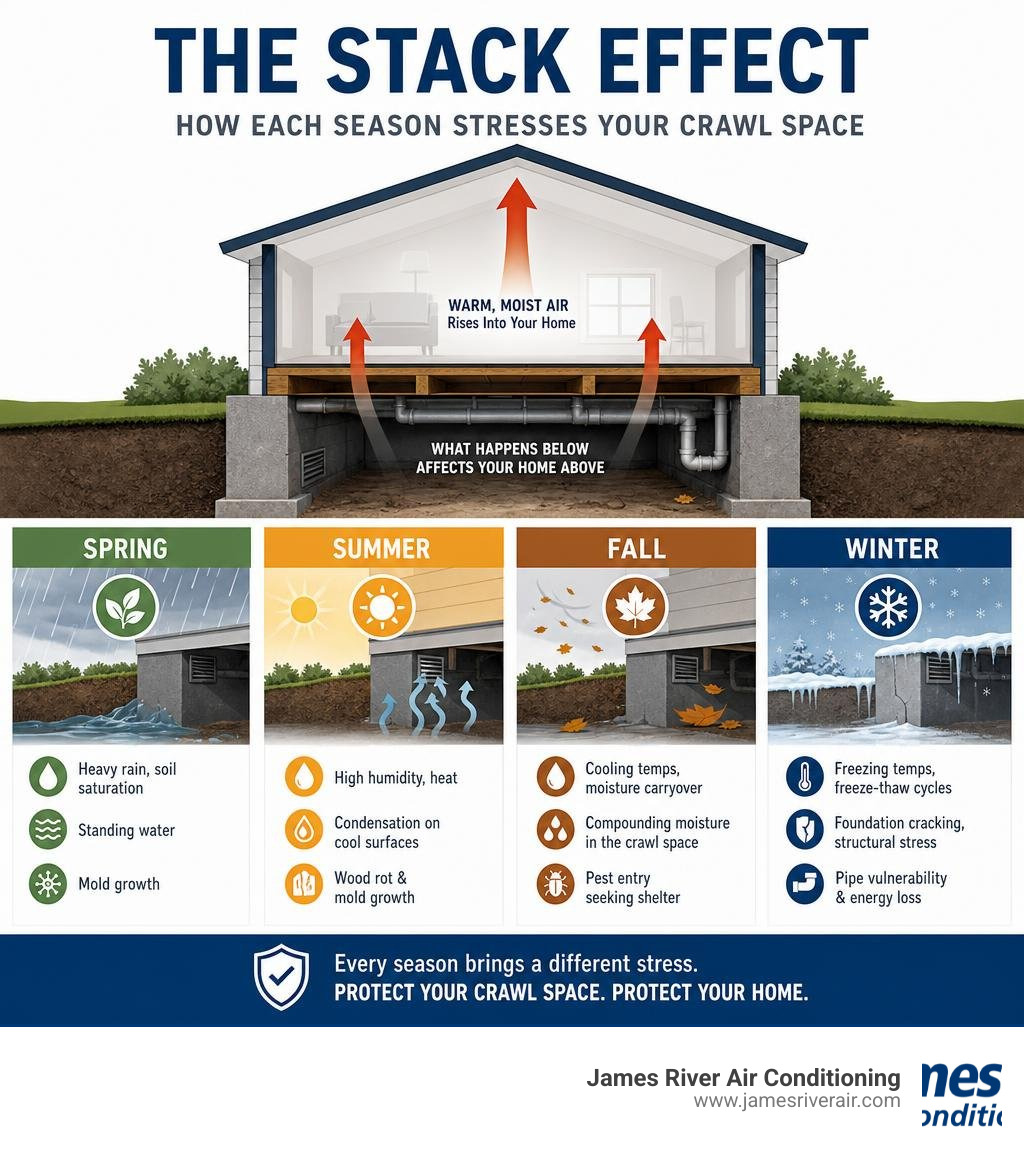
Here is a quick summary of what happens beneath your home across each season:
| Season | Primary Risk | What It Causes |
|---|---|---|
| Spring | Heavy rain, soil saturation | Standing water, hydrostatic pressure, mold |
| Summer | High humidity, heat | Condensation, wood rot, mold growth |
| Fall | Cooling temps, moisture carryover | Compounding moisture, pest entry |
| Winter | Freezing temps, freeze-thaw cycles | Pipe vulnerability, foundation cracking, energy loss |
Your crawl space sits at the intersection of soil, outdoor air, and the living space above it. Every season brings a different stress. Spring rains saturate the ground and push water through foundation walls. Summer humidity floods open vents with warm, moisture-heavy air that condenses on cool wood and ductwork. Winter freezing and thawing cycles crack concrete and stress pipes. And because crawl space air naturally rises into your home through a process called the stack effect, whatever happens below your floor eventually affects the air your family breathes above it.
The good news: most of this damage is preventable when you know what to look for and act before each season peaks.
Basic how seasonal extremes affect your crawl space vocab:
- how hot humid summers and cold winters stress your hvac
- how virginia weather extremes affect your home systems
How Seasonal Extremes Affect Your Crawl Space

Living in the Richmond area—whether you are in Henrico, Chesterfield, Midlothian, or Hanover—means experiencing a beautiful but highly demanding climate. We get a front-row seat to hot, humid summers, cold winters, and plenty of rain in between. While we adjust our wardrobes and crank up our HVAC systems to cope, our homes are left to deal with these aggressive transitions on their own.
The crawl space is particularly vulnerable to these swings. When outdoor temperatures fluctuate wildly, the crawl space struggles to maintain equilibrium. During these transitions, relative humidity levels can swing from a dry 30% in the dead of winter to an incredibly damp 80% or 90% in the heat of July. This constant shifting creates a dynamic environment where moisture, structural materials, and the air we breathe are in a perpetual tug-of-war. For a deeper look at this relationship, check out our guide on Surviving the Seasons: How Virginia’s Climate Impacts Your Home Systems.
Spring Thaw, Heavy Rains, and Soil Saturation
When spring arrives in Virginia, it brings more than just blooming dogwoods; it brings heavy, persistent rain. As the ground becomes saturated, a phenomenon known as hydrostatic pressure begins to build. This is the physical force exerted by standing water in the soil surrounding your foundation.
Because much of our local soil in places like Glen Allen, Powhatan, and Moseley contains heavy clay, it retains water like a sponge. Saturated clay soil can expand by 4% to 8% in volume, pressing tightly against your foundation walls. This lateral pressure forces water through microscopic pores and hairline cracks in concrete block or poured concrete walls, leading to active water intrusion and standing water on the crawl space floor.
When water pools under your home, it does not just sit there. It slowly evaporates, driving up the relative humidity of the space and creating a perfect breeding ground for wood-destroying fungi. To understand how this moisture behaves once it gets inside, read our article on how to Stop the Sog and Understand How Crawl Space Moisture Affects Your Home.
Summer Heat, Humidity, and Condensation
Summertime in the Mid-Atlantic is notoriously humid. In July and August, outdoor dew points regularly climb into the upper 60s and 70s. When this warm, moisture-laden air enters a traditional vented crawl space, it encounters an environment that is significantly cooler—usually kept in the 60s by the shaded earth and the air conditioning running directly above.
This temperature differential is where the physics of condensation takes over. When the warm, humid air cools down inside the crawl space, it can no longer hold its moisture. Water droplets begin to form on every cool surface, including metal ductwork, cold water pipes, and the wooden floor joists.
This is the exact moment when mold growth and wood rot become major threats. Mold spores require organic material (like your wood joists), warm temperatures, and a relative humidity level consistently above 60% to colonize. If the wood moisture content reaches 19% or higher, wood-decay fungi will actively begin to rot the structural supports of your home. To learn how to protect your home’s air systems during these muggy months, take a look at The Mid-Atlantic Survival Guide to HVAC Mold Prevention.
Winter Freezing, Thermal Stress, and Pipe Vulnerability
Winter brings a completely different set of challenges to crawl spaces in central Virginia. As temperatures drop below freezing, cold air rushes through foundation vents, cold-soaking the floorboards of your living space and exposing your plumbing to severe thermal stress.
This cold air infiltration makes your heating systems work twice as hard to keep your home warm, leading to drafty floors and significant energy loss. More dangerously, water lines running through an uninsulated, vented crawl space are at a high risk of freezing. When water freezes inside a pipe, it expands, creating immense pressure that can easily burst copper, PEX, or PVC lines, leading to catastrophic water damage when the system thaws.
Furthermore, the ground outside undergoes freeze-thaw cycles. As the water in the soil freezes and expands, then melts and contracts, it causes the ground to shift. This movement can put structural stress on foundation piers and concrete blocks, leading to cracking and settling over time. To keep your pipes safe when the winter chill sets in, consult The Ultimate Guide to Seasonal Extremes and Crawl Space Plumbing.
The Science of Soil, Air, and the Stack Effect
To truly understand how seasonal extremes affect your crawl space, we have to look at the basic building science of how air and soil interact under your home. Your house is not a sealed box sitting on top of the earth; it is an active thermal system.
The most important concept to understand here is the stack effect. Warm air in your home naturally rises and escapes through the upper levels and attic. As this air exits, it creates a negative pressure zone on the lower levels of your house. To equalize this pressure, air is drawn upward from the lowest point of the structure—your crawl space.
In fact, building scientists estimate that approximately 50% of the air you breathe on the first floor of your home actually originated in your crawl space. This means that whatever is floating around under your floorboards—whether it is mold spores, musty odors, or high humidity—is actively being pulled into your living room, kitchen, and bedrooms. Read more about this invisible process in The Secret to Fresh Air Is Hiding Under Your Floorboards.
How Soil Type and Local Climate Accelerate Damage
The geology of the Richmond basin plays a massive role in crawl space health. Many neighborhoods across Henrico, Chesterfield, and Goochland are built on expansive clay soils.
Unlike sandy soils that drain quickly, clay holds onto water for extended periods. During wet seasons, this clay expands, shifting foundation footings and putting immense pressure on crawl space walls. Conversely, during dry spells in late summer or autumn, the clay dries out and shrinks, leaving gaps between the soil and your foundation walls. This shrink-swell cycle can cause foundation cracks, uneven floors upstairs, and sticking doors.
When combined with our local climate’s high precipitation and humidity, this soil behavior accelerates the physical deterioration of unprotected crawl spaces. For a detailed breakdown of how our local environment affects your foundation, see The Commonwealth Climate vs. Your House: What You Need to Know.
Understanding How Seasonal Extremes Affect Your Crawl Space
As the seasons change, the air pressure dynamics inside your home shift, changing how crawl space air moves. In the winter, the stack effect is at its strongest because the temperature difference between the warm indoor air and the freezing outdoor air is at its peak. This strong upward draft pulls cold, damp air and musty odors directly through floor penetrations, wire runs, and plumbing gaps.
In the summer, high humidity in the crawl space acts like a heavy blanket, making your home feel muggy and forcing your air conditioning system to work harder to dehumidify the air. If your HVAC ductwork runs through a damp crawl space, leaky ducts can pull mold spores and allergens directly into your heating and cooling stream, distributing them throughout your entire house. To see how these seasonal shifts impact your comfort systems, read The Ins and Outs of How Hot, Humid Summers and Cold Winters Stress Your HVAC.
Warning Signs, Vented Space Failures, and Long-Term Solutions
Because crawl spaces are generally out of sight, problems can quietly grow for months or even years before they are noticed. Homeowners should look out for these early warning signs:
- Musty odors in the home, especially when the air conditioning or heating first kicks on.
- Cold floors during the winter months, making it uncomfortable to walk barefoot.
- Sticking doors or windows and soft, sagging, or bouncy spots in your hardwood flooring.
- Condensation forming on indoor windows, cold water pipes, or HVAC ductwork.
- Unexplained spikes in your monthly heating and cooling bills.
- Allergy or asthma flare-ups among family members, particularly during seasonal transitions.
If you notice any of these symptoms, your crawl space may be struggling. You can read more about identifying these issues in our guide on Warning Signs Your Crawl Space Is Impaired.
To address these issues, homeowners generally choose between a basic ground cover (vapor barrier) and a complete sealed system (encapsulation).
| Feature | Standard Ground Vapor Barrier | Full Crawl Space Encapsulation |
|---|---|---|
| Coverage | Covers loose soil only | Covers ground, walls, and seals vents |
| Material | Typically 6-mil thin plastic | Heavy-duty 12-mil to 20-mil reinforced poly |
| Seams | Loosely overlapped | Fully taped and sealed to walls and columns |
| Humidity Control | Passive (unmanaged) | Active (via dehumidifier or HVAC supply) |
| Pest Prevention | Minimal | High (blocks entry points) |
| Energy Savings | Negligible | Up to 15% to 18% reduction in utility bills |
Why Vented Crawl Spaces Fail in Extreme Climates
For decades, traditional building codes required crawl spaces to have open vents to allow air to circulate. However, modern building science has proven that this “vent myth” actually does more harm than good in humid or extreme climates.
Leaving vents open during a hot Virginia summer does not dry out a crawl space; it imports gallons of water vapor every single day. That warm, wet air hits the cooler wood and concrete beneath your home, creating immediate condensation. In the winter, those same open vents allow freezing drafts to chill your floorboards and water pipes.
Simply put, a vented crawl space is an unmanaged environment that remains at the mercy of whatever weather is happening outside. To understand why sealing these vents is essential for protecting your home, check out Why Crawl Space Maintenance Is Essential for Virginia Homes and Beyond.
When to Choose Encapsulation Over a Standalone Dehumidifier
While adding a standalone dehumidifier to a vented crawl space might seem like an easy fix, it is often a losing battle. Running a dehumidifier with open foundation vents is the equivalent of running your home’s air conditioner with all the windows wide open—you are trying to dehumidify the entire outdoors, which wears out the equipment quickly and drives up your electric bill.
True moisture control requires isolating the crawl space from both the damp earth and the outdoor air. Full crawl space encapsulation involves sealing all foundation vents, installing a heavy-duty, multi-mil vapor barrier across the floor and up the walls, sealing all seams, and adding a dedicated, commercial-grade crawl space dehumidifier. This creates a conditioned, dry space that protects your wooden structure, improves your home’s energy efficiency, and keeps your indoor air clean. Learn more about the health and structural benefits of this approach in The Foundation of Health: Why Professional Crawl Space Services Matter.
Actionable Steps to Mitigate How Seasonal Extremes Affect Your Crawl Space
Protecting your crawl space starts with managing the water outside your home. Here are practical steps you can take today to prevent seasonal damage:
- Maintain Your Gutters: Clean your gutters at least twice a year to prevent overflow, which dumps water directly next to your foundation walls.
- Extend Your Downspouts: Ensure all gutter downspouts discharge water at least 4 to 6 feet away from your home’s foundation.
- Correct the Grade: Slope the soil around your foundation downward and away from your home to prevent rainwater from pooling near the crawl space.
- Inspect After Storms: Grab a flashlight and peek into your crawl space access door after heavy rains to check for standing water or fallen insulation.
- Schedule a Professional Evaluation: Have a certified professional inspect your crawl space annually to catch structural issues, plumbing leaks, or insulation failures before they become costly repairs.
Frequently Asked Questions about Seasonal Crawl Space Issues
Why does my crawl space smell worse after heavy rain?
When heavy rain saturates the clay soil around your home, hydrostatic pressure forces moisture through your concrete foundation walls. As this water evaporates inside your crawl space, it raises the humidity, activating mold spores and damp organic debris. The stack effect then pulls these musty, earthy odors upward through your floorboards and into your living spaces.
Can seasonal temperature changes damage my home’s foundation?
Yes. The freeze-thaw cycles of winter cause water in the soil and foundation masonry to expand and contract, which can widen tiny cracks over time. Additionally, the shrink-swell behavior of Virginia’s clay soil during wet springs and dry summers puts lateral stress on foundation walls, which can lead to structural shifting and uneven floors.
How often should I have my crawl space inspected?
We recommend having your crawl space professionally inspected at least once or twice a year. Late spring (after the heavy rains) and late fall (before the winter freeze) are the ideal times to assess the space and ensure your insulation, plumbing, and moisture barriers are ready for the upcoming seasonal extremes.
Conclusion
Your crawl space may be out of sight, but it should never be out of mind. From spring rains to summer humidity and winter freezes, seasonal extremes put constant stress on the structural integrity, air quality, and energy efficiency of your home. Taking a proactive approach to crawl space care is one of the best investments you can make to protect your property and keep your family comfortable year-round.
Whether you live in Richmond, Midlothian, Henrico, Chesterfield, or any of our surrounding Virginia communities, our team is here to help you find the right long-term solutions for your home.
Schedule your professional crawl space evaluation with James River Air Conditioning today, and let us help you keep the foundation of your home dry, safe, and healthy through every season.
