
How to Tell If Your HVAC Needs Replacing, Not Just Fixing
Knowing the signs your HVAC needs replacing not just fixing can save you from throwing money at a system that’s already on its way out. If you’re noticing more repair calls, higher energy bills, or rooms that just won’t stay comfortable, your system may be telling you something important. Most HVAC systems last between 10 and 20 years depending on the type, but age alone isn’t always the deciding factor — it’s the pattern of problems that matters most.
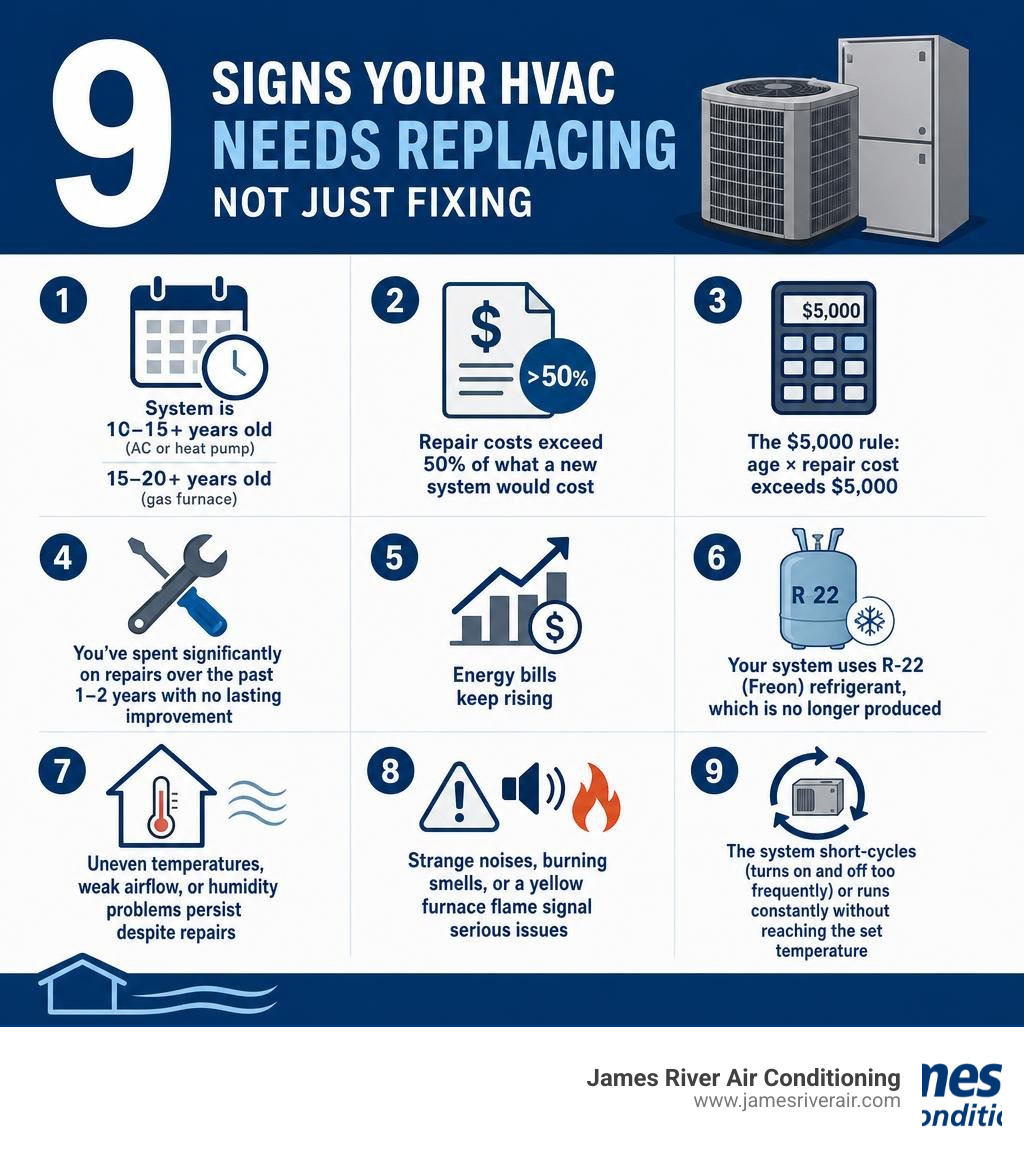
Here are the key signs your HVAC needs replacement rather than another repair:
- System is 10–15+ years old (air conditioner or heat pump) or 15–20+ years old (gas furnace)
- Repair costs exceed 50% of what a new system would cost
- The $5,000 rule applies — your system’s age multiplied by the repair cost exceeds $5,000
- You’ve spent significantly on repairs over the past 1–2 years with no lasting improvement
- Energy bills keep rising without a change in usage or rates
- Your system uses R-22 (Freon) refrigerant, which is no longer produced
- Uneven temperatures, weak airflow, or humidity problems persist despite repairs
- Strange noises, burning smells, or a yellow furnace flame signal serious mechanical or safety issues
- The system short-cycles (turns on and off too frequently) or runs constantly without reaching the set temperature
For Richmond homeowners, the stakes are real — summers are hot and humid, and winters get cold fast. A failing system isn’t just uncomfortable. It’s expensive and, in some cases, unsafe.
Understanding System Lifespan and the Signs Your HVAC Needs Replacing, Not Just Fixing
When your heating and cooling system acts up, it is easy to assume a quick visit from a technician will solve everything. While many minor issues can be resolved with a simple part replacement or a thorough cleaning, there comes a point in every system’s life where repairs cease to be a smart investment. Continuing to patch up an outdated, inefficient unit is often referred to as the “repair trap.”
Understanding where your equipment stands in its natural life cycle is the first step in making an informed choice. Like any major mechanical system with moving parts, an HVAC unit experiences steady wear and tear. Even with meticulous maintenance, the materials degrade, electrical components weaken, and the overall efficiency of the system declines.
Recognizing when your unit has crossed the threshold from a minor mid-life hiccup to a terminal decline is crucial. If you are starting to feel like your system is on life support, you are not alone. To help you self-diagnose your system’s current state, take a look at our guide on the 7 Signs Your HVAC System Is Having a Mid-Life Crisis.
Typical Lifespan of Heating and Cooling Components
Not all HVAC components are created equal, and they do not all age at the same rate. Understanding the typical lifespans of your specific components helps you plan ahead and avoid emergency replacements during a scorching July heatwave in Short Pump or a freezing January night in Midlothian.
- Central Air Conditioners (10–15 Years): Outdoor AC condensers are exposed to Central Virginia’s intense summer heat, heavy rain, and seasonal pollen. Because they work incredibly hard to pull humidity and heat out of your home, their performance typically begins to decline significantly after a decade of service.
- Gas Furnaces (15–20 Years): Located safely indoors (often in a basement, utility closet, or attic), furnaces generally enjoy a longer lifespan than outdoor AC units. However, because they rely on combustion to generate heat, their internal components—specifically the heat exchanger—are subjected to extreme thermal stress over the years.
- Heat Pumps (10–15 Years): Because heat pumps provide both heating in the winter and cooling in the summer, they run year-round. This double-duty operation means they accumulate run hours much faster than a standalone air conditioner or furnace, typically placing their reliable lifespan on the shorter end of the 10-to-15-year spectrum.
Neglecting regular checkups can shorten these timelines dramatically. If you want to know what happens when maintenance falls by the wayside, read about What Happens If You Skip HVAC Maintenance? 7 Key Consequences.
Performance Red Flags and Signs Your HVAC Needs Replacing, Not Just Fixing
If your system is approaching the end of its useful life, it will usually let you know through its daily performance. Here are the most common comfort and operational red flags that indicate a replacement is on the horizon:
- Uneven Temperatures: Do you have to wear a sweater in the living room while your upstairs bedroom feels like a sauna? When compressors and blowers weaken, they lose the ability to push conditioned air evenly throughout your home’s ductwork.
- Weak Airflow: If you hold your hand up to your registers and only feel a faint whisper of air, your blower motor may be failing, or your ductwork could be severely compromised.
- Frequent or Short Cycling: A healthy HVAC system should run in steady, predictable cycles to cool or heat your home and manage humidity. If your system turns on, runs for three minutes, shuts off, and then turns back on a few minutes later, it is short-cycling. This puts immense stress on the compressor and electrical components, often signaling that the system is either failing or was improperly sized from the start.
To ensure your next system doesn’t suffer from these same performance issues due to poor design, consult The Central Virginia Homeowner Guide to Getting the Right Size HVAC.
Financial Decision Frameworks: The 50% and $5,000 Rules
When you are presented with a repair recommendation, it can be incredibly difficult to decide whether to sign off on the fix or start looking at replacement options. Fortunately, the HVAC industry relies on two highly dependable financial frameworks to remove the guesswork: the 50% Rule and the $5,000 Rule.
| Decision Rule | Formula / Core Concept | When to Repair | When to Replace |
|---|---|---|---|
| The 50% Rule | Compare the cost of a single repair to the total value of a new, comparable system. | If the repair cost is less than 50% of a new system’s cost. | If the single repair cost meets or exceeds 50% of the replacement cost. |
| The $5,000 Rule | Multiply the age of the system (in years) by the cost of the proposed repair. | If the resulting number is under $5,000. | If the resulting number is $5,000 or greater. |
Using these simple mathematical guardrails helps ensure you aren’t throwing good money after bad. Let’s look at how these rules function in real-world scenarios. For a deeper dive into balancing these financial tipping points, check out our detailed guide, The HVAC Crossroads: How to Decide Between Repair and Replacement.
Applying the 50% Rule to Major Component Failures
The 50% Rule is straightforward: if a single repair costs 50% or more of what a brand-new, fully installed system would cost, you should always opt for replacement.
This rule is particularly relevant when dealing with “catastrophic” component failures. For instance, if your outdoor AC compressor fails or your furnace’s heat exchanger cracks, the cost of the part combined with the intensive labor required to swap it out will easily approach the 50% threshold.
Furthermore, replacing a major component on an old system does not reset the clock on the rest of the unit. You might spend a significant sum to replace a compressor on a 13-year-old air conditioner, only to have the fan motor fail three months later, followed by an electrical failure the following winter. If you are facing a major component breakdown right now and need immediate guidance, read our article Should I Repair or Replace My Furnace or AC Right Now?.
How the $5,000 Rule Guides Your Decision
While the 50% Rule is excellent for massive, single-component failures, the $5,000 Rule is the perfect tool for evaluating moderate repairs on aging systems.
To use the $5,000 Rule, simply take the age of your system in years and multiply it by the quoted repair cost.
- Scenario A (Repair): You have a 6-year-old heat pump that needs a new blower motor. The repair quote is $450. $$\text{6 years} \times \$450 = 2,700$$ Since 2,700 is well below the 5,000 threshold, repairing the unit is a highly sensible financial decision.
- Scenario B (Replace): You have a 12-year-old air conditioner that has developed a refrigerant leak, and replacing the evaporator coil will cost $600. $$\text{12 years} \times \$600 = 7,200$$ Because 7,200 comfortably exceeds the 5,000 threshold, investing that money into a new, highly efficient system is the smarter financial move. The age of the unit means other components are likely nearing their failure points as well.
Environmental and Efficiency Triggers for System Upgrades
Sometimes, the decision to replace your heating and cooling equipment is driven by external factors like environmental regulations and rapidly advancing technology. If your system was installed in the early 2010s or earlier, it operates on outdated standards that actively cost you money every single month.
The R-22 Refrigerant Phase-Out and Older Systems
If your air conditioner or heat pump was manufactured before 2010, there is a very high probability that it utilizes R-22 refrigerant (commonly known as Freon). R-22 is a hydrochlorofluorocarbon (HCFC) that contributes to ozone depletion. As part of a global environmental agreement, the U.S. Environmental Protection Agency (EPA) officially banned the production and import of R-22.
In 2026, finding virgin R-22 is virtually impossible, and HVAC service providers must rely entirely on limited, highly expensive recycled stocks. If your older system develops a refrigerant leak, recharging the system can cost an astronomical amount just for the refrigerant itself, without even addressing the labor to find and seal the leak.
If your unit uses R-22 and experiences a leak or compressor failure, continuing to repair it is a losing battle. Transitioning to a modern system that uses current, environmentally friendly refrigerants is the only logical path forward.
Efficiency Degradation and Signs Your HVAC Needs Replacing, Not Just Fixing
Even if your old system isn’t breaking down, it is likely costing you far more to operate than it did when it was new. Over time, HVAC systems lose their efficiency. An air conditioner that was rated at 14 SEER (Seasonal Energy Efficiency Ratio) when it was installed 15 years ago may actually be operating at only 10 or 11 SEER today due to internal wear, scale buildup in the coils, and declining motor performance.
Consider this: heating and cooling account for 40% to 70% of a typical home’s energy consumption. Upgrading an old, degraded system has a massive, immediate impact on your monthly utility bills. For example, replacing an old 10-SEER system with a modern 16-SEER unit reduces your cooling energy consumption by approximately 37%. Over the lifespan of the new equipment, those monthly savings can add up to thousands of dollars back in your pocket.
When to Replace the Entire System vs. Individual Components
A common dilemma homeowners face is whether to replace their entire HVAC system at once or simply replace components as they fail. For instance, if your air conditioner dies but your gas furnace is still chugging along, is it really necessary to replace both?
While stagger-replacing components might seem like a way to save money upfront, it almost always costs more in the long run. If you are planning to sell your home in Henrico or Chesterfield in the near future, a fully replaced, modern system is a massive selling point. To understand how this investment can pay off during a sale, read Does New HVAC Help Sell Your Home Faster?.
The Benefits of Matched System Efficiency and Comfort
An HVAC system is designed to work as a cohesive, single ecosystem. The indoor evaporator coil, the outdoor condenser, and the indoor furnace or air handler must be perfectly matched in capacity, airflow, and technology to achieve their rated efficiency and performance.
- System Compatibility: If you pair a brand-new, high-efficiency outdoor AC unit with an old, single-stage indoor furnace blower, the new unit will be severely bottlenecked. It will not be able to achieve its rated SEER2 efficiency, and you will miss out on the energy savings you paid for.
- Variable-Speed Technology and Humidity Control: Modern systems utilize advanced variable-speed blowers and compressors. Unlike older systems that only run at 0% or 100% capacity, variable-speed systems ramp up and down smoothly like a dimmer switch. This provides incredibly precise temperature control, whisper-quiet operation, and vastly superior dehumidification during humid Virginia summers.
- Labor Savings: Replacing both units at the same time means our technicians only have to make one trip, recover refrigerant once, and modify your duct connections once. The labor savings of a combined installation are substantial compared to paying for two separate installations a few years apart.
Investing in a matched system doesn’t just improve your daily comfort; it also significantly boosts your home’s market value. Learn more by reading Heating Up Your Resale Price with a New HVAC.
Safety Risks and Structural Integrity
Beyond comfort and financial considerations, safety should always be your top priority. This is especially true when dealing with aging gas furnaces.
The heat exchanger is the metal chamber inside your furnace where gas is burned to create heat. Over decades of heating cycles, this metal expands and contracts. Eventually, the metal can fatigue, leading to rust, cracks, or structural failure.
A cracked heat exchanger is an immediate, serious safety hazard. It can allow combustion gases—including deadly carbon monoxide (CO)—to leak directly into your home’s breathing air. If your technician discovers a cracked heat exchanger during a routine inspection, they are legally required to shut down the gas supply to your furnace to protect your family.
Signs of a failing heat exchanger or burner issue include:
- A furnace burner flame that is yellow or orange instead of a crisp, steady blue.
- Excessive soot inside the furnace cabinet.
- Frequent tripping of your home’s carbon monoxide detectors.
If your older furnace has a compromised heat exchanger, repairing it is rarely an option; full replacement is essential for your safety. To see how inspectors and appraisers view these safety and structural elements, check out The Appraiser’s Checklist: Why Your HVAC System Matters More Than You Think.
Frequently Asked Questions About HVAC Replacement
Is it better to replace the furnace and AC at the same time?
Yes, in the vast majority of cases, replacing both the furnace and the air conditioner simultaneously is the most cost-effective and logical choice.
Doing so ensures that your indoor and outdoor components are perfectly matched, allowing the system to operate at its peak rated efficiency. It also saves you significant labor costs, as our installation team can complete the entire job in a single visit. Finally, replacing both components at once resets the clock on your entire HVAC system, giving you peace of mind and a single, comprehensive warranty covering all parts of your heating and cooling system.
How does the R-410A refrigerant phase-down affect my current system in 2026?
As of 2026, the EPA’s phase-down of R-410A refrigerant is actively underway to transition the industry toward low-GWP (Global Warming Potential) alternatives like R-454B and R-32.
If you currently own a functional system that uses R-410A, you do not need to panic or replace your system immediately. It remains perfectly legal to own, operate, and service R-410A equipment. However, as the production of R-410A continues to scale down, the cost of this refrigerant for leak repairs will steadily rise. If you have an older R-410A system that develops a major refrigerant leak, the rising cost of servicing it should be a key factor in your decision to upgrade to a modern system.
What is the best time of year to schedule an HVAC replacement?
The ideal times to replace your HVAC system are during the “shoulder seasons”—specifically spring (March to May) and autumn (September to November).
During these temperate months, our schedule is typically more flexible, allowing you to choose an installation date that works perfectly for your schedule. More importantly, replacing your system during the off-season means you won’t have to suffer through days without heating or cooling during the extreme heat of summer or the deep freeze of winter. Planning ahead allows for a calm, well-thought-out transition rather than an emergency decision made in a freezing or sweltering home.
Conclusion
Recognizing the signs your HVAC needs replacing not just fixing is the key to maintaining a comfortable, safe, and energy-efficient home. While it can be tempting to opt for a quick fix, continuing to pour money into an aging, inefficient system using outdated refrigerants is a recipe for ongoing frustration and high utility bills.
At James River Air Conditioning, we have spent over 57 years helping Richmond families navigate these exact decisions. Whether you are in Ashland, Chesterfield, Glen Allen, or anywhere else in the greater Richmond area, our team of highly trained, friendly professionals is here to provide an honest, thorough evaluation of your current system. We will lay out your options clearly, without high-pressure sales tactics, so you can make the absolute best choice for your home and your budget.
Don’t wait for your system to fail on the hottest day of the year. Contact us today to schedule a professional evaluation, or explore our HVAC Replacement Cost Guide to start planning your home comfort upgrade.
