
The Complete Guide to New HVAC Health Benefits
Why New HVAC Benefits Beyond Comfort Should Matter to Every Richmond Homeowner
When most people think about replacing their heating and cooling system, they focus on one thing: staying comfortable. But the new HVAC benefits beyond comfort are just as compelling — and for many homeowners, they’re the real reason an upgrade makes sense.
Here’s a quick look at what a modern HVAC system actually delivers:
| Benefit | What It Means for You |
|---|---|
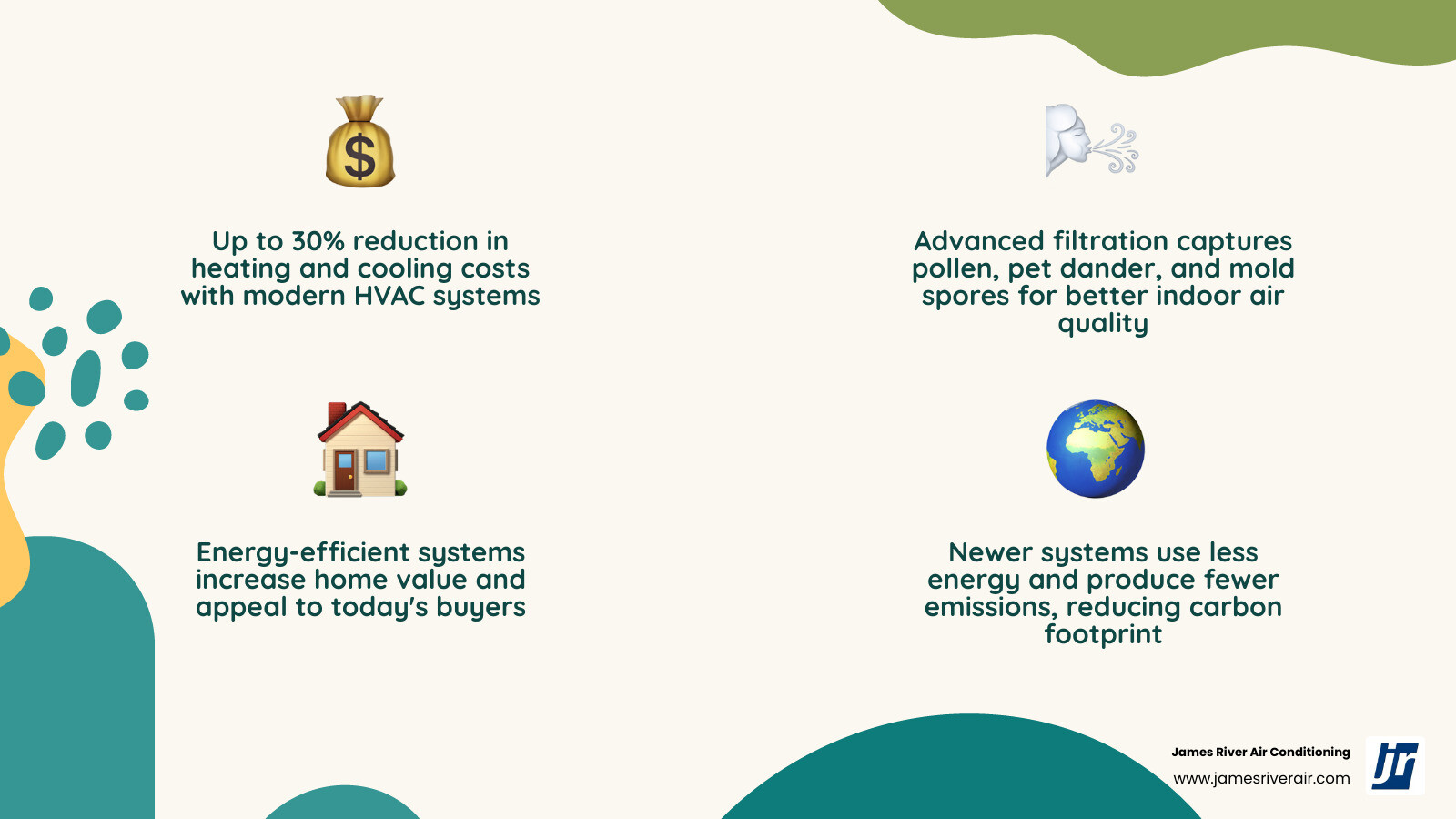
| Lower energy bills | Up to 30% reduction in heating and cooling costs |
| Better indoor air quality | Advanced filtration captures pollen, pet dander, and mold spores |
| Higher home value | Energy-efficient systems appeal to today’s buyers |
| Reduced carbon footprint | Newer systems use less energy and produce fewer emissions |
| Quieter operation | Modern units run nearly silently compared to aging equipment |
| Smarter controls | AI and zoning tech can cut energy use by an additional 15–42% |
| Longer lifespan | A well-maintained system can last 15–25 years |
Your HVAC system accounts for close to half of your home’s total energy use. That means upgrading isn’t just about feeling cooler in July or warmer in January — it’s a decision that touches your wallet, your health, and even your home’s resale price.
In this guide, we’ll walk through each of these benefits in plain language so you can see exactly what a new system could mean for your Richmond home.
New hvac benefits beyond comfort basics:
Maximizing Your Investment: New HVAC Benefits Beyond Comfort

When we talk to neighbors in Midlothian or Glen Allen about their aging units, the conversation usually starts with a rattling noise or a room that just won’t stay cool. But once the new system is in place, the first thing they notice isn’t just the silence—it’s the shift in their monthly budget.
Upgrading to a modern, high-efficiency system can reduce your heating and cooling bills by up to 30%. In May 2026, with energy costs being what they are, that’s not just “nice to have”; it’s a significant financial win. Modern systems achieve this through improved SEER2 (Seasonal Energy Efficiency Ratio) ratings and variable-speed motors.
Unlike older units that are either “all the way on” or “all the way off,” variable-speed motors adjust their output to match the exact needs of your home. It’s the difference between flooring the gas pedal and then slamming on the brakes versus using cruise control. This precision prevents the energy-wasting “starts and stops” that drive up utility costs.
If you’re currently pouring money into a system that’s over a decade old, you might be at The HVAC Crossroads: How to Decide Between Repair and Replacement. Sometimes, the most “expensive” choice is actually keeping an old unit that’s bleeding money every month.
To make the transition easier, there are several financial incentives available in 2026:
- Federal Tax Credits: High-efficiency heat pumps and central AC units often qualify for significant credits under federal energy programs.
- Utility Rebates: Many local Virginia utility providers offer cash-back incentives for installing Energy Star-certified equipment.
- Manufacturer Promotions: Spring and fall often bring seasonal rebates directly from the brands we trust.
- Flexible Financing: Spreading the cost over manageable monthly payments allows the energy savings to help “pay back” the investment over time.
Long-Term Savings: Why New HVAC Benefits Beyond Comfort Matter in 2026
The financial perks don’t stop at the monthly bill. A professionally installed HVAC system in the Mid-Atlantic region can last between 15 and 25 years when properly cared for. That is two decades of predictable performance.
When you install a new unit, you’re also hitting the “reset” button on repair costs. Older systems are notorious for failing at the worst possible times—like a humid July afternoon in Henrico—leading to emergency service fees and expensive parts. A new system under warranty provides peace of mind that those surprise expenses are a thing of the past.
Of course, the key to hitting that 25-year mark is consistent care. We can’t stress enough the Benefits of Regular HVAC Maintenance. Think of it like a car; you wouldn’t expect a brand-new engine to last forever without an oil change. Routine tune-ups catch small issues before they become catastrophic failures, ensuring your investment continues to pay dividends for years.
Breathing Easier: Health and Indoor Air Quality
If you’ve ever noticed dust dancing in a sunbeam or felt your allergies flare up the moment the heat kicks on, you’ve experienced poor Indoor Air Quality (IAQ). One of the most vital new HVAC benefits beyond comfort is the impact on your physical health.
Modern systems are designed to be more than just temperature regulators; they are sophisticated air filtration and dehumidification centers. In our humid Virginia climate, moisture control is everything. High humidity doesn’t just make you feel sticky; it creates a breeding ground for mold and dust mites. New HVAC units feature enhanced dehumidification cycles that pull excess moisture out of the air, keeping your home’s relative humidity in the “Goldilocks zone” (usually between 30% and 50%).
This moisture control is especially critical in areas of the home you might not see every day. For instance, The Foundation of Health: Why Professional Crawl Space Services Matter because much of the air you breathe on the first floor actually originates from below your floorboards. If your crawl space is damp, your HVAC system has to work harder to scrub that air. Often, The Secret to Fresh Air Is Hiding Under Your Floorboards, and a new system paired with proper sealing ensures that “basement smell” never reaches your living room.
To dive deeper into making your home a sanctuary, check out our guide on How to Improve Indoor Air Quality at Home Without Turning Your House Into a Bubble.
Advanced Filtration and Allergen Reduction
The filters in modern HVAC systems have come a long way from the thin fiberglass mesh of the past. High-efficiency filters (like HEPA or high-MERV rated options) are now standard or easily integrated into new units. These filters are capable of capturing:
- Pollen: A must-have for anyone living through a Richmond spring.
- Pet Dander: Essential for households with furry family members.
- Volatile Organic Compounds (VOCs): Chemicals emitted by household cleaners, paints, and new furniture.
- Mold Spores: Prevented by both the filter and the system’s humidity control.
For these filters to do their job, however, you have to stay on top of them. We recommend that you Stop Guessing and Start Changing Your HVAC Filter on Time to ensure your air stays clean and your new motor doesn’t strain against a wall of dust.
Boosting Property Value and Marketability
If you’re planning on selling your home in Chesterfield or Short Pump in the next few years, a new HVAC system is one of the smartest upgrades you can make. In the 2026 real estate market, buyers are increasingly wary of “hidden” costs. Seeing a 15-year-old outdoor unit is an immediate red flag that suggests a massive expense is lurking just around the corner.
Conversely, a brand-new, high-efficiency system acts as a powerful marketing tool. It provides “buyer reassurance.” When a prospective owner sees a modern system, they see lower utility bills and a decade of maintenance-free living. This often leads to faster sales and higher offers.
Don’t just take our word for it—HVAC condition is a major line item for professionals. You can see why in The Appraiser’s Checklist: Why Your HVAC System Matters More Than You Think. An appraiser looks for systems that meet modern energy standards, and having an upgraded unit can directly bump your home’s valuation. We’ve even put together a specific resource on Heating Up Your Resale Price with a New HVAC to help you understand the ROI.
Market Trends and Modern Home Standards
Today’s home standards have shifted toward “green” and “smart” features. In the Mid-Atlantic, where we deal with both freezing winters and sweltering summers, climate resilience is a selling point. A home that can maintain a steady 72 degrees during a heatwave without breaking the bank is a premium product.
Modern buyers also look for:
- Low-maintenance appeal: They want to spend their weekends at the James River, not waiting for a repairman.
- Long-term functionality: A new system guarantees the home is livable for the foreseeable future.
- Energy-efficient labeling: Units with high SEER2 ratings or Energy Star certification are seen as “future-proofed” against rising energy costs.
Environmental Sustainability and Modern Technology
One of the most exciting new HVAC benefits beyond comfort is the rapid advancement in “green” technology. As we move through 2026, the industry is seeing a massive shift toward sustainability.
For example, new materials like Metal-Organic Frameworks (MOFs) are beginning to revolutionize how we handle humidity. These “molecular sponges” can pull moisture out of the air before the cooling process even begins, potentially reducing energy use by up to 40% in some applications. While some of this tech is still scaling from commercial to residential, the high-efficiency heat pumps we install today already use similar principles to deliver incredible performance with a much smaller carbon footprint.
Reducing your energy consumption isn’t just about saving money; it’s about reducing the demand on our local Virginia power grid and lowering greenhouse gas emissions.
| Feature | Traditional HVAC (10+ years old) | Modern Eco-Friendly HVAC (2026) |
|---|---|---|
| Refrigerant | Often uses older, less eco-friendly types | Uses modern, low-GWP (Global Warming Potential) refrigerants |
| Energy Waste | Loses 20-30% of air through leaky ducts | Precision-sealed and often ductless options available |
| Motor Type | Single-speed (On/Off) | Variable-speed (Adaptive) |
| Average Savings | Baseline costs | Up to 30-40% reduction |
To keep your eco-friendly system running at peak performance, remember these 5 Tips to Show Your HVAC System Love.
Smart Technology: Unlocking New HVAC Benefits Beyond Comfort
The “brain” of your HVAC system has also received a major upgrade. Smart thermostats and AI-driven optimization are game-changers for efficiency.
Zoning Systems Why heat the guest room in Mechanicsville if no one is staying there? Zoning systems use automatic dampers to direct air only where it’s needed. This can result in energy savings of 21% to 42% because you aren’t wasting power on empty square footage.
AI Optimization Modern “smart” systems can learn your habits. They know you like the house cooler at 10 PM and warmer by 7 AM. By adjusting the temperature by just 7–10 degrees for eight hours a day (while you’re at work or asleep), you can save an additional 10% annually. AI-based optimization takes this further, checking weather forecasts and adjusting the system every 15 minutes to stay ahead of a heatwave.
Remote Monitoring With a new system, you can check your home’s temperature from your phone while you’re on vacation. More importantly, some systems can alert us directly if they detect a performance drop, allowing for proactive service before you even realize there’s a problem. For a full breakdown of what to look for, see The Ultimate HVAC Maintenance Checklist for Mid-Atlantic Homeowners.
Conclusion
At James River Air Conditioning, we’ve spent over 57 years serving our neighbors across Richmond, from the historic streets of Petersburg to the growing communities in Short Pump and Moseley. We believe in delivering world-class service with an entrepreneurial spirit, and that means staying at the forefront of the new HVAC benefits beyond comfort.
An HVAC upgrade is more than a purchase; it’s an investment in your home’s value, your family’s health, and your long-term financial stability. Whether you’re looking to slash your utility bills, breathe cleaner air, or get your home ready for the market, we’re here to help you navigate the options.
Ready to see what a modern system can do for your home? Discover professional installation services in Richmond and let us help you unlock the full potential of your home’s climate control.
How much can I save on my utility bills with a new HVAC system?
Most homeowners see a reduction of up to 30% on their heating and cooling costs when switching from an older, inefficient unit to a high-efficiency SEER2-rated system. When you factor in smart thermostat integration—which can save an additional 10% annually through strategic setbacks—the savings become even more substantial.
Does a new HVAC system really improve my home’s resale value?
Absolutely. A new HVAC system is a major selling point in the Mid-Atlantic region. It increases marketability by offering “buyer reassurance” against immediate repair costs. It also shows up favorably on an appraiser’s checklist, as modern, energy-efficient systems are a standard expectation for high-value homes in 2026.
What are the health benefits of upgrading my air conditioning?
The primary health benefits include advanced filtration that removes pollen, pet dander, and VOCs from your breathing air. Additionally, modern systems provide superior humidity control, which is the most effective way to prevent mold growth and dust mite infestations—two of the leading causes of indoor allergies and respiratory issues.
