
Everything You Need to Know About HVAC Challenges in Richmond Metro
Why HVAC Challenges in the Richmond Metro Area Are Harder to Ignore Than You Think
HVAC challenges in the Richmond metro area are more complex than in most mid-Atlantic cities — and they catch homeowners and business owners off guard every single season.
Here is a quick look at the most common challenges Richmond property owners face:
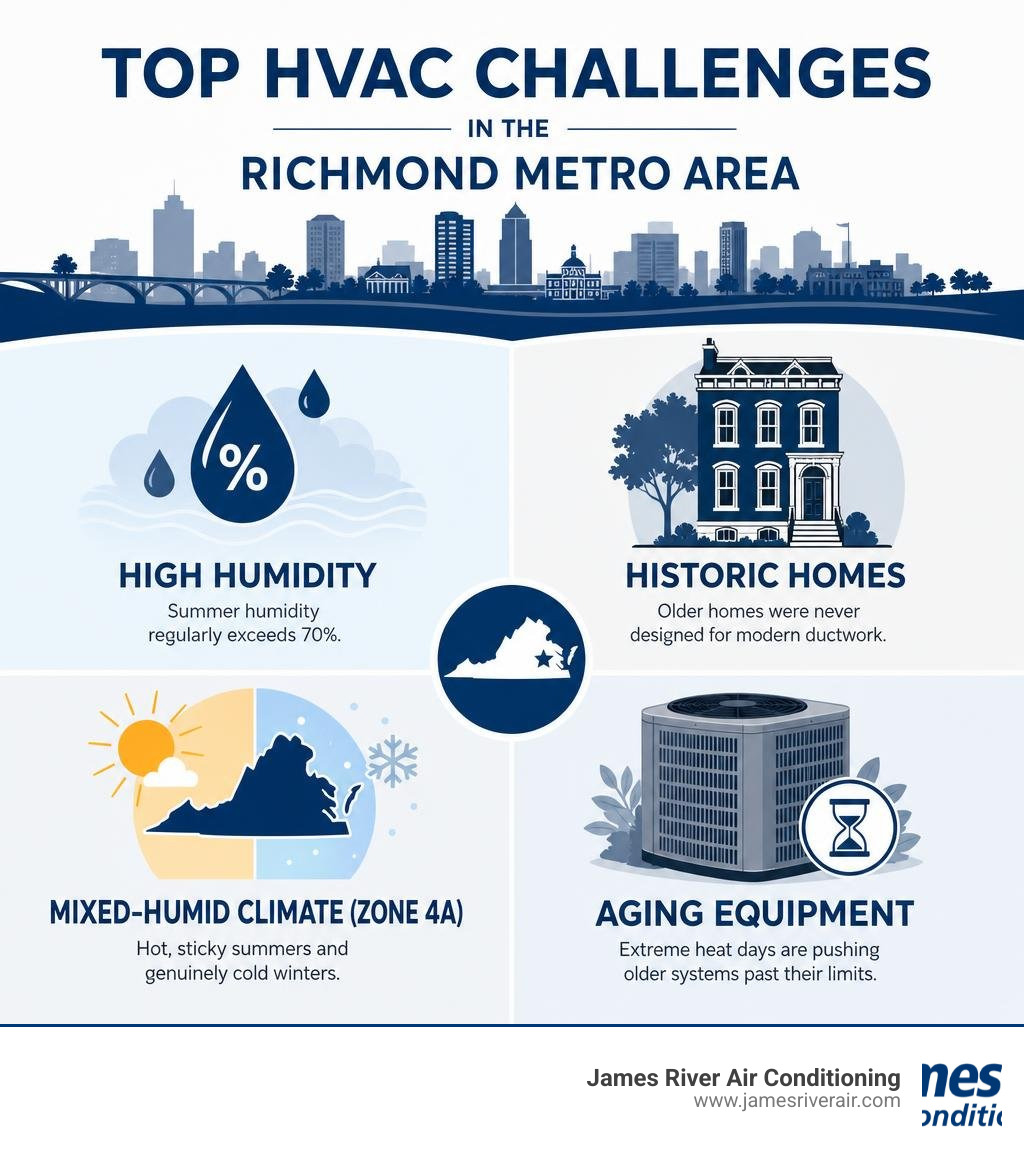
- Mixed-humid climate — Richmond sits in ASHRAE Climate Zone 4A, meaning your system must handle hot, sticky summers and genuinely cold winters
- High humidity — Summer humidity regularly exceeds 70%, forcing AC systems to work harder to remove moisture, not just heat
- Historic housing stock — Neighborhoods like the Fan District, Church Hill, and Oregon Hill have older homes that were never designed for modern ductwork
- Aging equipment under growing strain — Richmond has logged significantly more extreme heat days compared to just a few decades ago, pushing older systems past their limits
- Improper sizing — Studies suggest up to 90% of HVAC systems are incorrectly sized or installed, leading to short cycling, poor dehumidification, and early failure
- Regulatory requirements — Virginia requires licensed contractors and mechanical permits for most HVAC replacements, adding steps many homeowners do not expect
- Rising energy demand — The electricity needed to cool a Virginia home has grown by roughly a third since 1970
Richmond’s climate does not give your HVAC system a break. Summers push heat indices above 100°F. Winters can drop into the teens. That is a brutal range for any piece of mechanical equipment, and it explains why unexpected breakdowns are so common here.
Whether you own a 1920s rowhouse in the Fan or a newer build in Chesterfield County, understanding what drives these challenges is the first step toward keeping your home or business comfortable year-round.
Quick look at hvac challenges in the richmond metro area:
- how central virginia climate affects your home systems
- how four season weather creates maintenance demands
- how seasonal extremes affect your crawl space and plumbing
Navigating HVAC Challenges in the Richmond Metro Area
For homeowners and small businesses in Richmond, Henrico, Chesterfield, Midlothian, Mechanicsville, Glen Allen, Short Pump, Ashland, Petersburg, Colonial Heights, and nearby Central Virginia communities, HVAC problems rarely come from one cause. They usually come from several stressors piling up at once.
The most common and costly issues we see include:
- AC systems that run constantly but do not feel comfortable because they are removing heat without adequately removing humidity
- Frozen evaporator coils caused by dirty filters, low airflow, refrigerant problems, or overly aggressive thermostat settings
- Clogged condensate drains that lead to water damage, musty smells, or system shutdowns
- Short cycling from oversized equipment, thermostat issues, or airflow restrictions
- High energy bills from leaky ducts, aging equipment, poor insulation, or neglected maintenance
- Weak airflow caused by dirty blower components, duct leakage, blocked returns, or undersized ducts
- Heating failures during cold snaps when heat pumps, furnaces, or auxiliary heat components are already under stress
- Indoor air quality problems from humidity, dust, pollen, crawl space moisture, and inadequate filtration
- Emergency breakdowns during peak summer or winter, when systems are working hardest and repair schedules are tight
Small businesses face an extra layer of risk. A failed rooftop unit or heat pump can affect employee comfort, customer experience, product storage, and operating hours. For restaurants, offices, medical spaces, salons, shops, and multi-tenant buildings, comfort is not just a convenience. It is part of staying open.
Homeowners feel the same pressure in a different way. A system that quits on a humid July evening or during a January cold snap can quickly become more than uncomfortable, especially for older adults, young children, pets, or anyone with respiratory concerns.
The good news: many of these problems are preventable when the system is correctly sized, properly installed, maintained before peak seasons, and matched to the building itself.
How Climate Zone 4A Drives HVAC Challenges in the Richmond Metro Area
Richmond sits in ASHRAE Climate Zone 4A, also known as mixed-humid. That label may sound technical, but the impact is simple: your HVAC system has to be good at two very different jobs.
In summer, it must cool the home and remove moisture. In winter, it must provide reliable heat during real cold weather. Richmond has meaningful heating demand and significant cooling demand, which makes HVAC selection more nuanced than “just get a bigger AC” or “just install a furnace.”
Here is what makes Zone 4A tricky:
- Humidity creates a hidden cooling load. Your AC has to remove moisture before the air feels comfortable.
- Oversized systems cool too fast. That may sound nice, but fast cooling can leave humidity behind.
- Undersized systems run nonstop. During heat waves, an undersized unit may never catch up.
- Shoulder seasons are unpredictable. Spring and fall can swing from chilly mornings to warm afternoons.
- Winter still matters. Heat pumps and furnaces need to be selected for local cold-weather performance, not just summer cooling.
For a deeper look at how Virginia weather affects home systems, see our guide to how Virginia’s climate impacts your home systems.
Why Humidity Makes AC Problems Feel Worse
High humidity is one of the biggest HVAC challenges in Central Virginia. When indoor humidity is too high, a room can feel sticky even when the thermostat says the temperature is fine. That is because comfort depends on both temperature and moisture.
Common signs your AC is losing the humidity battle include:
- The home feels cool but clammy
- Windows fog or sweat
- Musty odors come from vents or closets
- The system runs constantly
- Floors, furniture, or bedding feel damp
- Allergy or asthma symptoms feel worse indoors
- Condensate drain lines clog repeatedly
- The evaporator coil freezes during humid weather
One of the simplest homeowner mistakes is leaving the thermostat fan set to “On” during muggy weather. When the fan runs continuously after the cooling cycle ends, it can blow moisture from the wet indoor coil back into the home. In many Richmond-area homes, “Auto” is the better summer setting.
Humidity also affects system health. Moisture supports biological growth, contributes to dirty coils, and makes drain line maintenance more important. Crawl spaces can add to the problem, especially in older homes with air leaks, exposed ductwork, or poor vapor control.
Extreme Heat Is Increasing System Strain
Richmond has seen more extreme heat days than it did decades ago, and the amount of electricity needed to keep Virginia homes cool has grown substantially since 1970. That means today’s HVAC systems are working longer and harder.
Heat waves are especially tough on:
- Outdoor condenser coils
- Capacitors and contactors
- Compressor motors
- Blower motors
- Ductwork in hot attics or crawl spaces
- Older thermostats
- Electrical connections
- Air filters that clog faster during heavy use
During extreme heat, even a healthy AC may run longer than usual. But if it runs all day and the house still will not cool, the problem may be airflow, refrigerant charge, duct leakage, insulation, equipment sizing, or aging components.
For more on this issue, read our guide to AC performance during extreme heat in Richmond.
Historic Homes Create Special HVAC Challenges
Richmond’s older neighborhoods are beautiful, character-filled, and sometimes a little dramatic about mechanical upgrades. Homes in the Fan District, Church Hill, Oregon Hill, Jackson Ward, parts of Northside, and older areas around Petersburg or Ashland may have been built long before central air was common.
That creates real HVAC design challenges, including:
- Limited attic or crawl space access
- Narrow wall cavities
- Masonry walls or plaster finishes
- Older electrical panels
- Undersized or leaky ductwork
- Rooms that were added over time
- Tall ceilings and large windows
- Historic appearance considerations
- Uneven heating and cooling between floors
In these homes, replacing equipment “like for like” is not always the best answer. The original system may have been squeezed into the house, poorly sized, or connected to ducts that cannot move enough air.
Common retrofit options include:
- Ductless mini-splits for additions, third floors, sunrooms, offices, or homes without ducts
- High-velocity systems where smaller flexible ducts are easier to route
- Zoned ducted systems to reduce hot and cold spots
- Hybrid systems where existing ducts serve part of the home and ductless equipment serves problem areas
- Duct sealing and insulation to improve comfort without changing the entire layout
Historic homes need careful planning. A good design protects comfort, energy efficiency, indoor air quality, and architectural character. It also helps prevent the classic old-house complaint: “The downstairs is freezing, the upstairs is tropical, and everyone is negotiating with the thermostat like it owes them money.”
The Hidden Problem: Incorrect HVAC Sizing
Improper sizing is one of the most important HVAC issues in the Richmond metro area. Research suggests a large share of HVAC systems are incorrectly sized or installed, and the effects are easy to feel.
An oversized system can:
- Start and stop too often
- Fail to remove enough humidity
- Create temperature swings
- Wear out components faster
- Leave rooms feeling cold and clammy
An undersized system can:
- Run constantly
- Struggle during heat waves or cold snaps
- Increase energy use
- Reduce comfort in upstairs rooms
- Shorten equipment life from excessive runtime
The right approach is not guessing based on square footage alone. A professional load calculation should account for insulation, windows, orientation, air leakage, ceiling height, duct condition, occupancy, appliances, and local climate.
In HVAC terms, that means:
- Manual J for heating and cooling load calculation
- Manual S for equipment selection
- Manual D for duct design
If you want to understand why “just replace it with the same size” can backfire, read The Central Virginia Homeowner Guide to Getting the Right Size HVAC.
Choosing the Right HVAC System for Richmond Homes and Businesses
Different properties need different solutions. Richmond’s mixed-humid climate supports several HVAC system types, but each has strengths and tradeoffs.
| System type | Best fit | Richmond-area advantages | Watch-outs |
|---|---|---|---|
| Air-source heat pump | Many homes, townhomes, and light commercial spaces | Efficient heating and cooling in one system; strong fit for Zone 4A when properly selected | Must be sized and installed correctly for winter performance and humidity control |
| Gas furnace plus central AC | Homes with existing gas service and ductwork | Strong winter heat; familiar setup in many older and suburban homes | AC still must be sized for humidity, and ducts must be evaluated |
| Hybrid dual-fuel system | Homes with gas service that also want heat pump efficiency | Uses a heat pump in milder weather and gas heat when conditions call for it | Controls and setup must be configured carefully |
| Ductless mini-split | Additions, bonus rooms, historic homes, garages, offices, rooms without ducts | Flexible zoning; avoids major duct installation; efficient spot conditioning | Indoor unit placement and condensate drainage matter |
| High-velocity system | Historic homes with limited duct pathways | Smaller duct runs can work where traditional ducts are difficult | Requires experienced design and installation |
For many Richmond-area homes, modern heat pumps are a strong option because they provide both heating and cooling. Cold-weather performance has improved significantly, and variable-speed models can help with humidity control when designed properly.
Gas furnaces remain a good fit for some properties, especially homes with existing gas infrastructure and owners who prefer that heating style. Hybrid dual-fuel systems can also make sense where homeowners want the efficiency of a heat pump with the backup strength of gas heat.
Ductless systems are often the quiet problem-solvers. They are especially useful for finished attics, converted porches, room additions, workshops, older homes, and small business spaces where ductwork is impractical.
Permits, Codes, and Rules Richmond-Area Property Owners Should Know
HVAC work in Richmond and the surrounding Central Virginia communities is governed by state code and local enforcement. For homeowners and business owners, the key point is simple: major HVAC work usually requires the right permit, the right documentation, and a properly licensed professional.
Requirements commonly apply to:
- New HVAC installations
- Full system replacements
- Heat pump replacements
- Furnace replacements
- Central AC replacements
- Ductwork modifications
- Commercial rooftop unit replacements
- Work involving refrigerant handling
- Electrical changes related to HVAC equipment
Virginia uses the Uniform Statewide Building Code, and local building departments enforce permitting and inspections. Refrigerant work must follow federal EPA Section 608 rules. HVAC work above state thresholds must be performed by properly licensed contractors.
Why does this matter? Because unpermitted or improperly performed work can create problems later with:
- Home sales
- Appraisals
- Insurance claims
- Safety inspections
- Warranty coverage
- Energy code compliance
- Tenant comfort requirements in rental properties
For property owners, the safest approach is to ask upfront:
- Will this project require a mechanical permit?
- Who is pulling the permit?
- Will ductwork be inspected if modified?
- Is electrical work involved?
- Will the system be commissioned after installation?
- Will I receive documentation for the equipment and inspection?
HVAC is not the place for “close enough.” Close enough is for parallel parking, and even then, Richmond has opinions.
Rebates, Tax Credits, and Efficiency Programs
In 2026, Richmond-area homeowners and businesses may have access to energy-efficiency programs through utility providers and federal tax incentives, depending on the equipment, property type, income eligibility, and current program rules.
Programs and incentives may apply to:
- High-efficiency heat pumps
- Energy-efficient HVAC upgrades
- Smart thermostats
- Home energy evaluations
- Air sealing and insulation improvements
- Income-qualified efficiency upgrades
- Certain indoor air quality improvements when tied to eligible equipment
Because incentive rules change, we recommend verifying eligibility before starting work. The best questions to ask are:
- Does the equipment qualify under current efficiency standards?
- Is pre-approval required?
- Can utility programs and federal incentives be combined?
- What documentation will I need?
- Does the installation need to be completed by a participating contractor?
- Are there income or age qualifications?
- Do commercial programs differ from residential programs?
Efficiency incentives can help guide decisions, but they should not be the only factor. Comfort, humidity control, equipment sizing, duct condition, and long-term reliability matter just as much.
If high utility bills are one of your concerns, start with our high energy bill tips.
Repair or Replace? How to Make a Smart HVAC Decision
One of the most stressful HVAC decisions is whether to repair the system again or plan for replacement. There is no one-size-fits-all answer, but there are clear warning signs.
Repair may make sense when:
- The system is relatively young
- The issue is minor and isolated
- Comfort has been good overall
- The system has been maintained
- Parts are readily available
- Energy bills are stable
- The ductwork is in good condition
Replacement may make more sense when:
- Breakdowns are becoming frequent
- Comfort problems never fully go away
- The system uses outdated refrigerant
- Major components are failing
- Energy bills keep rising
- The system is incorrectly sized
- Humidity remains high indoors
- Repairs are becoming a pattern, not an exception
- You are planning to sell or renovate the home
Aging systems often give warning signs before they fail completely. You may notice longer run times, uneven temperatures, odd sounds, weak airflow, burning smells, musty odors, or rooms that never feel right.
For a practical decision framework, see The HVAC Crossroads: How to Decide Between Repair and Replacement. You can also review 7 Signs Your HVAC System Is Having a Mid-Life Crisis.
If you are preparing to sell, HVAC condition can also affect buyer confidence. Learn more in Does New HVAC Help Sell Your Home Faster? and The Appraiser’s Checklist: Why Your HVAC System Matters More Than You Think.
Preventing Unexpected HVAC Failures
Regular maintenance is the best way to reduce surprise breakdowns, lower energy waste, and protect indoor air quality. Professional maintenance can reduce energy consumption and help catch small issues before they become expensive emergencies.
Here is a practical Richmond-area maintenance rhythm:
Spring Cooling Prep
Before summer humidity arrives:
- Replace or clean air filters
- Clear leaves, grass, and debris from the outdoor unit
- Keep proper clearance around the condenser
- Check thermostat settings
- Make sure vents and returns are not blocked
- Have coils inspected and cleaned as needed
- Have refrigerant performance checked by a professional
- Flush or inspect condensate drain lines
- Test the system before the first heat wave
Summer Humidity Control
During peak cooling season:
- Use the thermostat fan “Auto” setting in humid weather
- Change filters more often if you have pets, allergies, or heavy system use
- Keep supply and return vents open
- Avoid setting the thermostat extremely low
- Watch for water around the indoor unit
- Call promptly if the system freezes
- Monitor indoor humidity and musty odors
Fall Heating Prep
Before cold nights arrive:
- Test heat mode early
- Replace filters
- Have burners, igniters, heat exchangers, and safety controls checked where applicable
- Confirm heat pump defrost operation
- Inspect ductwork in crawl spaces and attics
- Check carbon monoxide detectors in homes with combustion appliances
Winter Reliability
During winter:
- Keep filters clean
- Do not block vents with furniture or rugs
- Keep outdoor heat pump units clear of debris
- Know how auxiliary heat works
- Avoid shutting heat off completely when traveling
- Watch for unusual noises or burning smells
- Address electrical issues promptly
For a deeper seasonal plan, use The Ultimate HVAC Maintenance Checklist for Mid-Atlantic Homeowners.
Indoor Air Quality Is Part of the HVAC Challenge
Richmond’s climate makes indoor air quality a year-round concern. Pollen, humidity, dust, crawl space moisture, pet dander, and poor ventilation can all affect comfort and health.
HVAC-related indoor air quality improvements may include:
- Better filtration
- Whole-home dehumidification
- Duct sealing
- Duct cleaning when appropriate
- Ventilation improvements
- UV or air purification options
- Crawl space moisture control
- Smart thermostat humidity monitoring
Indoor air quality problems often show up as comfort complaints:
- “The house smells musty.”
- “My allergies are worse inside.”
- “The upstairs feels stuffy.”
- “The AC runs, but the air feels heavy.”
- “There is dust everywhere.”
- “Some rooms never feel fresh.”
The HVAC system is the lungs of the home. If airflow, filtration, and moisture control are off, comfort suffers even when the equipment is technically running.
For a broader look at how local weather affects your house, read The Commonwealth Climate vs Your House: What You Need to Know.
What Richmond Homeowners and Businesses Should Do Next
If you are trying to stay ahead of hvac challenges in the richmond metro area, start with a clear plan instead of waiting for the next weather emergency.
Here are the smartest next steps:
- Schedule maintenance before peak season. Spring and fall are ideal times to prepare cooling and heating systems.
- Replace filters consistently. Monthly checks are smart during heavy-use seasons.
- Pay attention to humidity. Comfort problems are not always temperature problems.
- Ask for proper sizing. A Manual J load calculation helps avoid oversized or undersized equipment.
- Evaluate ductwork. Leaky or undersized ducts can undermine even high-quality equipment.
- Confirm permit requirements. Major HVAC work should follow local code requirements.
- Review system options carefully. Heat pumps, gas furnaces, dual-fuel systems, and ductless equipment all have valid uses.
- Do not ignore warning signs. Odd noises, weak airflow, short cycling, water leaks, and musty odors deserve attention.
- Think about indoor air quality. Filtration, ventilation, and humidity control are part of comfort.
- Plan before replacement becomes an emergency. Emergency decisions are rarely the calmest decisions.
At James River Air Conditioning, we have served the Richmond area for over 57 years with HVAC, plumbing, electrical, and appliance repair and installation services. We understand the homes, weather, codes, and comfort concerns that make Central Virginia unique.
If your system is struggling, your energy bills are climbing, or you are planning an upgrade, we are here to help you make a confident decision. Start with our residential services team and let us help keep your home comfortable through every Richmond season.
